







Question: (nefFalse) Let r, y} be any function of e: and 3;. Then I; I; sin( I (1:, 9-)} dsdy E. ?. (nefFalse) Every point [.r,y,
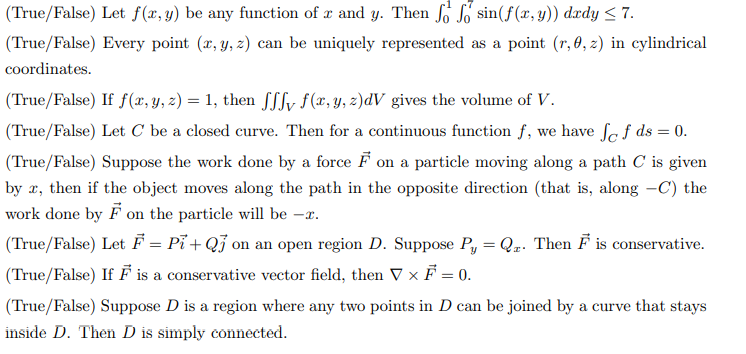
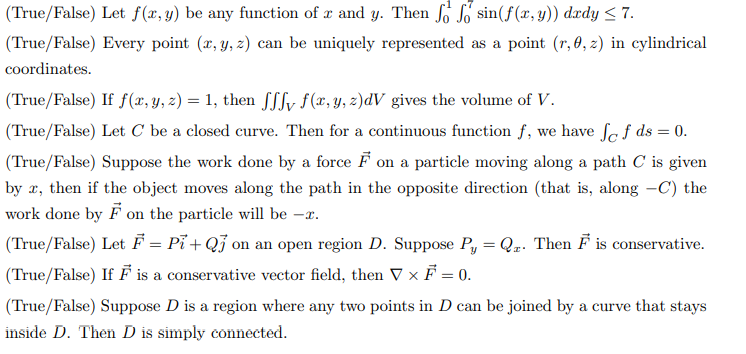
(nefFalse) Let r, y} be any function of e: and 3;. Then I; I; sin( I (1:, 9-)} dsdy E. ?. (nefFalse) Every point [.r,y, s} can he uniquer represented as a point {rufe} in cylindrical coordinates. {TruefFalse} If f{:s,y,e} = 1, then fffv f{:r,y, z}dV gives the volume of V. (nefFalse) Let C be a closed curve. Then for a continuous function f, we have fa f {is = U. {TruefFalse} Suppose the work done by a force F_' on a particle moving along a path C is given by :s, then if the object moves along the path in the opposite direction {that is, along C} the work done by 1:". on the particle will he 1:. {TruefFalse} Let F = P+ Q} on an open region B. Suppose Pr = Qt. Then F" is conservative. {TiroefFalse} If F_' is a conservative vector eld, then 'E X I? = D. {TruefFalse} Suppose D is a region where an}.r two points in D can he joined by a curve that stays inside D. Then L' is simply connected
Step by Step Solution
There are 3 Steps involved in it

Get step-by-step solutions from verified subject matter experts
 Study Help