







Question: No need to answer part C, Part B is a demand with Uniform(500,1500), I am wondering how to do part d and part e (30

No need to answer part C, Part B is a demand with Uniform(500,1500), I am wondering how to do part d and part e
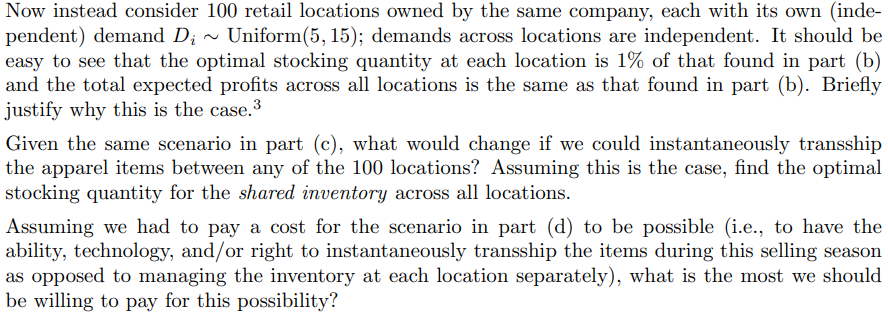
(30 points) Consider a new apparel item which retails for $90, costs $50 to procure, and can be sold at a clearance price of $40 after it is no longer fashionable. Now instead consider 100 retail locations owned by the same company, each with its own (inde- pendent) demand Di~ Uniform(5,15); demands across locations are independent. It should be easy to see that the optimal stocking quantity at each location is 1% of that found in part (b) and the total expected profits across all locations is the same as that found in part (b). Briefly justify why this is the case.3 Given the same scenario in part (c), what would change if we could instantaneously transship the apparel items between any of the 100 locations? Assuming this is the case, find the optimal stocking quantity for the shared inventory across all locations. Assuming we had to pay a cost for the scenario in part (d) to be possible (i.e., to have the ability, technology, and/or right to instantaneously transship the items during this selling season as opposed to managing the inventory at each location separately), what is the most we should be willing to pay for this possibility? (30 points) Consider a new apparel item which retails for $90, costs $50 to procure, and can be sold at a clearance price of $40 after it is no longer fashionable. Now instead consider 100 retail locations owned by the same company, each with its own (inde- pendent) demand Di~ Uniform(5,15); demands across locations are independent. It should be easy to see that the optimal stocking quantity at each location is 1% of that found in part (b) and the total expected profits across all locations is the same as that found in part (b). Briefly justify why this is the case.3 Given the same scenario in part (c), what would change if we could instantaneously transship the apparel items between any of the 100 locations? Assuming this is the case, find the optimal stocking quantity for the shared inventory across all locations. Assuming we had to pay a cost for the scenario in part (d) to be possible (i.e., to have the ability, technology, and/or right to instantaneously transship the items during this selling season as opposed to managing the inventory at each location separately), what is the most we should be willing to pay for this possibilityStep by Step Solution
There are 3 Steps involved in it
1 Expert Approved Answer
Step: 1 Unlock

Question Has Been Solved by an Expert!
Get step-by-step solutions from verified subject matter experts
Step: 2 Unlock
Step: 3 Unlock
 Study Help