



Question: Now there are two bidders 1 and 2. Each bidder i now has a value vi and a budget wi. For each i, vi ?
Now there are two bidders 1 and 2. Each bidder i now has a value vi and a budget wi. For each i, vi ? [0,1], and wi ? [0,1]. Each bidder can bid as much as he wants, but if he wins the object, he cannot pay an amount that is higher than his budget. If he has to pay an amount higher than his budget, he will default, and in that case he has to pay a small fine. Both vi and wi are only known to bidder i only. The auction that we will consider is the second price auction that we discussed in class. Both bidders bid b1 and b2 ? 0. The bidder who bids the higher amount wins the object and has to pay the second highest bid , that is the lower of the two bids. Verify that in this scenario, in the second price auction, it is a dominant strategy for each bidder to bidb?i =min{vi,wi}.
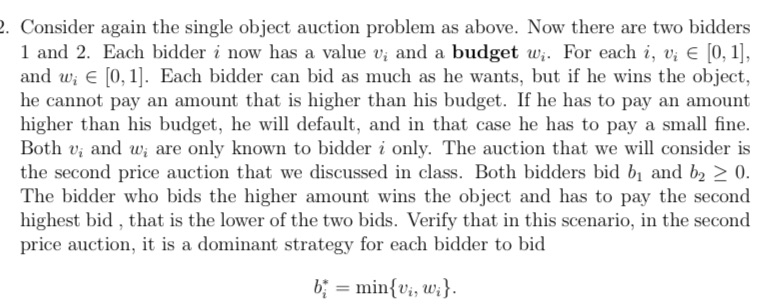
!. Consider again the single object auctiou problem as above. Now there are two bidders 1 and 2. Each bidder i now has a 1value e,- and a budget as. For each i, v, E [I], 1], and to, E [0, 1]. Each bidder can bid as much as he wants, but if he wins the object, he cannot pay an amount that is higher than his budget. If he has to pay an amount higher than his budget, he will default, and in that case he has to pay a small ne. Both a, and w,- are only known to bidder i only. The auction that we will consider is the second price auction that we discussed in class. Both bidders bid E31 and b; 3 0. The bidder who bids the higher amount wins the object and has to pay the second highest bid , that is the lower of the two bids. Verify that in this scenario, in the second price auction, it is a dominant strategy for each bidder to bid b: = min{e,-, 1a,}
Step by Step Solution
There are 3 Steps involved in it

Get step-by-step solutions from verified subject matter experts