



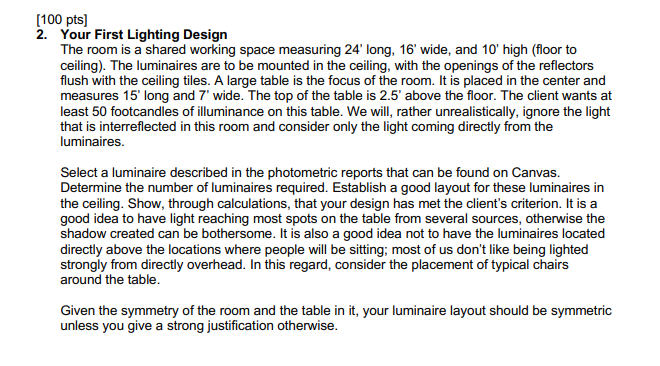
Question: On Excel [100 pts) 2. Your First Lighting Design The room is a shared working space measuring 24' long, 16' wide, and 10' high (floor
On Excel
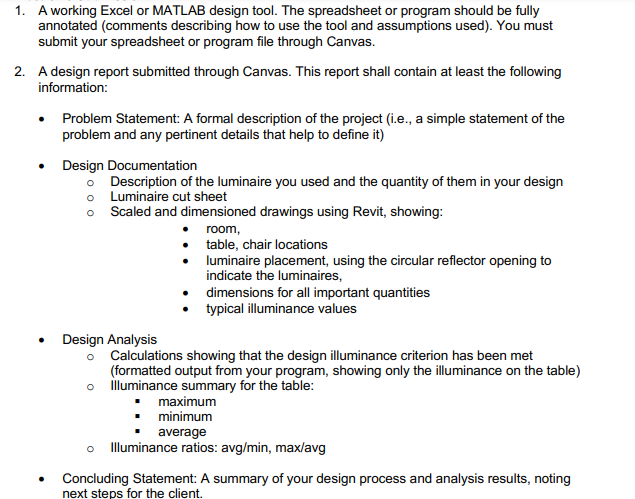
[100 pts) 2. Your First Lighting Design The room is a shared working space measuring 24' long, 16' wide, and 10' high (floor to ceiling). The luminaires are to be mounted in the ceiling, with the openings of the reflectors flush with the ceiling tiles. A large table is the focus of the room. It is placed in the center and measures 15' long and 7' wide. The top of the table is 2.5' above the floor. The client wants at least 50 footcandles of illuminance on this table. We will, rather unrealistically, ignore the light that is interreflected in this room and consider only the light coming directly from the luminaires. Select a luminaire described in the photometric reports that can be found on Canvas. Determine the number of luminaires required. Establish a good layout for these luminaires in the ceiling. Show, through calculations, that your design has met the client's criterion. It is a good idea to have light reaching most spots on the table from several sources, otherwise the shadow created can be bothersome. It is also a good idea not to have the luminaires located directly above the locations where people will be sitting; most of us don't like being lighted strongly from directly overhead. In this regard, consider the placement of typical chairs around the table. Given the symmetry of the room and the table in it, your luminaire layout should be symmetric unless you give a strong justification otherwise. 1. A working Excel or MATLAB design tool. The spreadsheet or program should be fully annotated (comments describing how to use the tool and assumptions used). You must submit your spreadsheet or program file through Canvas. 2. A design report submitted through Canvas. This report shall contain at least the following information: Problem Statement: A formal description of the project (i.e., a simple statement of the problem and any pertinent details that help to define it) Design Documentation o Description of the luminaire you used and the quantity of them in your design o Luminaire cut sheet O Scaled and dimensioned drawings using Revit, showing: room, table, chair locations luminaire placement, using the circular reflector opening to indicate the luminaires, dimensions for all important quantities typical illuminance values Design Analysis o Calculations showing that the design illuminance criterion has been met (formatted output from your program, showing only the illuminance on the table) o illuminance summary for the table: maximum minimum average o Illuminance ratios: avg/min, max/avg Concluding Statement: A summary of your design process and analysis results, noting next steps for the client
Step by Step Solution
There are 3 Steps involved in it

Get step-by-step solutions from verified subject matter experts