Question: ONLY ASWER 5-15 and 5-16... please answer thoroughly and do not copy from google and do not copy from existing answers in chegg CASE INCIDENT
 ONLY ASWER 5-15 and 5-16... please answer thoroughly and do not copy from google and do not copy from existing answers in chegg
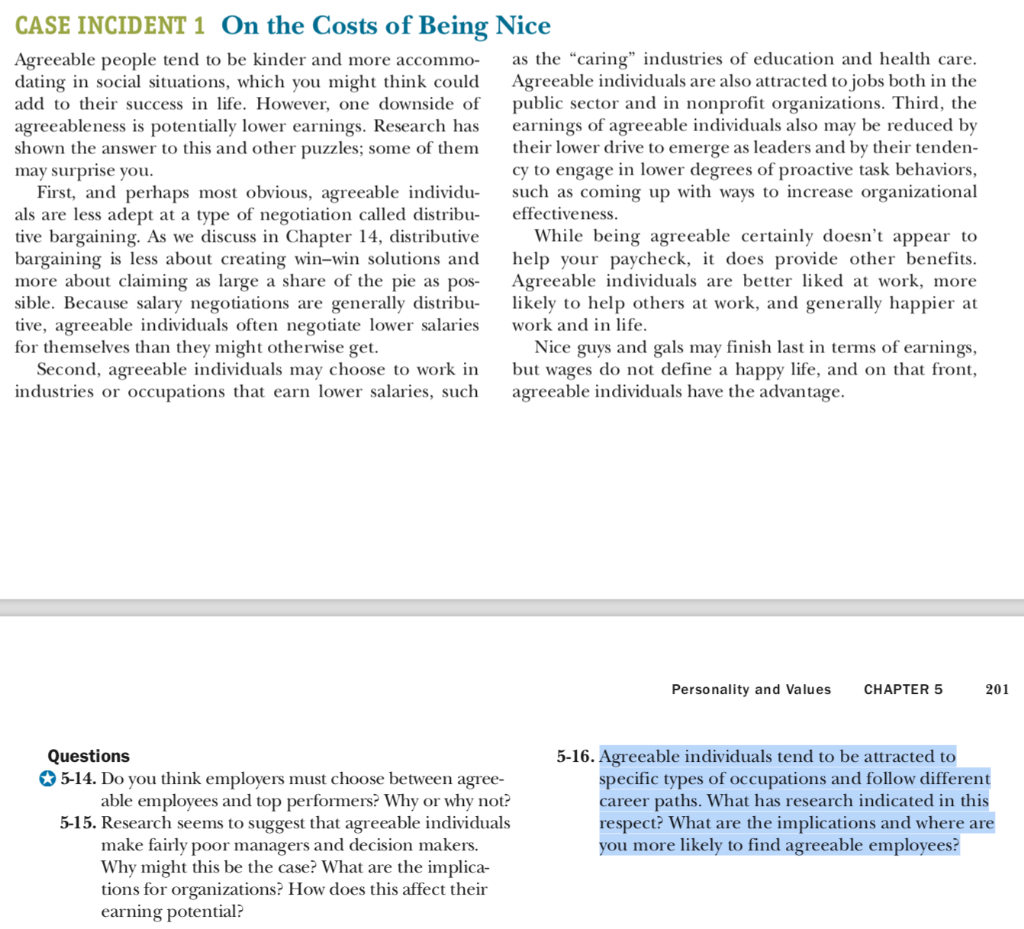
CASE INCIDENT 1 On the Costs of Being Nice Agreeable people tend to be kinder and more accommo as the caring industries of education and health care. dating in social situations, which you might think could Agreeable individuals are also attracted to jobs both in the add to their success in life. However, one downside of public sector and in nonprofit organizations. Third, the agreeableness is potentially lower earnings. Research has earnings of agreeable individuals also may be reduced by shown the answer to this and other puzzles, some of them their lower drive to emerge as leaders and by their tenden- may surprise you. cy to engage in lower degrees of proactive task behaviors, First, and perhaps most obvious, agreeable individu such as coming up with ways to increase organizational als are less adept at a type of negotiation called distribu effectiveness. tive bargaining. As we discuss in Chapter 14, distributive While being agreeable certainly doesn't appear to bargaining is less about creating win-win solutions and help your paycheck, it does provide other benefits. more about claiming as large a share of the pie as pos Agreeable individuals are better liked at work, more sible. Because salary negotiations are generally distribu likely to help others at work, and generally happier at tive, agreeable individuals often negotiate lower salaries work and in life. for themselves than they might otherwise get. Nice guys and gals may finish last in terms of earnings, Second, agreeable individuals may choose to work in but wages do not define a happy life, and on that front, industries or occupations that earn lower salaries, such agreeable individuals have the advantage. Personality and Values CHAPTER 5 201 Questions 5-14. Do you think employers must choose between agree- able employees and top performers? Why or why not? 5-15. Research seems to suggest that agreeable individuals make fairly poor managers and decision makers. Why might this be the case? What are the implica- tions for organizations? How does this affect their earning potential? 5-16. Agreeable individuals tend to be attracted to specific types of occupations and follow different career paths. What has research indicated in this respect? What are the implications and where are you more likely to find agreeable employees









 Study Help