







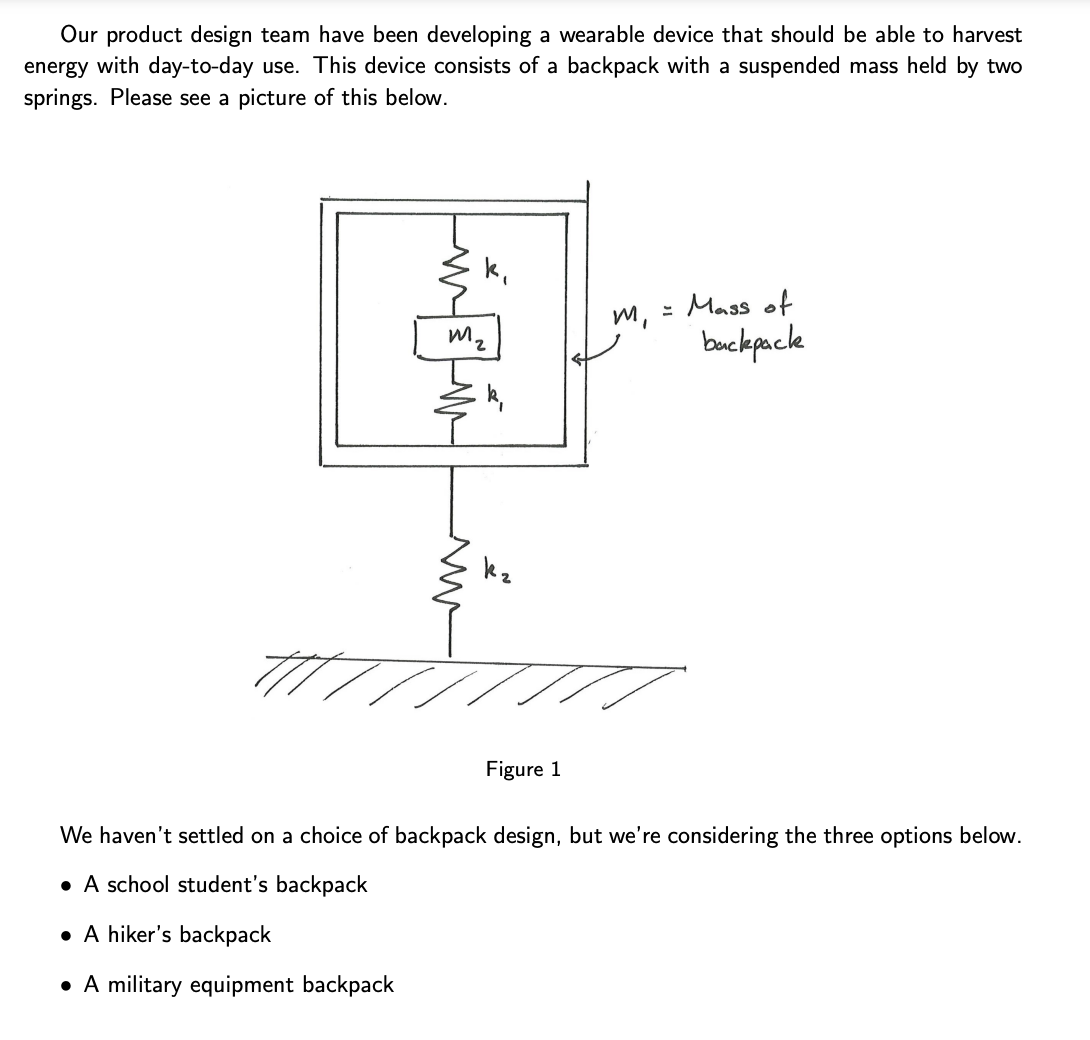
Question: Our product design team have been developing a wearable device that should be able to harvest energy with day - to - day use. This
Our product design team have been developing a wearable device that should be able to harvest
energy with daytoday use. This device consists of a backpack with a suspended mass held by two
springs. Please see a picture of this below.
Figure
We haven't settled on a choice of backpack design, but we're considering the three options below.
A school student's backpack
A hiker's backpack
A military equipment backpack
The team have some leftover components from a previous project, so they intend to use two springs with a stiffness of k Nm to suspend the mass internally. On the diagram shown, the bottom spring is used to show the stiffness informing the backpacks position relative to the ground taking into account the straps and physicality of the wearer etc. The mass of the suspended mass is yet to be decided, so feel free to make a reasonable assumption for what this should be and we can circle back to it at a later date.
It would be useful to know how the mass values and spring stiffness values impact the frequencies of the system.
Model the DOF system described and determine its natural frequencies.
Considering the resulting motion of the backpack, how much of the vibration is transmitted to the wearer?
Solve the system of ODEs and determine the displacement of the backpack. Using this response, determine the magnitude of the force transmitted to the wearer. Hint: the backpack is an oscillating mass and the wearer is a fixed base. Assume that the bag straps remain taut and estimate an appropriate value for the stiffnessdamping this contributes to the system.
Finally, before this design goes any further, it would be useful to understand how much energy this system can harvest. While we dont have a precise means of harvesting this energy yet, lets start by understanding how much energy it can store.
Determine the maximum amount of energy that can be stored in the system depicted The team have some leftover components from a previous project, so they intend to use two springs with a stiffness of k mathrm~Nmathrmm to suspend the mass internally. On the diagram shown, the bottom spring is used to show the stiffness informing the backpack's position relative to the ground taking into account the straps and physicality of the wearer etc. The mass of the suspended mass is yet to be decided, so feel free to make a reasonable assumption for what this should be and we can circle back to it at a later date.
It would be useful to know how the mass values and spring stiffness values impact the frequencies of the system.
Model the DOF system described and determine its natural frequencies.
Considering the resulting motion of the backpack, how much of the vibration is transmitted to the wearer?
Solve the system of ODEs and determine the displacement of the backpack. Using this response, determine the magnitude of the force transmitted to the wearer. Hint: the backpack is an oscillating mass and the wearer is a fixed base. Assume that the bag straps remain taut and estimate an appropriate value for the stiffnessdamping this contributes to the system.
Finally, before this design goes any further, it would be useful to understand how much energy this system can harvest. While we don't have a precise means of harvesting this energy yet, let's start by understanding how much energy it can store.
Determine the maximum amount of energy that can be stored in the system depicted.
Step by Step Solution
There are 3 Steps involved in it
1 Expert Approved Answer
Step: 1 Unlock

Question Has Been Solved by an Expert!
Get step-by-step solutions from verified subject matter experts
Step: 2 Unlock
Step: 3 Unlock
 Study Help