







Question: oWhat is the main poi nt(s) of the article? oWh y is the main point(s) made by the article important to understanding sales force management?
oWhat is the main poi nt(s) of the article?
oWh y is the main point(s) made by the article important to understanding sales force management?
oAp ply concepts discussed in the article to assi st in answering the above ques tion. Being spe cific, gi ve exam ples.
oIf yo u were in a sales role, how would yo u incorporate this information to perform yo ur job more effectively?
oShould be wri tt en from a 1stperson perspective. Imagine yo u are in a sales role. How would yo u incorporate this information into yo ur work?B e specific and gi ve direct exam ples of what actions yo u would take and wh y.
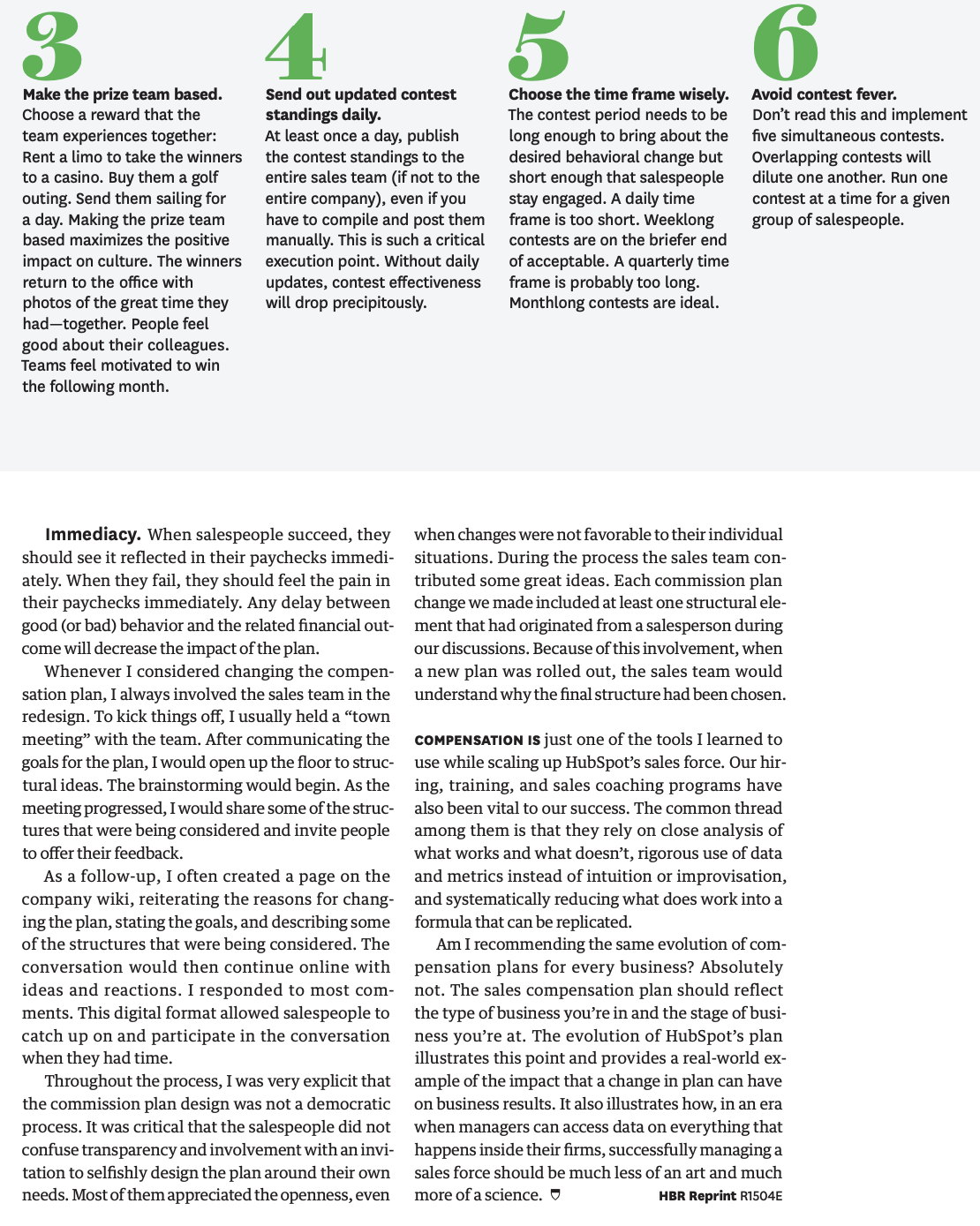
Mark Roberge is the chief revenue officer of HubSpot, a Boston-based inbound marketing firm. This article is adapted from his book, The Sales Acceleration Formula (2015), with permission of its publisher, Wiley. I WAS THE fourth employee hired at HubSpot. I'd met the two cofounders when we were all pur- suing graduate degrees at MIT's Sloan School of Management. They're smart guys with a big mission: to help companies transform their mar- keting by using online content to draw potential customers to their websites-a practice known as "inbound" marketing. My job was to build the sales team. An engineer by training, I'd never worked in sales-I'd begun my career writing code. But my background proved to be more of an advantage than I'd expected. It led me to challenge many conventional notions of sales man- agement, using the metrics-driven, process-oriented lens through which I'd been trained to see the world. For instance, instead of hiring by instinct, I meticu lously tracked data on sales, identified predictors of success, and looked for people whose traits and skills closely resembled those of our top sellers. Instead of training new recruits by having them tag along on a successful salesperson's calls, I created a regimented training program that gave them firsthand experi- ence with our technology and then taught them to systematically work leads. That approach worked well: Within seven years of its founding, HubSpot crossed the $100 million run-rate revenue mark and had acquired more than 10,000 customers in over 60 countries. In the fall of 2014 our company went public in an offering worth $125 million.When I look back on the various strategies I used to grow our sales force from zero to several hundred people, I realize that one of the biggest lessons I've learned involves the power of a compensation plan to motivate salespeople not only to sell more but to act in ways that support a start-up's evolving business model and overall strategy. Whether you're a CEO or a VP of sales, the sales compensation plan is probably the most powerful tool you have. Most of the critical strategic shifts that HubSpot made as a business were executed through changes to the sales compensation plan. In this ar- ticle [will look at how we did this and at the general principles you should keep in mind when designing your own rm's plan. The ideal plan is tailored to the company's stage of growth. Knowing what You Need and When Business leaders often ask, \"What's the best sales compensation structure to use?\" It's a complicated question. The ideal plan is contextualtailored to both the type of business and the stage of growth the company is in. Start-ups typically go through three key stages: customer acquisition, customer reten- tion and success, and sustainable growth. In the rst seven years at HubSpot, we used three different sales compensation plans, each of which was appropriate for the stage our business was in at the time. rst compensation plan was oriented toward \"hunting\" new customers. When we put it in place, we had 100 customers and an annual run rate of barely $300,000. Like most start-ups at this stage of development, we needed to acquire customers quickly so that we could see how valuable our of- fering actually was to them. We'd been pretty good at gathering feedback from potential customers as we'd developed our productwhich is true of most new venturesbut the real test would be asking customers for money. The rst plan paid salespeople a base salary and $2 up front for every $1 of monthly recurring revenue 1 The customer acquisition plan. HubSpot's they brought in. To protect the company if custom- ers defected, we implemented a four-month claw- back on commissions. This meant that if a customer jumped ship within the rst four months, HubSpot took the entire commission back (deducting it from the salesperson's earned commissions the next month). Once a customer had stayed on the platform for four months, the salesperson could keep the en- tire commission even if the customer later canceled. This plan was simple, clean, and hunting oriented. It worked well to accelerate the pace of new customer acquisition. In under six months our base shot up to 1,000 customers, and our revenue hit $3 million. With plenty of customers on board, we could now analyze how well the company was pro- gressing toward \"productlmarket frt\"ithe point at which product features and pricing are aligned with the market's preferences. The biggest sign that the fit wasn't perfect was a clear problem with customer retention. Among our early customers, the level of chum was unsustainable. This was not surprising. It's rare that a start-up nds a fit on its rst attempt with customers. That's why a fast feedback cycle, proper diagnosis of the issues, and quick, disci- plined iteration are necessary during this stage. At this point in a start-up's evolution, it's key to gure out who your best customers are and what steps will make them successful. Looking for answers, we studied the data. At the time, each new customer was being assigned a postsale consultant, who would set our service up and train the customer's staff in how to use it. Our first theory was that some of the postsale consul- tants were doing a better job than others. Ifwe could identify which consultants were most successJl, we could dig into their processes, understand what they were doing differently, and introduce the best prac- tices across the team. However, when we examined customer chum by postsale consultant, the levels were similar across the team. That particular theory didn't check out. Next we analyzed customer churn rates by sales- person. Eureka! Here was our answer. Across the or- ganization, there was a more than 10-fold difference between the lowest and highest churn rates among salespeople. We did not have a customer onboard- ing problem. We had a sales problem. Our customer retention was predicated on the types of customers 2 The customer success and retention plan. THE CHALLENGE A start-up often changes direction as it grows. As the strategy shifts, it's critical that the employees who bring in the revenuethe sales force understand and behave in ways that support the new strategy. The sales compensation system can help ventures achieve that alignment. THE PRESCRIPTION acquisition early on, sustainable growth. Revise the incentive system to focus salespeople on new goals at each growth phase. The start-up HubSpot did this; it implemented a plan that encouraged rapid customer THE RESULT Changes to the sales compensation plan helped HubSpot quickly grow its business to $100 million in annual revenue and acquire more than 10,000 customers but in 60 countries. switched to a second plan to promote customer retention and then to a third geared for the salespeople chose to target and the expectations they set with each new ac count. I immediately shared the analysis with the sales team, revealing each salesperson's churn rate and how it compared with the team average. I educated the team on the importance of retention, both to our business and to our customers. I said that [would be adjusting the sales compensation plan, in order to align customer retention performance with com- mission checks. Sure enough, the next quarter I followed through on my promise. I stack-ranked the sales team from the person with the best retention rate right down to the person with the worst rate. Then I segmented the team into quartiles. The top-performing quartile would earn .154 per $1 of monthly recurring revenue from then on. \"Congratulations,\" I said to this group. \"I'm doubling your commission payments. Why? Because you bring in the best customers. Keep it up.\" I moved on to the next quartile. \"Good work,\" I said. \"You now eam $3 per $1 of monthly recurring revenue a 50% increase above your previous rate.\" \"For the folks in the third quartile, there is no change. You will be paid the same rate of $2 per $1 of monthly recurring revenue.\" I concluded with the most diicult message. \"For the fourth and worst-performing quartile, your eanr- ings are cut to $1 per $1 of monthly recurring revenue. Why? Your customers are not succeeding. 0n aver- age, they're unprotable for our company. More im- portant, you are wasting our customers' money by not setting proper expectations about how to suc- ceed with our service. We have initiated training on better customer expectation setting. We need you to take that training seriously. We are here to help you through this skill developmen The combination of a different set of incentives and better training worked: Within six months, customer churn had dropped by 70%. Once again, a sales compensation plan had driven the results of the business. part to plan two, HubSpot had quickly closed in on productz'market t. Unre alistic expectations set by sales were now almost never among the rea- sons customers gave for quitting our service. Churn in general was far lower, and the reasons for cancella- tions were not alarming. It was time for our start-up to focus on achieving faster, protable growthin other words, scaling up the business. To do that, we had to align the sales compensation accordingly. To ensure healthy growth, I needed to incorpo- rate what we had already learned on our journey. I certainly wanted a strong incentive forthe sales team to acquire new customers at a rapid clip. However, I needed to keep the team aligned with maximiz- ing customer retention, since that would obviously offset acquisition costs and increase protability. One important insight we'd had earlier was that it was important for the customer to be committed to adopting inbound marketing. Though it can trans- form the way an organization gets its mess age to cus- tomers, inbound marketing is not a turnkey solution. It takes work. Customers must understand that to succeed. We had already worked to get salespeople to set realistic expectations, but we now had to nd a way to focus them on clients who would make a real investment (of time, energy, and money) in learning to use HubSpot's service. How could I align the sales team with this goal in a clear and measurable way.' The answer was advance-payment terms for new customers. When we looked at the data, we realized that our customers who paid month-to-month were less committed to the overall HubSpot service and were far more likely to defect. Those that prepaid 31he sustainable growth plan. Thanks in Boosting Performance with Sales Contests Contests are almost as effective as compensation plans when it comes to motivating the sales team. Contests bring a fun, dynamic aspect to a sometimes mundane daily routine. They can be designed to promote desired behaviors and, unlike commission plans, can be temporary. They can even be used to build team culture. For these reasons, I ran a sales contest at HubSpot almost every month, especially in the early years of team development. Here are my six best practices for sales contest design: Align the contest with a Make the contest team based. short-term behavioral change. This approach has a remarkable For example, fearing a summer slump, you may want to boost activity in June. This increase would be difcult to pull off through the commission plan, but holding an activity-based contest for one month would do the trick. effect on team culture, espe- cially early on. For the rst three years at HubSpot, every contest I ran was a team contest. I'd often see high-performing sales- people help out teammates who were [aging and the low performers would start working late to avoid letting their teams down. When I nally ran a con- test based on individual perfor- mance, I heard accusations of cheating and saw backstabbing annually were more committed to the service and ultimately were more successful. (of course, ad- vance payments also had a positive impact on HubSpot's cash flowanother factor that becomes important for a start-up as it reaches scale.) As a result, our third plan was designed as fol- lows: (1) Salespeople would earn $2 per $1 of monthly recurring revenue. (2) The commission would be paid out as follows: 50% on the customer's rst month's payment, 25% on the sixth month's payment, and 25% on the 12th month's payment. So if a customer signed up paying month-to- month, the salesperson would wait a full year to earn the last quarter of the commission for that cus- tomer. However, if the customer paid a ll] year's subscription in advancea factor that was com- pletely under the control of the salespersonthe entire commission would be earned immediately. Before this plan was put in place, the average prepayment comminnent was 2.5 months. After the plan was rolled out, that average jumped to seven months. Customer churn was checked; in fact, reten- tion improved. The new customers were protable to HubSpot. Salespeople felt in control of their destiny. Mission accomplished. Before You change the Comp Plan... Hub Spot is still a young and growing company, and we may have to adjust the sales compensation formula again as the business evolves. Drawing behavior for the rst time. We immediately returned to team contests. on what we've learned during our rst eight years, my team has developed a few questions that we ask about any potential change: Is it simple? Is it aligned? And is it immediate? Let me elaborate. Sim plicity. Salespeople should not need a spreadsheet to calculate their earnings. If too many variables are included, they may become con- fused about which behaviors will lead to the larg- est commission check. They might throw the plan aside and just go sell the way they know best. The opportunity to drive the desired behavior through the compensation plan is lost. Keep the plan simple. It should be extraordinarily clear which outcomes you are rewarding. Alignment. Look ahead to the next year and ask yourself, \"What is the most important goal the company needs to achieve? Customer count? Protability? Customer success? Market share? New product distribution? New market penetration?\" Once you've identied that goal, ask yourself, \"How can the sales compensation plan be aligned with this objective?\" Don't underestimate the power of the compensation plan. You can tweak sales train- ing, redesign marketing materials, attend customer conferencesyou name it. Regardless of those ef- forts, if the majority of your company's revenue is generated by salespeople, properly aligning their compensation plan will have greater impact than anything else will. Make the prize team based. Choose a reward that the team experiences together: Rent a limo to take the winners to a casino. Buy them a golf outing. Send them sailing for a day. Making the prize team based maximizes the positive impact on culture. The winners return to the office with photos of the great time they send out updated content standings daily. At least once a day, publish the contest standings to the entire sales team (if not to the entire company), even if you have to compile and post them manually. This is such a critical execution point. Without daily updates, contest effectiveness will drop precipitously. Choose the time frame wisely. The contest period needs to be long enough to bring about the desired behavioral change but short enough that salespeople stay engaged. A daily time frame is too short. Weeklong contests are on the briefer end of acceptable. A quarterly time frame is probably too long. Monthlong contests are ideal. Avoid contest fever. Don't read this and implement ve simultaneous contests. Overlapping contests will dilute one another. Run one contest at a time for a given group of salespeople. hadtogether. People feel good about their colleagues. Teams feel motivated to win the following month. Immediacy. When salespeople succeed, they should see it reected in their paychecks immedi- ately. When they fail, they should feel the pain in their paychecks immediately. Any delay between good (or bad) behavior and the related nancial out- come will decrease the impact of the plan. Whenever I considered chang'ng the compen- sation plan, I always involved the sales team in the redesign. To kick things off, I usually held a \"town meeting\" with the team. After communicating the goals for the plan, Iwould open up the oor to struc- tural ideas. The brainstorming would begin. As the meeting progressed, Iwould share some of the struc- tures that were being considered and invite people to offer their feedback. As a follow-up, I often created a page on the company wiki, reiterating the reasons for chang- ing the plan, stating the goals, and describing some of the structures that were being considered. The conversation would then continue online with ideas and reactions. I responded to most com- ments. This digtal format allowed salespeople to catch up on and participate in the conversation when they had time. Throughout the process, Iwas very explicit that the commission plan design was not a democratic process. It was critical that the salespeople did not confuse transparency and involvement with an invi- tation to selfishly design the plan around their own needs. Most of them appreciated the openness, even when changes were not favorable to their individual situations. During the process the sales team con- tributed some great ideas. Each commission plan change we made included at least one structural ele- ment that had originated from a salesperson during our discussions. Because of this involvement, when a new plan was rolled out, the sales team would understand why the final structure had been chosen. COMPENSATION Is just one of the tools I learned to use while scaling up HubSpot's sales force. Our hir- ing, training, and sales coaching programs have also been vital to our success. The common thread among them is that they rely on close analysis of what works and what doesn't, rigorous use of data and metrics instead of intuition or improvisation, and systematically reducing what does work into a formula that can be replicated. Am I recommending the same evolution of com- pensation plans for every business? Absolutely not. The sales compensation plan should reect the type of business you're in and the stage of busi- ness you're at. The evolution of HubSpot's plan illustrates this point and provides a real-world ex- ample of the impact that a change in plan can have on business results. It also illustrates how, in an era when managers can access data on everything that happens inside their rms, successfully managing a sales force should be much less of an art and much more of a science. 0 Hall Reprint msme
Step by Step Solution
There are 3 Steps involved in it

Get step-by-step solutions from verified subject matter experts
 Study Help