







Question: P CO2 PN2 Consider an Idealized case for the removal of CO2 from dry Flue gas. The feed rate of the Flue gas is 100
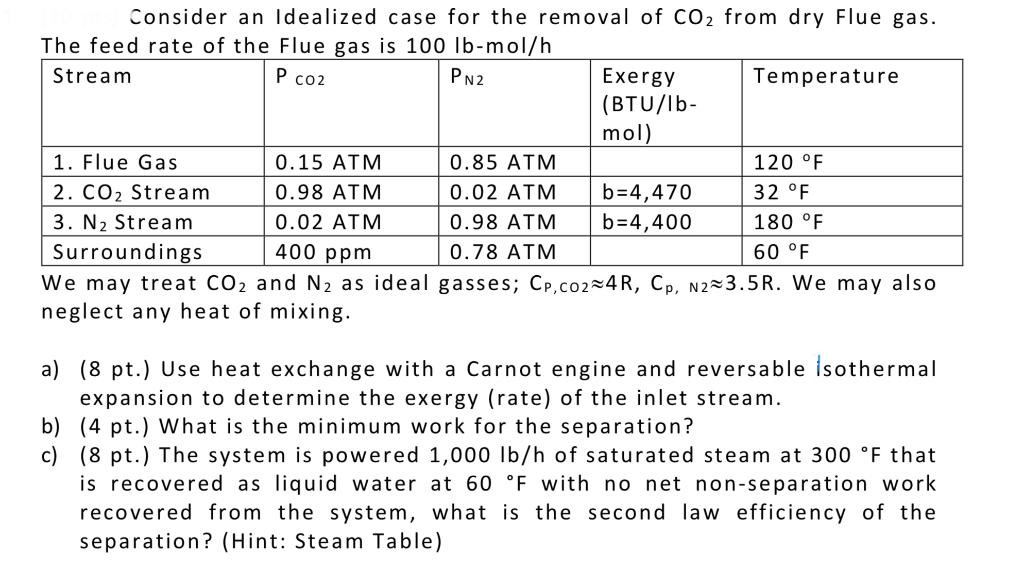
P CO2 PN2 Consider an Idealized case for the removal of CO2 from dry Flue gas. The feed rate of the Flue gas is 100 lb-mol/h Stream Exergy Temperature (BTU/lb- mol) 1. Flue Gas 0.15 ATM 0.85 ATM 120 F 2. CO2 Stream 0.98 ATM 0.02 ATM b=4,470 32 F 3. N2 Stream 0.02 ATM 0.98 ATM b=4,400 180 F Surroundings 0.78 ATM 60 F We may treat CO2 and N2 as ideal gasses; Cp,co224R, Cp, N23.5R. We may also neglect any heat of mixing. 400 ppm a) (8 pt.) Use heat exchange with a Carnot engine and reversable isothermal expansion to determine the exergy (rate) of the inlet stream. b) (4 pt.) What is the minimum work for the separation? c) (8 pt.) The system is powered 1,000 lb/h of saturated steam at 300 F that is recovered as liquid water at 60 F with no net non-separation work recovered from the system, what is the second law efficiency of the separation? (Hint: Steam Table) P CO2 PN2 Consider an Idealized case for the removal of CO2 from dry Flue gas. The feed rate of the Flue gas is 100 lb-mol/h Stream Exergy Temperature (BTU/lb- mol) 1. Flue Gas 0.15 ATM 0.85 ATM 120 F 2. CO2 Stream 0.98 ATM 0.02 ATM b=4,470 32 F 3. N2 Stream 0.02 ATM 0.98 ATM b=4,400 180 F Surroundings 0.78 ATM 60 F We may treat CO2 and N2 as ideal gasses; Cp,co224R, Cp, N23.5R. We may also neglect any heat of mixing. 400 ppm a) (8 pt.) Use heat exchange with a Carnot engine and reversable isothermal expansion to determine the exergy (rate) of the inlet stream. b) (4 pt.) What is the minimum work for the separation? c) (8 pt.) The system is powered 1,000 lb/h of saturated steam at 300 F that is recovered as liquid water at 60 F with no net non-separation work recovered from the system, what is the second law efficiency of the separation? (Hint: Steam Table)
Step by Step Solution
There are 3 Steps involved in it

Get step-by-step solutions from verified subject matter experts
 Study Help