







Question: Parallel Plate Capacitor Design and Dielectric Properties Analysis A parallel plate capacitor is designed with a dielectric material of relative permittivity ( r ) equal
Parallel Plate Capacitor Design and Dielectric Properties Analysis
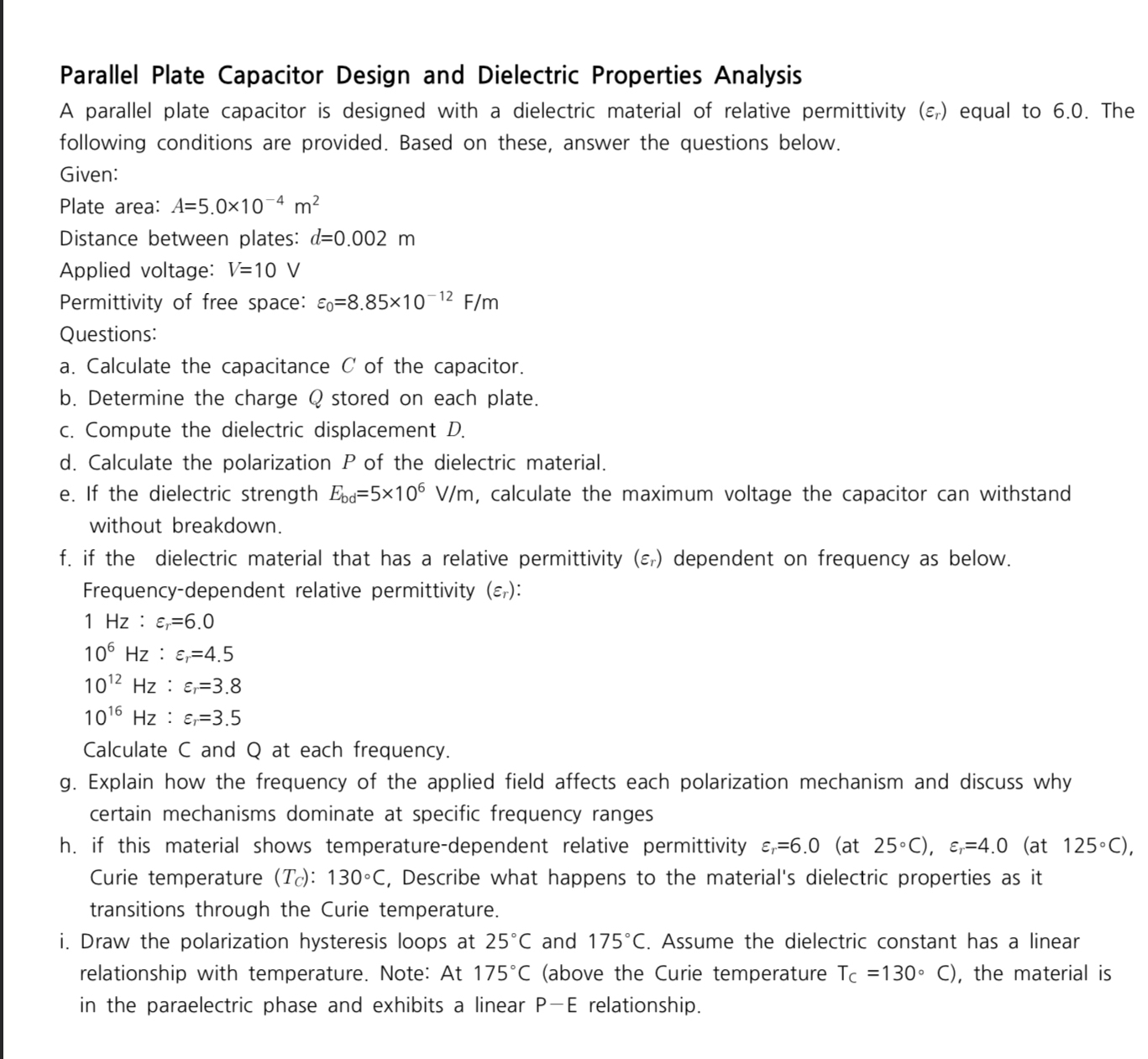
A parallel plate capacitor is designed with a dielectric material of relative permittivity equal to The following conditions are provided. Based on these, answer the questions below.
Given:
Plate area:
Distance between plates:
Applied voltage: V V
Permittivity of free space:
Questions:
a Calculate the capacitance of the capacitor.
b Determine the charge stored on each plate.
c Compute the dielectric displacement
d Calculate the polarization of the dielectric material.
e If the dielectric strength calculate the maximum voltage the capacitor can withstand without breakdown.
f if the dielectric material that has a relative permittivity dependent on frequency as below.
Frequencydependent relative permittivity :
:
:
:
:
Calculate C and Q at each frequency.
g Explain how the frequency of the applied field affects each polarization mechanism and discuss why certain mechanisms dominate at specific frequency ranges
h if this material shows temperaturedependent relative permittivity at at Curie temperature : Describe what happens to the material's dielectric properties as it transitions through the Curie temperature.
i Draw the polarization hysteresis loops at and Assume the dielectric constant has a linear relationship with temperature. Note: At above the Curie temperature the material is in the paraelectric phase and exhibits a linear relationship.
Step by Step Solution
There are 3 Steps involved in it
1 Expert Approved Answer
Step: 1 Unlock

Question Has Been Solved by an Expert!
Get step-by-step solutions from verified subject matter experts
Step: 2 Unlock
Step: 3 Unlock
 Study Help