





Question: Part A: Use Case Diagram In the object-oriented approach, analysts use a collection of models based on use cases to capture system requirementsan approach referred
Part A: Use Case Diagram In the object-oriented

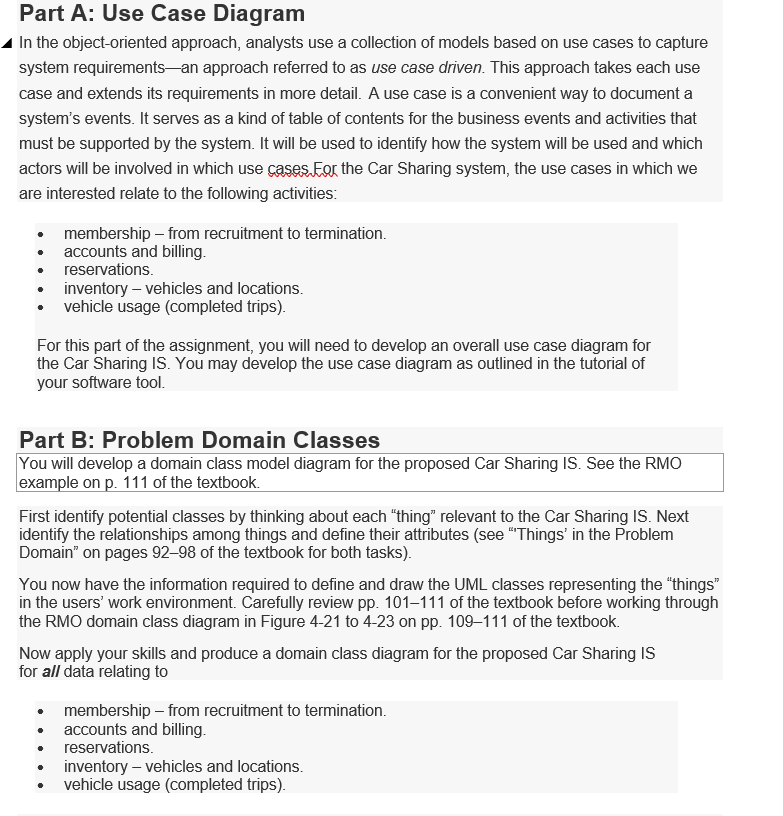
Part A: Use Case Diagram In the object-oriented approach, analysts use a collection of models based on use cases to capture system requirementsan approach referred to as use case driven. This approach takes each use case and extends its requirements in more detail. A use case is a convenient way to document a system's events. It serves as a kind of table of contents for the business events and activities that must be supported by the system. It will be used to identify how the system will be used and which actors will be involved in which use cases. For the Car Sharing system, the use cases in which we are interested relate to the following activities: membership from recruitment to termination. accounts and billing. reservations. inventory - vehicles and locations. vehicle usage (completed trips). For this part of the assignment, you will need to develop an overall use case diagram for the Car Sharing IS. You may develop the use case diagram as outlined in the tutorial of your software tool. Part B: Problem Domain Classes You will develop a domain class model diagram for the proposed Car Sharing IS. See the RMO example on p. 111 of the textbook. First identify potential classes by thinking about each "thing" relevant to the Car Sharing IS. Next identify the relationships among things and define their attributes (see "Things' in the Problem Domain" on pages 92-98 of the textbook for both tasks). You now have the information required to define and draw the UML classes representing the "things" in the users' work environment. Carefully review pp. 101111 of the textbook before working through the RMO domain class diagram in Figure 4-21 to 4-23 on pp. 109111 of the textbook. Now apply your skills and produce a domain class diagram for the proposed Car Sharing IS for all data relating to membership from recruitment to termination. accounts and billing. reservations inventory - vehicles and locations. vehicle usage (completed trips). Part A: Use Case Diagram In the object-oriented approach, analysts use a collection of models based on use cases to capture system requirementsan approach referred to as use case driven. This approach takes each use case and extends its requirements in more detail. A use case is a convenient way to document a system's events. It serves as a kind of table of contents for the business events and activities that must be supported by the system. It will be used to identify how the system will be used and which actors will be involved in which use cases. For the Car Sharing system, the use cases in which we are interested relate to the following activities: membership from recruitment to termination. accounts and billing. reservations. inventory - vehicles and locations. vehicle usage (completed trips). For this part of the assignment, you will need to develop an overall use case diagram for the Car Sharing IS. You may develop the use case diagram as outlined in the tutorial of your software tool. Part B: Problem Domain Classes You will develop a domain class model diagram for the proposed Car Sharing IS. See the RMO example on p. 111 of the textbook. First identify potential classes by thinking about each "thing" relevant to the Car Sharing IS. Next identify the relationships among things and define their attributes (see "Things' in the Problem Domain" on pages 92-98 of the textbook for both tasks). You now have the information required to define and draw the UML classes representing the "things" in the users' work environment. Carefully review pp. 101111 of the textbook before working through the RMO domain class diagram in Figure 4-21 to 4-23 on pp. 109111 of the textbook. Now apply your skills and produce a domain class diagram for the proposed Car Sharing IS for all data relating to membership from recruitment to termination. accounts and billing. reservations inventory - vehicles and locations. vehicle usage (completed trips)

Step by Step Solution

There are 3 Steps involved in it

1 Expert Approved Answer
Step: 1 Unlock blur-text-image

Question Has Been Solved by an Expert!

Get step-by-step solutions from verified subject matter experts

Step: 2 Unlock
Step: 3 Unlock

Students Have Also Explored These Related General Management Questions!