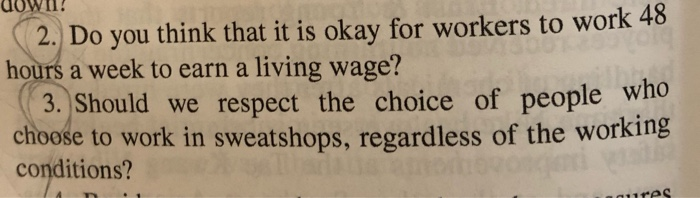
Question: please answer 3 and 4 thoroughly. The article is attached below. 2. Do you think that it is okay for workers to work 48 hours
please answer 3 and 4 thoroughly. The article is attached below.
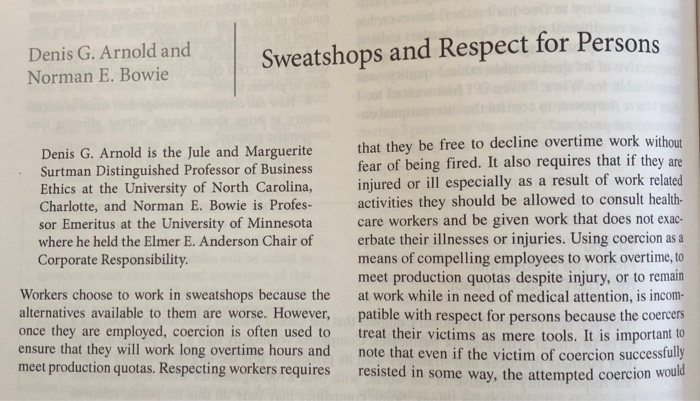
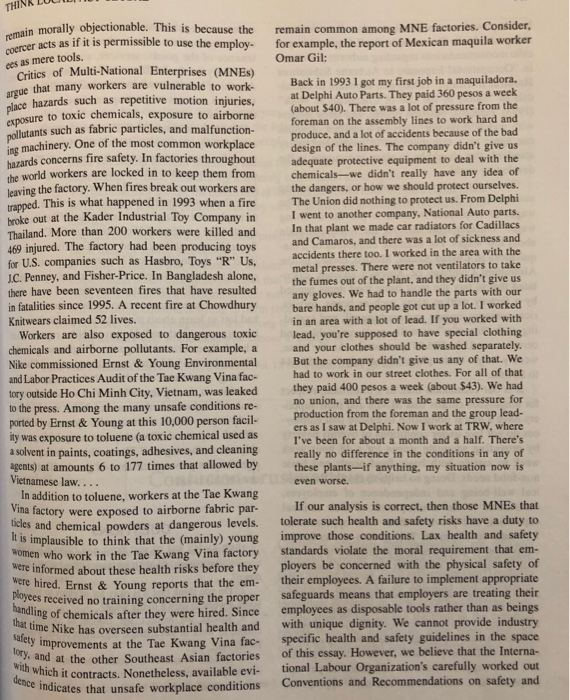
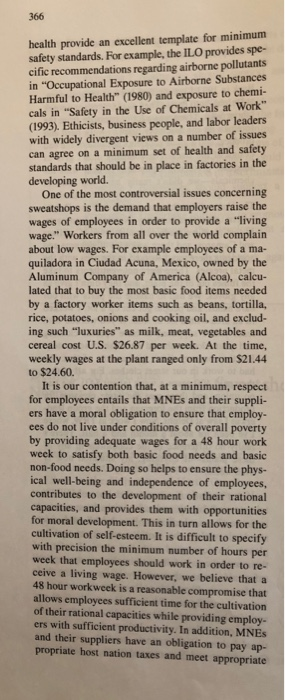
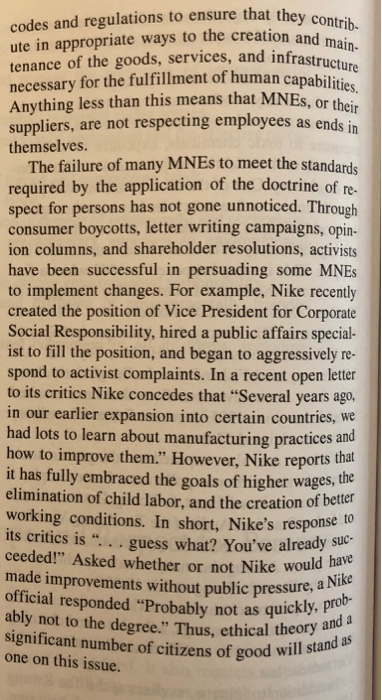
2. Do you think that it is okay for workers to work 48 hours a week to earn a living wage? 3. Should we respect the choice of choose to work in sweatshops, regardless of the working conditions? people who aures Denis G. Arnold and Norman E. Bowie Sweatshops and Respect for Persons Denis G. Arnold is the Jule and Marguerite Surtman Distinguished Professor of Business Ethics at the University of North Carolina, Charlotte, and Norman E. Bowie is Profes- sor Emeritus at the University of Minnesota where he held the Elmer E. Anderson Chair of Corporate Responsibility. that they be free to decline overtime work without fear of being fired. It also requires that if they are injured or ill especially as a result of work related activities they should be allowed to consult health- care workers and be given work that does not exac- erbate their illnesses or injuries. Using coercion as a means of compelling employees to work overtime, to meet production quotas despite injury, or to remain at work while in need of medical attention, is incom- patible with respect for persons because the coercers treat their victims as mere tools. It is important to note that even if the victim of coercion successfully resisted in some way, the attempted coercion would Workers choose to work in sweatshops because the alternatives available to them are worse. However, once they are employed, coercion is often used to ensure that they will work long overtime hours and meet production quotas. Respecting workers requires dence indicates that unsafe workplace conditions THIN ees as mere tools. argue that many workers are vulnerable to work- place hazards such as repetitive motion injuries, exposure to toxic chemicals, exposure to airborne pollutants such as fabric particles, and malfunction- handling of chemicals after they were hired. Since that time Nike has overseen substantial health and Safety improvements at the Tae Kwang Vina fac- lory, and at the other Southeast Asian factories with which it contracts. Nonetheless, available evi- remain morally objectionable. This is because the coercer acts as if it is permissible to use the employ- Critics of Multi-National Enterprises (MNE) ing machinery. One of the most common workplace hazards concerns fire safety. In factories throughout the world workers are locked in to keep them from leaving the factory. When fires break out workers are trapped. This is what happened in 1993 when a fire broke out at the Kader Industrial Toy Company in Thailand. More than 200 workers were killed and 469 injured. The factory had been producing toys for U.S. companies such as Hasbro, Toys"R" Us, J.C. Penney, and Fisher-Price. In Bangladesh alone, there have been seventeen fires that have resulted in fatalities since 1995. A recent fire at Chowdhury Knitwears claimed 52 lives. Workers are also exposed to dangerous toxic chemicals and airborne pollutants. For example, a Nike commissioned Ernst & Young Environmental and Labor Practices Audit of the Tae Kwang Vina fac- tory outside Ho Chi Minh City, Vietnam, was leaked to the press. Among the many unsafe conditions re- ported by Ernst & Young at this 10,000 person facil- ity was exposure to toluene (a toxic chemical used as a solvent in paints, coatings, adhesives, and cleaning agents) at amounts 6 to 177 times that allowed by Vietnamese law.... In addition to toluene, workers at the Tae Kwang Vina factory were exposed to airborne fabric par- ticles and chemical powders at dangerous levels. It is implausible to think that the (mainly) young women who work in the Tae Kwang Vina factory were informed about these health risks before they were hired. Ernst & Young reports that the em- ployees received no training concerning the proper remain common among MNE factories. Consider, for example, the report of Mexican maquila worker Omar Gil: Back in 1993 I got my first job in a maquiladora, at Delphi Auto Parts. They paid 360 pesos a week (about $40). There was a lot of pressure from the foreman on the assembly lines to work hard and produce, and a lot of accidents because of the bad design of the lines. The company didn't give us adequate protective equipment to deal with the chemicals-we didn't really have any idea of the dangers, or how we should protect ourselves. The Union did nothing to protect us. From Delphi I went to another company, National Auto parts. In that plant we made car radiators for Cadillacs and Camaros, and there was a lot of sickness and accidents there too. I worked in the area with the metal presses. There were not ventilators to take the fumes out of the plant, and they didn't give us any gloves. We had to handle the parts with our bare hands, and people got cut up a lot. I worked in an area with a lot of lead. If you worked with lead, you're supposed to have special clothing and your clothes should be washed separately. But the company didn't give us any of that. We had to work in our street clothes. For all of that they paid 400 pesos a week (about $43). We had no union, and there was the same pressure for production from the foreman and the group lead- ers as I saw at Delphi. Now I work at TRW, where I've been for about a month and a half. There's really no difference in the conditions in any of these plants-if anything. my situation now is even worse. If our analysis is correct, then those MNEs that tolerate such health and safety risks have a duty to improve those conditions. Lax health and safety standards violate the moral requirement that em- ployers be concerned with the physical safety of their employees. A failure to implement appropriate safeguards means that employers are treating their employees as disposable tools rather than as beings with unique dignity. We cannot provide industry specific health and safety guidelines in the space of this essay. However, we believe that the Interna- tional Labour Organization's carefully worked out Conventions and Recommendations on safety and 366 health provide an excellent template for minimum safety standards. For example, the ILO provides spe- cific recommendations regarding airborne pollutants in "Occupational Exposure to Airborne Substances Harmful to Health" (1980) and exposure to chemi- cals in "Safety in the Use of Chemicals at Work" (1993). Ethicists, business people, and labor leaders with widely divergent views on a number of issues can agree on a minimum set of health and safety standards that should be in place in factories in the developing world. One of the most controversial issues concerning sweatshops is the demand that employers raise the wages of employees in order to provide a "living wage." Workers from all over the world complain about low wages. For example employees of a ma- quiladora in Ciudad Acuna, Mexico, owned by the Aluminum Company of America (Alcoa), calcu- lated that to buy the most basic food items needed by a factory worker items such as beans, tortilla, rice, potatoes, onions and cooking oil, and exclud- ing such "luxuries" as milk, meat, vegetables and cereal cost U.S. $26.87 per week. At the time, weekly wages at the plant ranged only from $21.44 to $24.60 It is our contention that, at a minimum, respect for employees entails that MNEs and their suppli- ers have a moral obligation to ensure that employ. ees do not live under conditions of overall poverty by providing adequate wages for a 48 hour work week to satisfy both basic food needs and basic non-food needs. Doing so helps to ensure the phys- ical well-being and independence of employees, contributes to the development of their rational capacities, and provides them with opportunities for moral development. This in turn allows for the cultivation of self-esteem. It is difficult to specify with precision the minimum number of hours per week that employees should work in order to re- ceive a living wage. However, we believe that a 48 hour workweek is a reasonable compromise that allows employees sufficient time for the cultivation of their rational capacities while providing employ- ers with sufficient productivity. In addition, MNES and their suppliers have an obligation to pay ap- propriate host nation taxes and meet appropriate significant number of citizens of good will stand as codes and regulations to ensure that they contrib- ute in appropriate ways to the creation and main- necessary for the fulfillment of human capabilities. tenance of the goods, services, and infrastructure ceeded! Asked whether or not Nike would have made improvements without public pressure, a official responded Probably not as quickly, prob- ably not to the degree." Thus, ethical theory and a Anything less than this means that MNEs, or their suppliers, are not respecting employees as ends in themselves. The failure of many MNEs to meet the standards required by the application of the doctrine of re- spect for persons has not gone unnoticed. Through consumer boycotts, letter writing campaigns, opin- ion columns, and shareholder resolutions, activists have been successful in persuading some MNES to implement changes. For example, Nike recently created the position of Vice President for Corporate Social Responsibility, hired a public affairs special- ist to fill the position, and began to aggressively re- spond to activist complaints. In a recent open letter to its critics Nike concedes that Several years ago, in our earlier expansion into certain countries, we had lots to learn about manufacturing practices and how to improve them. However, Nike reports that it has fully embraced the goals of higher wages, the elimination of child labor, and the creation of better working conditions. In short, Nike's response its critics is ... guess what? You've already to Suc- Nike one on this issue









 Study Help