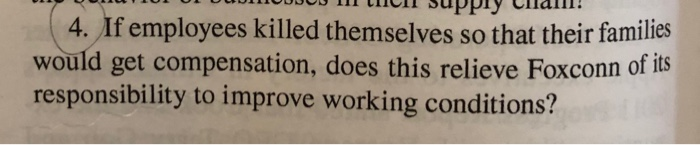
Question: please answer and explain thoroughly. The article is attached below. 4. If employees killed themselves so that their families would get compensation, does this relieve
please answer and explain thoroughly. The article is attached below.
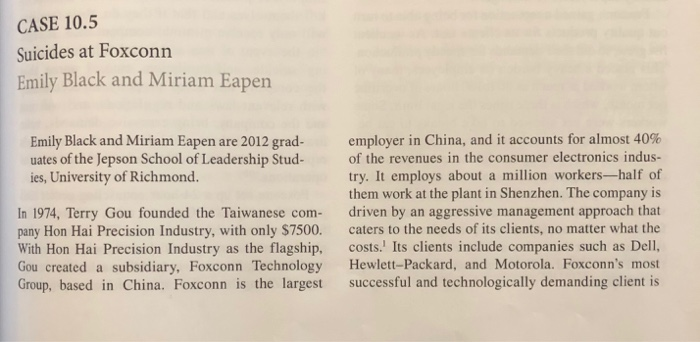
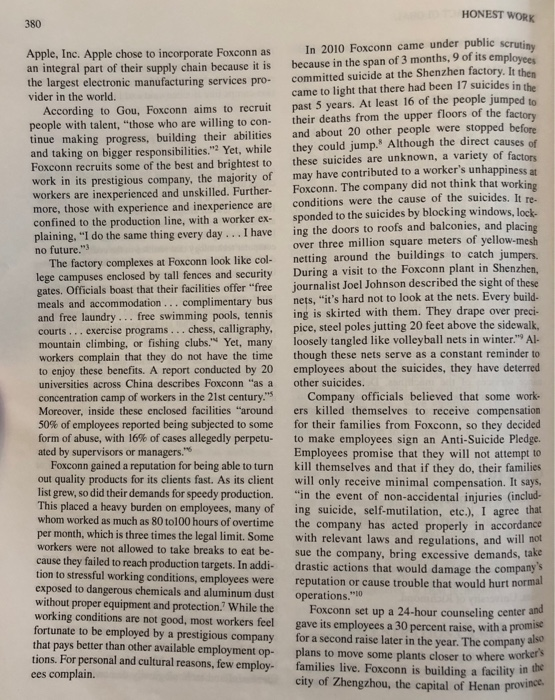
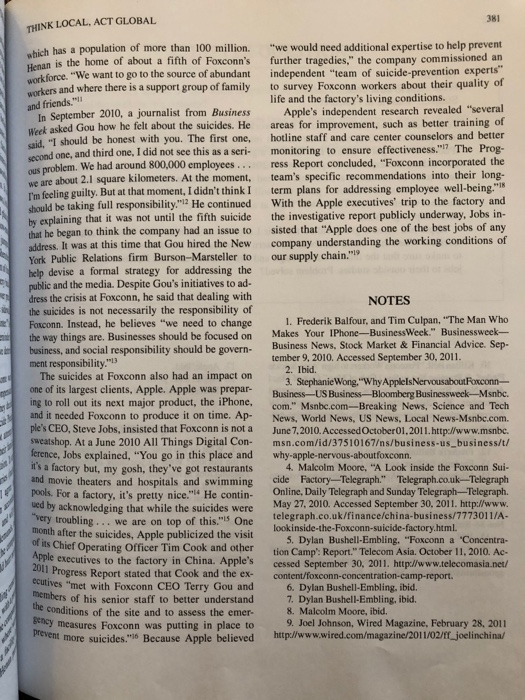
4. If employees killed themselves so that their families would get compensation, does this relieve Foxconn of its responsibility to improve working conditions? CASE 10.5 Suicides at Foxconn Emily Black and Miriam Eapen Emily Black and Miriam Eapen are 2012 grad employer in China, and it accounts for almost 40% uates of the Jepson School of Leadership Stud of the revenues in the consumer electronics indus- ies, University of Richmond. try. It employs about a million workers--half of them work at the plant in Shenzhen. The company is In 1974, Terry Gou founded the Taiwanese com driven by an aggressive management approach that pany Hon Hai Precision Industry, with only $7500. caters to the needs of its clients, no matter what the With Hon Hai Precision Industry as the flagship, costs.' Its clients include companies such as Dell, Gou created a subsidiary, Foxconn Technology Hewlett-Packard, and Motorola. Foxconn's most Group, based in China. Foxconn is the largest successful and technologically demanding client is HONEST WORK 380 Apple, Inc. Apple chose to incorporate Foxconn as an integral part of their supply chain because it is the largest electronic manufacturing services pro- vider in the world. According to Gou, Foxconn aims to recruit people with talent, "those who are willing to con- tinue making progress, building their abilities and taking on bigger responsibilities." Yet, while Foxconn recruits some of the best and brightest to work in its prestigious company, the majority of workers are inexperienced and unskilled. Further- more, those with experience and inexperience are confined to the production line, with a worker ex- plaining, "I do the same thing every day ... I have no future." The factory complexes at Foxconn look like col- lege campuses enclosed by tall fences and security gates. Officials boast that their facilities offer "free meals and accommodation ... complimentary bus and free laundry... free swimming pools, tennis courts... exercise programs... chess, calligraphy, mountain climbing, or fishing clubs." Yet, many workers complain that they do not have the time to enjoy these benefits. A report conducted by 20 universities across China describes Foxconn "as a concentration camp of workers in the 21st century.*** Moreover, inside these enclosed facilities around 50% of employees reported being subjected to some form of abuse, with 16% of cases allegedly perpetu- ated by supervisors or managers."** Foxconn gained a reputation for being able to turn out quality products for its clients fast. As its client list grew, so did their demands for speedy production. This placed a heavy burden on employees, many of whom worked as much as 80 to 100 hours of overtime per month, which is three times the legal limit. Some workers were not allowed to take breaks to eat be- cause they failed to reach production targets. In addi- tion to stressful working conditions, employees were exposed to dangerous chemicals and aluminum dust without proper equipment and protection. While the working conditions are not good, most workers feel fortunate to be employed by a prestigious company that pays better than other available employment op- tions. For personal and cultural reasons, few employ- ees complain. In 2010 Foxconn came under public scrutiny because in the span of 3 months, 9 of its employees committed suicide at the Shenzhen factory. It then came to light that there had been 17 suicides in the past 5 years. At least 16 of the people jumped to their deaths from the upper floors of the factory and about 20 other people were stopped before they could jump. Although the direct causes of these suicides are unknown, a variety of factors may have contributed to a worker's unhappiness at Foxconn. The company did not think that working conditions were the cause of the suicides. It re- sponded to the suicides by blocking windows, lock ing the doors to roofs and balconies, and placing over three million square meters of yellow-mesh netting around the buildings to catch jumpers. During a visit to the Foxconn plant in Shenzhen, journalist Joel Johnson described the sight of these nets, "it's hard not to look at the nets. Every build- ing is skirted with them. They drape over preci- pice, steel poles jutting 20 feet above the sidewalk, loosely tangled like volleyball nets in winter." Al- though these nets serve as a constant reminder to employees about the suicides, they have deterred other suicides. Company officials believed that some work ers killed themselves to receive compensation for their families from Foxconn, so they decided to make employees sign an Anti-Suicide Pledge. Employees promise that they will not attempt to kill themselves and that if they do, their families will only receive minimal compensation. It says, "in the event of non-accidental injuries (includ. ing suicide, self-mutilation, etc.), I agree that the company has acted properly in accordance with relevant laws and regulations, and will not sue the company, bring excessive demands, take drastic actions that would damage the company's reputation or cause trouble that would hurt normal operations." Foxconn set up a 24-hour counseling center and gave its employees a 30 percent raise, with a promise for a second raise later in the year. The company also plans to move some plants closer to where worker's families live. Foxconn is building a facility in the city of Zhengzhou, the capital of Henan province 381 THINK LOCAL, ACT GLOBAL and friends." "we would need additional expertise to help prevent further tragedies," the company commissioned an independent "team of suicide-prevention experts" to survey Foxconn workers about their quality of life and the factory's living conditions. Apple's independent research revealed "several areas for improvement, such as better training of hotline staff and care center counselors and better monitoring to ensure effectiveness." The Prog- ress Report concluded, "Foxconn incorporated the team's specific recommendations into their long- term plans for addressing employee well-being." With the Apple executives' trip to the factory and the investigative report publicly underway, Jobs in- sisted that "Apple does one of the best jobs of any company understanding the working conditions of our supply chain." NOTES which has a population of more than 100 million. Henan is the home of about a fifth of Foxconn's workforce. "We want to go to the source of abundant workers and where there is a support group of family In September 2010, a journalist from Business Week asked Gou how he felt about the suicides. He said, "I should be honest with you. The first one, second one, and third one, I did not see this as a seri- ous problem. We had around 800,000 employees... we are about 2.1 square kilometers. At the moment, I'm feeling guilty. But at that moment, I didn't think I should be taking full responsibility." He continued by explaining that it was not until the fifth suicide that he began to think the company had an issue to address. It was at this time that Gou hired the New York Public Relations firm Burson-Marsteller to help devise a formal strategy for addressing the public and the media. Despite Gou's initiatives to ad- dress the crisis at Foxconn, he said that dealing with the suicides is not necessarily the responsibility of Foxconn. Instead, he believes "we need to change the way things are. Businesses should be focused on business, and social responsibility should be govern- ment responsibility." The suicides at Foxconn also had an impact on one of its largest clients, Apple. Apple was prepar- ing to roll out its next major product, the iPhone, and it needed Foxconn to produce it on time. Ap- ple's CEO, Steve Jobs, insisted that Foxconn is not a sweatshop. At a June 2010 All Things Digital Con- ference, Jobs explained, "You go in this place and it's a factory but, my gosh, they've got restaurants and movie theaters and hospitals and swimming pools. For a factory, it's pretty nice." He contin- wed by acknowledging that while the suicides were very troubling... we are on top of this." One month after the suicides, Apple publicized the visit of its Chief Operating Officer Tim Cook and other Apple executives to the factory in China. Apple's 2011 Progress Report stated that Cook and the ex- ecutives "met with Foxconn CEO Terry Gou and members of his senior staff to better understand the conditions of the site and to assess the emer- Bency measures Foxconn was putting in place to Prevent more suicides."16 Because Apple believed 1. Frederik Balfour, and Tim Culpan, "The Man Who Makes Your IPhone-Business Week." Businessweek- Business News, Stock Market & Financial Advice. Sep- tember 9, 2010. Accessed September 30, 2011. 2. Ibid. 3. Stephanie Wong. "Why ApplelsNervousabout Foxconn- Business-US Business-Bloomberg Businessweek-Msnbc. com." Msnbc.com-Breaking News, Science and Tech News, World News, US News, Local News-Msnbc.com. June 7, 2010. Accessed October 01, 2011. http://www.msnbc. msn.com/id/37510167s/business-us_business/t/ why-apple-nervous-aboutfoxconn. 4. Malcolm Moore, "A Look inside the Foxconn Sui- cide Factory-Telegraph." Telegraph.co.uk-Telegraph Online, Daily Telegraph and Sunday Telegraph-Telegraph. May 27, 2010. Accessed September 30, 2011. http://www. telegraph.co.uk/finance/china-business/7773011/A- lookinside-the-Foxconn-suicide-factory.html. 5. Dylan Bushell-Embling. "Foxconn a 'Concentra- tion Camp': Report." Telecom Asia. October 11, 2010. Ac- cessed September 30, 2011. http://www.telecomasia.net/ content/foxconn-concentration-camp-report. 6. Dylan Bushell-Embling, ibid. 7. Dylan Bushell-Embling, ibid. 8. Malcolm Moore, ibid. 9. Joel Johnson, Wired Magazine, February 28, 2011 http://www.wired.com/magazine/2011/02/ff_joelinchina/ 7









 Study Help