Question: Please answer #4 and #5 Se Management in Action C prod.reader-ui.prod.mheducation.com/epub/sn_b3da/data-uuid-6c123514e44e4ba1801cabefa0917568 Paused Management in Action Problems started to emerge in 2009. At this point, Richard
 Please answer #4 and #5
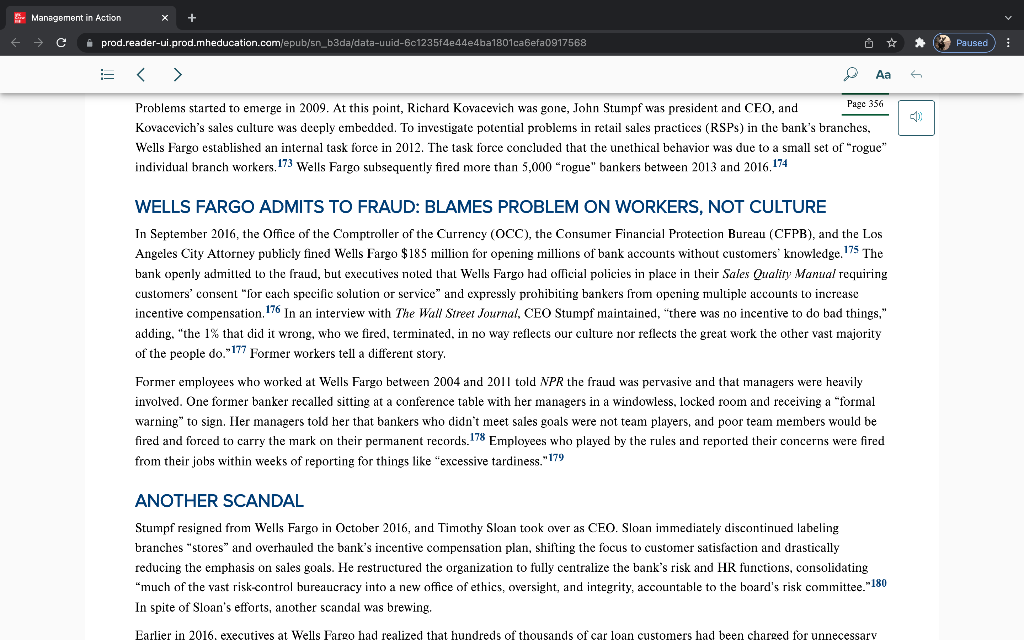
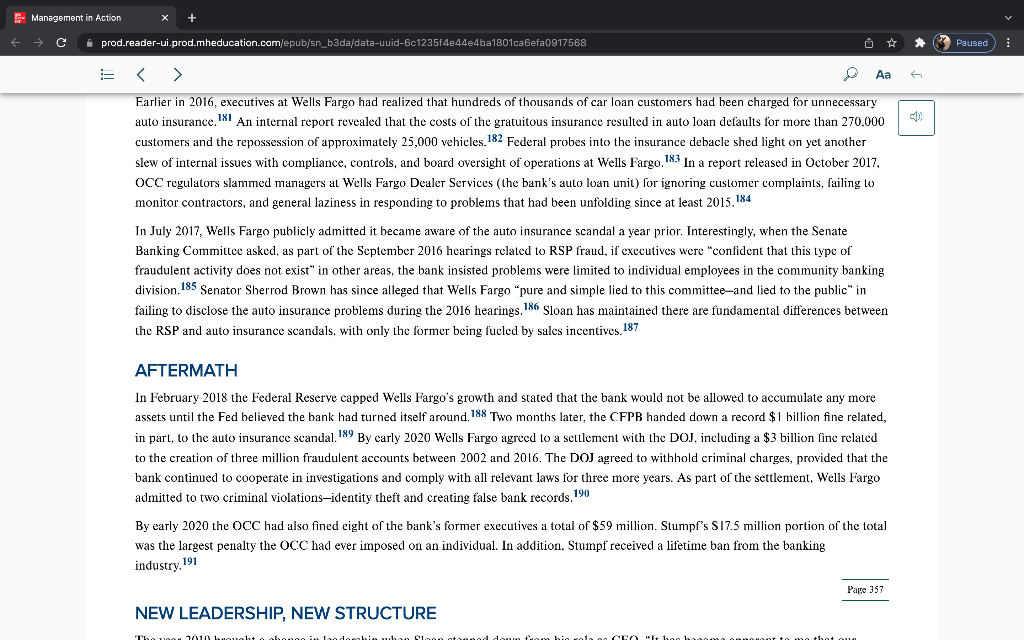
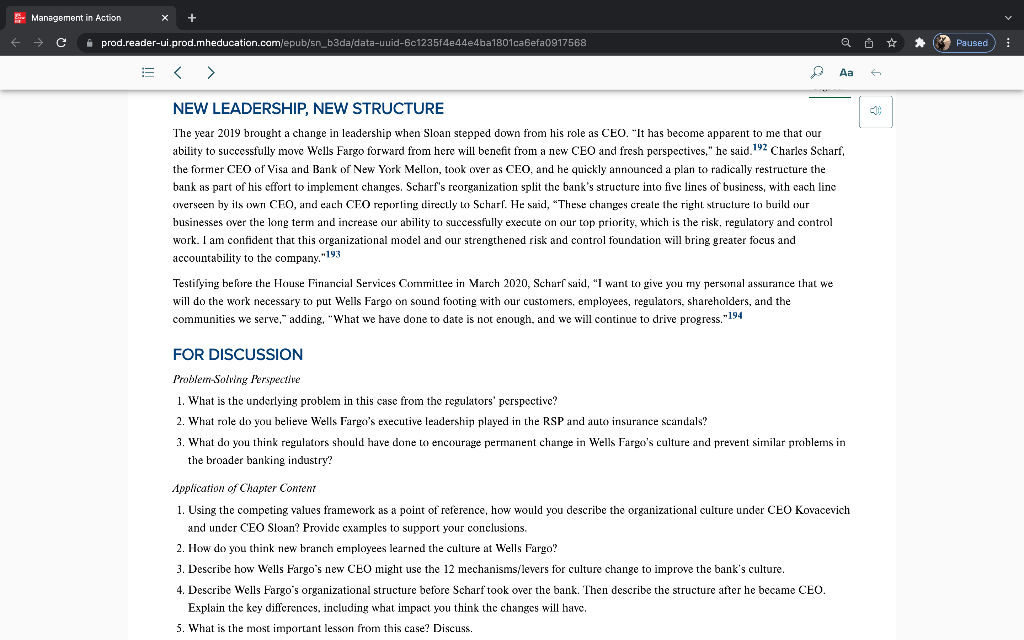
Se Management in Action C prod.reader-ui.prod.mheducation.com/epub/sn_b3da/data-uuid-6c123514e44e4ba1801cabefa0917568 Paused Management in Action Problems started to emerge in 2009. At this point, Richard Kovacevich was gone, John Stumpf was president and CEO, and Page 356 Kovacevich's sales culture was deeply embedded. To investigate potential problems in retail sales practices (RSPs) in the bank's branches, Wells Fargo established an internal task force in 2012. The task force concluded that the unethical behavior was due to a small set of "rogue" individual branch workers. 173 Wells Fargo subsequently fired more than 5,000 rogue" bankers between 2013 and 2016.174 WELLS FARGO ADMITS TO FRAUD: BLAMES PROBLEM ON WORKERS, NOT CULTURE In September 2016, the Office of the Comptroller of the Currency (OCC), the Consumer Financial Protection Bureau (CFPB), and the Los Angeles City Attorney publicly fined Wells Fargo $185 million for opening millions of bank accounts without customers' knowledge. 175 The bank openly admitted to the fraud, but executives noted that Wells Fargo had official policies in place in their Sales Quality Manual requiring customers' consent for cach specific solution or service and expressly prohibiting bankers from opening multiple accounts to increase incentive compensation. 176 In an interview with The Wall Street Journal, CEO Stumpf maintained, "there was no incentive to do bad things," adding "the 1% that did it wrong, who we fired, terminated, in no way reflects our culture nor reflects the great work the other vast majority of the people do."177 Former workers tell a different story. Former employees who worked at Wells Fargo between 2004 and 2011 told NPR the fraud was pervasive and that managers were heavily involved. One former banker recalled sitting at a conference table with her managers in a windowless, locked room and receiving a "formal warning" to sign. Her managers told her that bankers who didn't meet sales goals were not team players, and poor team members would be fired and forced to carry the mark on their permanent records 178 Employees who played by the rules and reported their concerns were fired from their jobs within weeks of reporting for things like "excessive tardiness."179 ANOTHER SCANDAL Stumpf resigned from Wells Fargo in October 2016, and Timothy Sloan took over as CEO. Sloan immediately discontinued labeling branches "stores and overhauled the bank's incentive compensation plan, shifting the focus to customer satisfaction and drastically reducing the emphasis on sales goals. He restructured the organization to fully centralize the bank's risk and HR functions, consolidating "much of the vast risk-control bureaucracy into a new office of ethics, oversight, and integrity, accountable to the board's risk committee."180 In spite of Sloan's efforts, another scandal was brewing. Earlier in 2016, executives at Wells Fargo had realized that hundreds of thousands of car loan customers had been charged for unnecessary Se Management in Action C prod.reader-ui.prod.mheducation.com/epub/sn_b3da/data-uuid-6c1235f4e44e4ba1801ca6efa0917568 Paused 31 Earlier in 2016, executives at Wells Fargo had realized that hundreds of thousands of car loan customers had been charged for unnecessary auto insurance, 181 An internal report revealed that the costs of the gratuitous insurance resulted in auto loan defaults for more than 270.000 customers and the repossession of approximately 25,000 vehicles 182 Federal probes into the insurance debacle shed light on yet another slew of internal issues with compliance, controls, and board oversight of operations at Wells Fargo 183 In a report released in October 2017, OCC regulators slammed managers at Wells Fargo Dealer Services (the bank's auto loan unit) for ignoring customer complaints, failing to monitor contractors, and general laziness in responding to problems that had been unfolding since at least 2015.184 In July 2017, Wells Fargo publicly admitted it became aware of the auto insurance scandal a year prior. Interestingly, when the Senate Banking Committee asked, as part of the September 2016 hearings related to RSP fraud, if executives were "confident that this type of fraudulent activity does not exista in other areas, the bank insisted problems were limited to individual employees in the community banking division.185 Senator Sherrod Brown has since alleged that Wells Fargo "pure and simple lied to this committee and lied to the public" in failing to disclose the auto insurance problems during the 2016 hearings. 186 Sloan has maintained there are fundamental differences between the RSP and auto insurance scandals, with only the former being fucled by sales incentives 187 AFTERMATH In February 2018 the Federal Reserve capped Wells Fargo's growth and stated that the bank would not be allowed to accumulate any more assets until the Fed believed the bank had turned itself around. 188 Two months later, the CFPB handed down a record $1 billion fine related, in part, to the auto insurance scandal.189 By carly 2020 Wells Fargo agreed to a settlement with the DOJ, including a $3 billion fine related to the creation of three million fraudulent accounts between 2002 and 2016. The DOJ agreed to withhold criminal charges, provided that the bank continued to cooperate in investigations and comply with all relevant laws for three more years. As part of the settlement, Wells Fargo admitted to two criminal violations-identity theft and creating false bank records.190 By early 2020 the OCC had also fined eight of the bank's former executives a total of $59 million. Stumpf's $17.5 million portion of the total was the largest penalty the OCC had ever imposed on an individual. In addition. Stumpf received a lifetime ban from the banking industry, 191 Pape 357 NEW LEADERSHIP, NEW STRUCTURE TL 6 1010 bin tod fubiowols Stomat Sre Management in Action e > C prod.reader-ui.prod.mheducation.com/epub/sn_b3da/data-uuid-6c1235f4e44e4ba1801ca6efa0917568 @ Paused Aa 6 NEW LEADERSHIP, NEW STRUCTURE The year 2019 brought a change in leadership when Sloan stepped down from his role as CEO. "It has become apparent to me that our ability to successfully move Wells Fargo forward from here will benefit from a new CEO and fresh perspectives," he said. 192 Charles Scharf, the former CEO of Visa and Bank of New York Mellon, took over as CEO, and he quickly announced a plan to radically restructure the bank as part of his effort to implement changes. Scharf's reorganization split the bank's structure into five lines of business, with each line (werseen by its owTi CEO, and each CEO reporting directly to Scharl. He said, "These changes create the right structure to build our businesses over the long term and increase our ability to successfully execute on our top priority, which is the risk, regulatory and control work. I am confident that this organizational model and our strengthened risk and control foundation will bring greater focus and accountability to the company "193 Testifying before the House Financial Services Committee in March 2020, Scharf said, "I want to give you my personal assurance that we will do the work necessary to put Wells Fargo on sound footing with our customers, employees, regulators, shareholders, and the communities we serve," adding, "What we have done to date is not enough, and we will continue to drive progress. "194 FOR DISCUSSION Problem Solving Perspective 1. What is the underlying problem in this case from the regulators' perspective? 2. What role do you believe Wells Fargo's executive leadership played in the RSP and auto insurance scandals? 3. What do you think regulators should have done to encourage permanent change in Wells Fargo's culture and prevent similar problems in the broader banking industry? Application Chapter Content 1. Using the competing values framework as a point of reference, how would you describe the organizational culture under CEO Kovacevich and under CEO Sloan? Provide cxamples to support your conclusions. 2. How do you think new branch employees learned the culture at Wells Fargo? 3. Describe how Wells Fargo's new CEO might use the 12 mechanisms/levers for culture change to improve the bank's culture. 4. Describe Wells Fargo's organizational structure before Scharf took over the bank. Then describe the structure after he became CEO. Explain the key differences, including what impact you think the changes will havc. 5. What is the most important lesson from this case? Discuss




