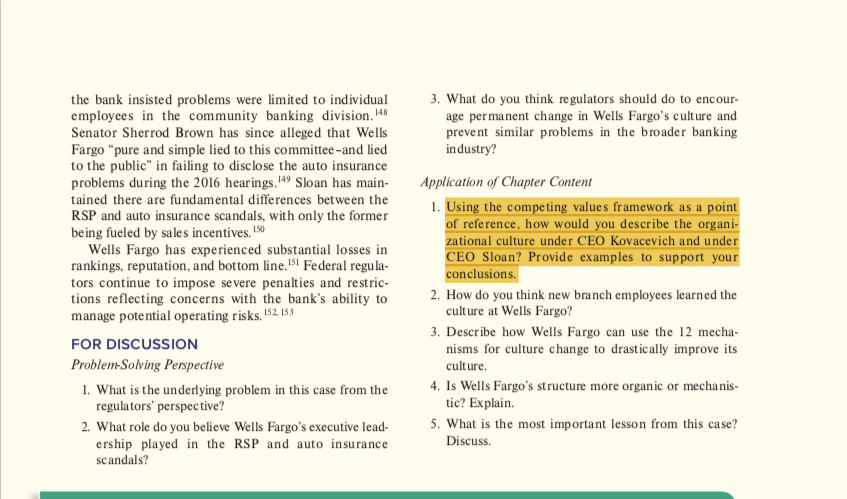
Question: ONE QUESTION ONLY: Using the competing values framework as a point of reference, how would you describe the organi- zational culture under CEO Kovacevich
 \
\
ONE QUESTION ONLY:
-
Using the competing values framework as a point of reference, how would you describe the organi- zational culture under CEO Kovacevich and under CEO Sloan? Provide examples to support your conclusions.
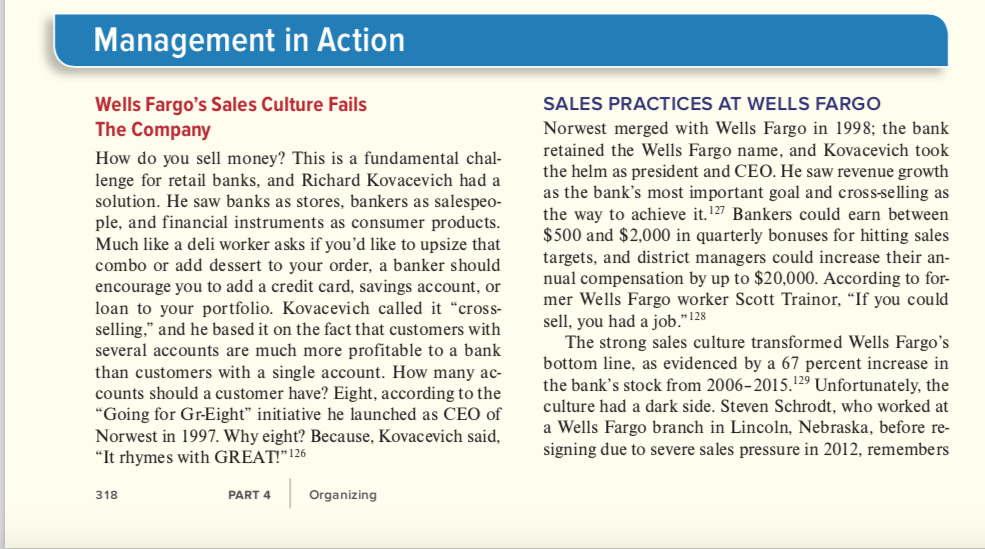
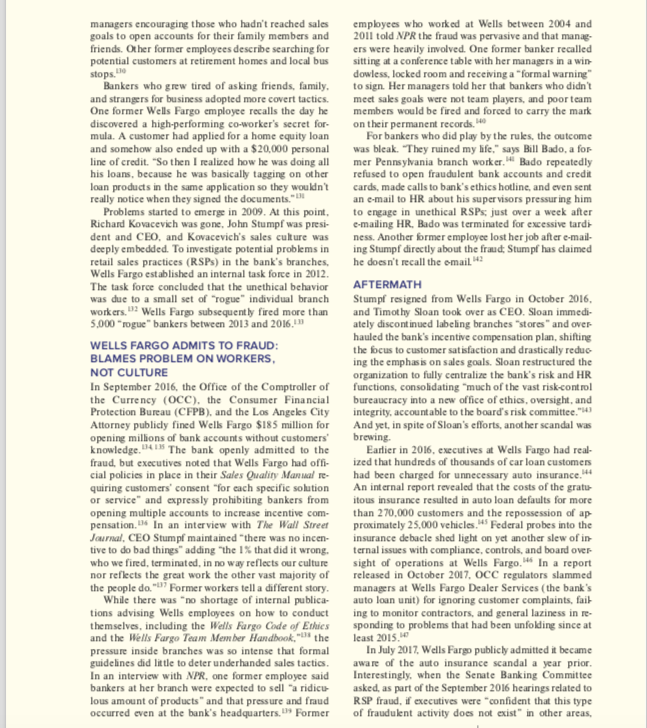
Management in Action Wells Fargo's Sales Culture Fails The Company How do you sell money? This is a fundamental chal- lenge for retail banks, and Richard Kovacevich had a solution. He saw banks as stores, bankers as salespeo- ple, and financial instruments as consumer products. Much like a deli worker asks if you'd like to upsize that combo or add dessert to your order, a banker should encourage you to add a credit card, savings account, or loan to your portfolio. Kovacevich called it "cross- selling," and he based it on the fact that customers with several accounts are much more profitable to a bank than customers with a single account. How many ac- counts should a customer have? Eight, according to the "Going for Gr-Eight" initiative he launched as CEO of Norwest in 1997. Why eight? Because, Kovacevich said, "It rhymes with GREAT!"126 SALES PRACTICES AT WELLS FARGO Norwest merged with Wells Fargo in 1998; the bank retained the Wells Fargo name, and Kovacevich took the helm as president and CEO. He saw revenue growth as the bank's most important goal and cross-selling as the way to achieve it.127 Bankers could earn between $500 and $2,000 in quarterly bonuses for hitting sales targets, and district managers could increase their an- nual compensation by up to $20,000. According to for- mer Wells Fargo worker Scott Trainor, "If you could sell, you had a job."128 The strong sales culture transformed Wells Fargo's bottom line, as evidenced by a 67 percent increase in the bank's stock from 2006-2015.129 Unfortunately, the culture had a dark side. Steven Schrodt, who worked at a Wells Fargo branch in Lincoln, Nebraska, before re- signing due to severe sales pressure in 2012, remembers 318 PART 4 Organizing managers encouraging those who hadn't reached sales goals to open accounts for their family members and friends. Other former employees describe searching for potential customers at retirement homes and local bus stops. Bankers who grew tired of asking friends, family, and strangers for business adopted more covert tactics. One former Wells Fargo employee recalls the day he discovered a high-performing co-worker's secret for mula. A customer had applied for a home equity loan and somehow also ended up with a $20,000 personal line of credit. "So then I realized how he was doing all his loans, because he was basically tagging on other loan products in the same application so they wouldn't really notice when they signed the documents." Problems started to emerge in 2009. At this point, Richard Kovacevich was gone, John Stumpf was presi- dent and CEO, and Kovacevich's sales culture was deeply embedded. To investigate potential problems in retail sales practices (RSPs) in the bank's branches, Wells Fargo established an internal task force in 2012. The task force concluded that the unethical behavior was due to a small set of "rogue individual branch workers. 02 Wells Fargo subsequently fired more than 5,000 "rogue" bankers between 2013 and 2016.123 WELLS FARGO ADMITS TO FRAUD: BLAMES PROBLEM ON WORKERS, NOT CULTURE In September 2016, the Office of the Comptroller of the Currency (OCC), the Consumer Financial Protection Bureau (CFPB), and the Los Angeles City Attorney publicly fined Wells Fargo $185 million for opening millions of bank accounts without customers' knowledge. 415 The bank openly admitted to the fraud, but executives noted that Wells Fargo had off- cial policies in place in their Sales Quality Manwal re- quiring customers' consent for each specific solution or service and expressly prohibiting bankers from opening multiple accounts to increase incentive com- pensation. In an interview with The Wall Street Journal, CEO Stumpf maintained there was no incen- tive to do bad things" adding "the 1% that did it wrong. who we fired, terminated, in no way reflects our culture nor reflects the great work the other vast majority of the people do "17 Former workers tell a different story. While there was "no shortage of internal publica- tions advising Wells employees on how to conduct themselves, including the Wells Fargo Code of Ethics and the Wells Fargo Team Member Handbook. *** the pressure inside branches was so intense that formal guidelines did little to deter underhanded sales tactics. In an interview with NPR, one former employee said bankers at her branch were expected to sell a ridicu lous amount of products" and that pressure and fraud occurred even at the bank's headquarters. Former employees who worked at Wells between 2004 and 2011 told NPR the fraud was pervasive and that manag- ers were heavily involved. One former banker recalled sitting at a conference table with her managers in a win dowless, locked room and receiving a formal warning" to sign. Her managers told her that bankers who didn't meet sales goals were not team players, and poor team members would be fired and forced to carry the mark on their permanent records. We For bankers who did play by the rules, the outcome was bleak. They ruined my life," says Bill Bado, a fos mer Pennsylvania branch worker. Bado repeatedly refused to open fraudulent bank accounts and credit cards, made calls to bank's ethics hotline, and even sent an e-mail to HR about his supervisors pressuring him to engage in unethical RSPs: just over a week after e-mailing HR, Bado was terminated for excessive tardi ness. Another former employee lost her job after e-mail ing Stumpf directly about the fraud, Stumpf has claimed he doesn't recall the omail2 AFTERMATH Stumpf resigned from Wells Fargo in October 2016, and Timothy Sloan took over as CEO. Sloan immedi- ately discontinued labeling branches "stores" and over hauled the bank's incentive compensation plan, shifting the focus to customer satisfaction and drastically redu ing the emphasis on sales goals. Sloan restructured the organization to fully centralize the bank's risk and HR functions, consolidating much of the vast risk-control bureaucracy into a new office of ethics, oversight, and integrity, accountable to the board's risk committee." And yet, in spite of Sloan's efforts, another scandal was brewing. Earlier in 2016, executives at Wells Fargo had real- ized that hundreds of thousands of car loan customers had been charged for unnecessary auto insurance.144 An internal report revealed that the costs of the gratu itous insurance resulted in auto loan defaults for more than 270,000 customers and the repossession of ap proximately 25,000 vehicles. 45 Federal probes into the insurance debacle shed light on yet another slew of in ternal issues with compliance, controls, and board over sight of operations at Wells Fargo. In a report released in October 2017, OCC regulators slammed managers at Wells Fargo Dealer Services (the bank's auto loan unit) for ignoring customer complaints, fait ing to monitor contractors, and general laziness in te sponding to problems that had been unfolding since at least 2015.10 In July 2017, Wells Fargo publicly admitted it became aware of the auto insurance scandal a year prior. Interestingly, when the Senate Banking Committee asked, as part of the September 2016 hearings related to RSP fraud, if executives were confident that this type of fraudulent activity does not exist in other areas, 3. What do you think regulators should do to encour- age permanent change in Wells Fargo's culture and prevent similar problems in the broader banking industry? the bank insisted problems were limited to individual employees in the community banking division. 48 Senator Sherrod Brown has since alleged that Wells Fargo "pure and simple lied to this committee -and lied to the public" in failing to disclose the auto insurance problems during the 2016 hearings.149 Sloan has main- tained there are fundamental differences between the RSP and auto insurance scandals, with only the former being fueled by sales incentives. 150 Wells Fargo has experienced substantial losses in rankings, reputation, and bottom line.Sl Federal regula- tors continue to impose severe penalties and restric- tions reflecting concerns with the bank's ability to manage potential operating risks. 152, 153 FOR DISCUSSION Problem Solving Perspective 1. What is the underlying problem in this case from the regulators' perspective? 2. What role do you believe Wells Fargo's executive lead- ership played in the RSP and auto insurance scandals? Application of Chapter Content 1. Using the competing values framework as a point of reference, how would you describe the organi- zational culture under CEO Kovacevich and under CEO Sloan? Provide examples to support your conclusions. 2. How do you think new branch employees learned the culture at Wells Fargo? 3. Describe how Wells Fargo can use the 12 mecha- nisms for culture change to drastically improve its culture. 4. Is Wells Fargo's structure more organic or mechanis- tic? Explain. 5. What is the most important lesson from this case? Discuss









 Study Help