



Question: please answer all questions, for a like and good rating :) THANKS!! II. By chance, each investigator is invited by the journal to review the
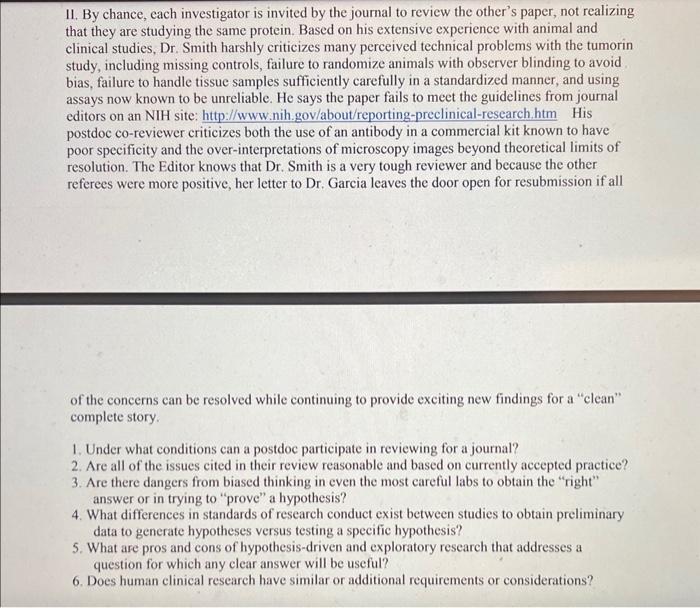
II. By chance, each investigator is invited by the journal to review the other's paper, not realizing that they are studying the same protein. Based on his extensive experience with animal and clinical studies, Dr. Smith harshly criticizes many perceived technical problems with the tumorin study, including missing controls, failure to randomize animals with observer blinding to avoid bias, failure to handle tissue samples sufficiently carefully in a standardized manner, and using assays now known to be unreliable. He says the paper fails to meet the guidelines from journal editors on an NIH site: http://www.nih.gov/about/reporting-preclinical-research.htm His postdoc co-reviewer criticizes both the use of an antibody in a commercial kit known to have poor specificity and the over-interpretations of microscopy images beyond theoretical limits of resolution. The Editor knows that Dr. Smith is a very tough reviewer and because the other referees were more positive, her letter to Dr. Garcia leaves the door open for resubmission if all of the concerns can be resolved while continuing to provide exciting new findings for a "clean" complete story. 1. Under what conditions can a postdoc participate in reviewing for a journal? 2. Are all of the issues cited in their review reasonable and based on currently accepted practice? 3. Are there dangers from biased thinking in even the most careful labs to obtain the "right" answer or in trying to "prove" a hypothesis? 4. What differences in standards of research conduct exist between studies to obtain preliminary data to generate hypotheses versus testing a specific hypothesis? 5. What are pros and cons of hypothesis-driven and exploratory research that addresses a question for which any clear answer will be useful? 6. Does human clinical research have similar or additional requirements or considerations? II. By chance, each investigator is invited by the journal to review the other's paper, not realizing that they are studying the same protein. Based on his extensive experience with animal and clinical studies, Dr. Smith harshly criticizes many perceived technical problems with the tumorin study, including missing controls, failure to randomize animals with observer blinding to avoid bias, failure to handle tissue samples sufficiently carefully in a standardized manner, and using assays now known to be unreliable. He says the paper fails to meet the guidelines from journal editors on an NIH site: http://www.nih.gov/about/reporting-preclinical-research.htm His postdoc co-reviewer criticizes both the use of an antibody in a commercial kit known to have poor specificity and the over-interpretations of microscopy images beyond theoretical limits of resolution. The Editor knows that Dr. Smith is a very tough reviewer and because the other referees were more positive, her letter to Dr. Garcia leaves the door open for resubmission if all of the concerns can be resolved while continuing to provide exciting new findings for a "clean" complete story. 1. Under what conditions can a postdoc participate in reviewing for a journal? 2. Are all of the issues cited in their review reasonable and based on currently accepted practice? 3. Are there dangers from biased thinking in even the most careful labs to obtain the "right" answer or in trying to "prove" a hypothesis? 4. What differences in standards of research conduct exist between studies to obtain preliminary data to generate hypotheses versus testing a specific hypothesis? 5. What are pros and cons of hypothesis-driven and exploratory research that addresses a question for which any clear answer will be useful? 6. Does human clinical research have similar or additional requirements or considerations
Step by Step Solution
There are 3 Steps involved in it

Get step-by-step solutions from verified subject matter experts