



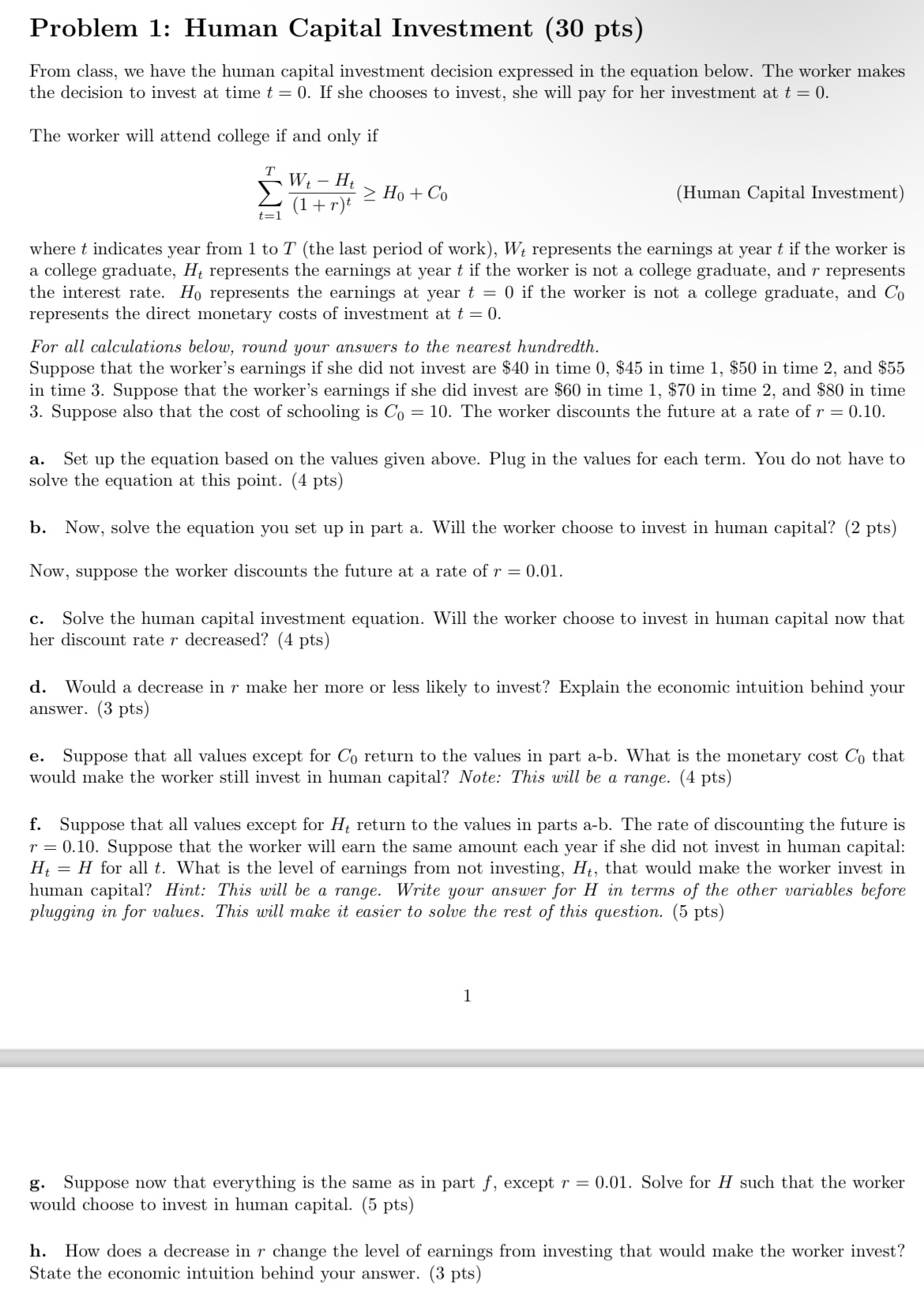
Question: Please answer all questions thoroughly. Problem 1: Human Capital Investment (30 pts) From class, we have the human capital investment decision expressed in the equation
Please answer all questions thoroughly.
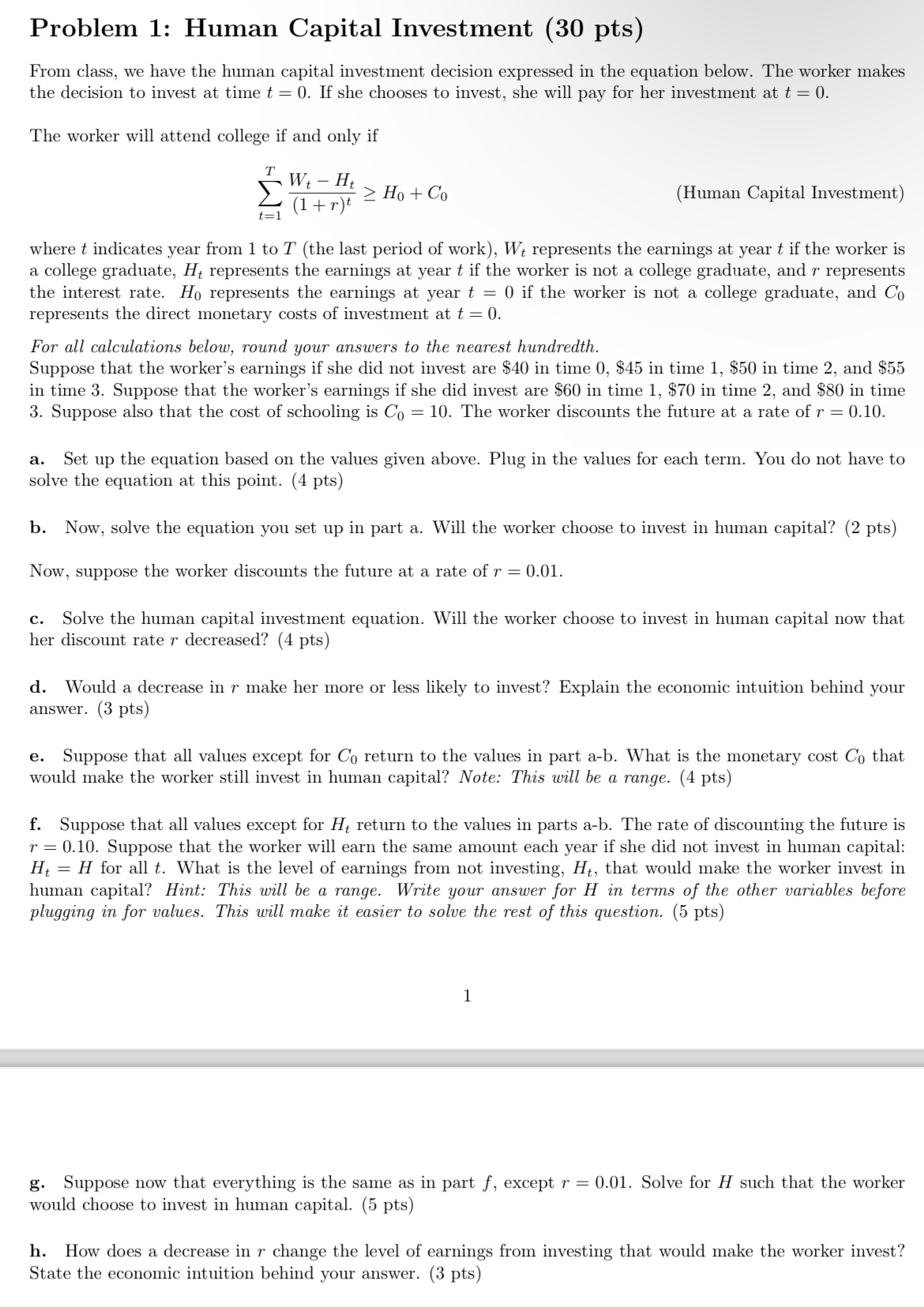
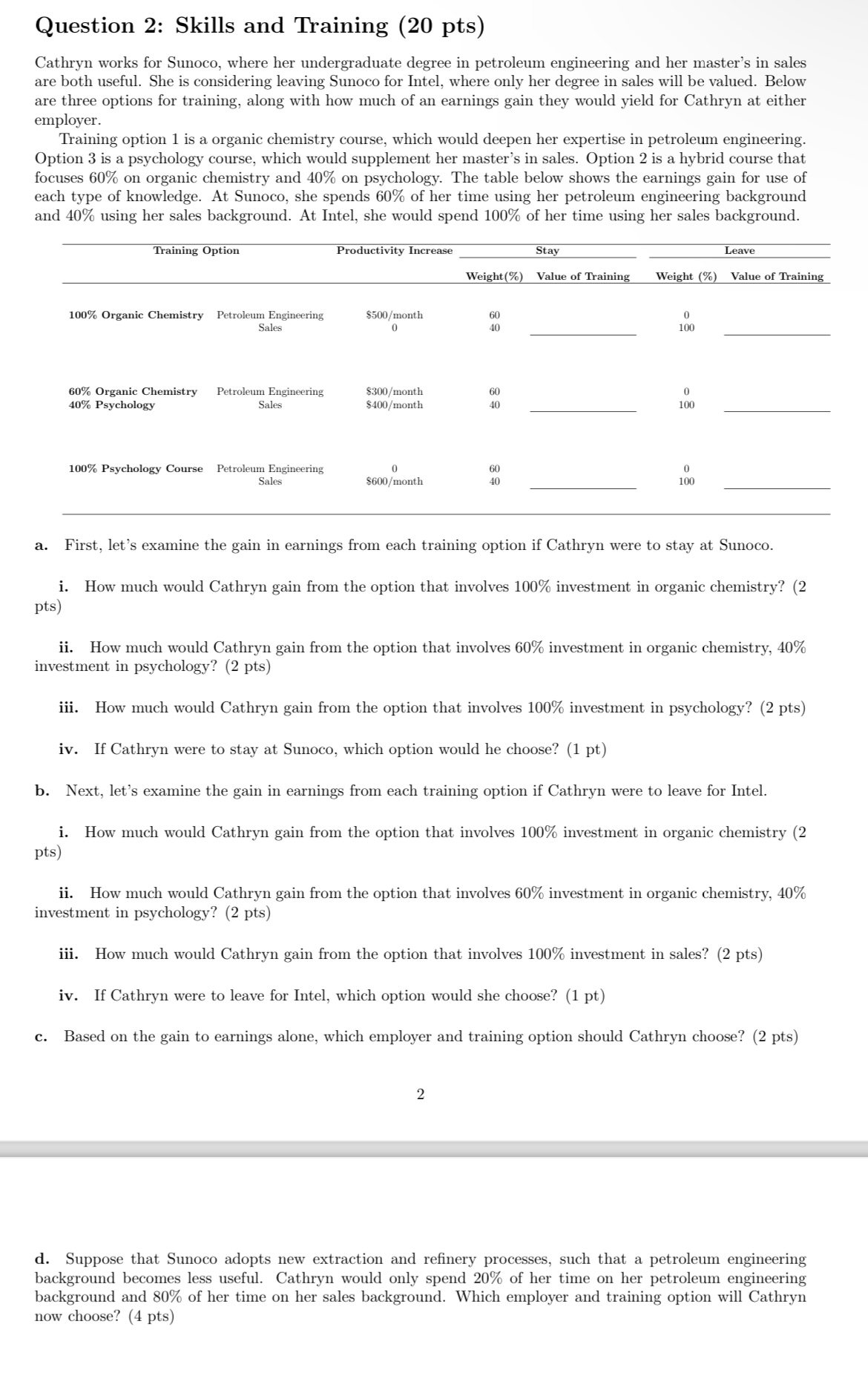
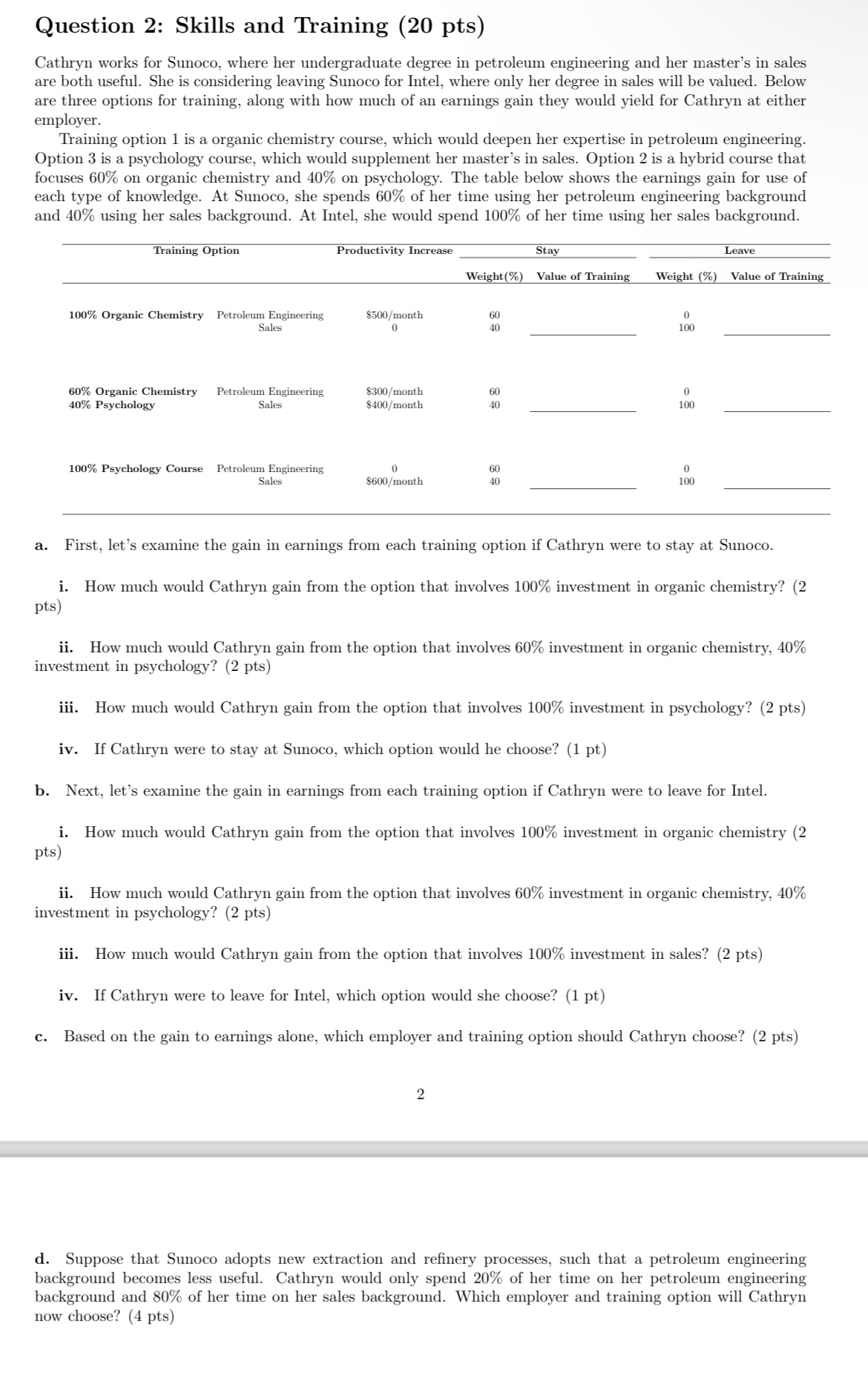
Problem 1: Human Capital Investment (30 pts) From class, we have the human capital investment decision expressed in the equation below. The worker makes the decision to invest at time t = (). If she chooses to invest, she will pay for her investment at = 0. The worker will attend college if and only if T W, H Z L>Hy+C (Human Capital Investment) r (14+7r)t where t indicates year from 1 to T (the last period of work), W} represents the earnings at year if the worker is a college graduate, H; represents the earnings at year if the worker is not a college graduate, and r represents the interest rate. Hg represents the earnings at year t = 0 if the worker is not a college graduate, and Cj represents the direct monetary costs of investment at t = 0. For all calculations below, round your answers to the nearest hundredth. Suppose that the worker's earnings if she did not invest are $40 in time 0, $45 in time 1, $50 in time 2, and $55 in time 3. Suppose that the worker's earnings if she did invest are $60 in time 1, $70 in time 2, and $80 in time 3. Suppose also that the cost of schooling is Cjy = 10. The worker discounts the future at a rate of r = 0.10. a. Set up the equation based on the values given above. Plug in the values for each term. You do not have to solve the equation at this point. (4 pts) b. Now, solve the equation you set up in part a. Will the worker choose to invest in human capital? (2 pts) Now, suppose the worker discounts the future at a rate of r = 0.01. c. Solve the human capital investment equation. Will the worker choose to invest in human capital now that her discount rate r decreased? (4 pts) d. Would a decrease in r make her more or less likely to invest? Explain the economic intuition behind your answer. (3 pts) e. Suppose that all values except for Cy return to the values in part a-b. What is the monetary cost Cj that would make the worker still invest in human capital? Note: This will be a range. (4 pts) f. Suppose that all values except for H; return to the values in parts a-b. The rate of discounting the future is r = 0.10. Suppose that the worker will earn the same amount each year if she did not invest in human capital: H; = H for all t. What is the level of earnings from not investing, H;, that would make the worker invest in human capital? Hint: This will be a range. Write your answer for H in terms of the other variables before plugging in for values. This will make it easier to solve the rest of this question. (5 pts) g. Suppose now that everything is the same as in part f, except r = 0.01. Solve for H such that the worker would choose to invest in human capital. (5 pts) h. How does a decrease in r change the level of earnings from investing that would make the worker invest? State the economic intuition behind your answer. (3 pts) Question 2: Skills and Training (20 pts) Cathryn works for Sunoco, where her undergraduate degree in petroleum engineering and her master's in sales are both useful. She is considering leaving Sunoco for Intel, where only her degree in sales will be valued. Below are three options for training, along with how much of an earnings gain they would yield for Cathryn at either employer. Training option 1 is a organic chemistry course, which would deepen her expertise in petroleum engineering. Option 3 is a psychology course, which would supplement her master's in sales. Option 2 is a hybrid course that focuses 60% on organic chemistry and 40% on psychology. The table below shows the earnings gain for use of each type of knowledge. At Sunoco, she spends 60% of her time using her petroleum engineering background and 40% using her sales background. At Intel, she would spend 100% of her time using her sales background. Training Option Productivity Increase Stay Leave Weight(%) Value of Training Weight (%) Value of Training 100% Organic Chemistry Petroleum Engineering $500/month 60 0 Sales 0 40 100 60% Organic Chemistry Petroleum Engineering $300/month 60 0 40% Psychology Sales 400/month 40 100 100% Psychology Course Petroleum Engineering 0 60 0 Sales $600/month 40 100 a. First, let's examine the gain in earnings from each training option if Cathryn were to stay at Sunoco. i. How much would Cathryn gain from the option that involves 100% investment in organic chemistry? (2 pts) ii. How much would Cathryn gain from the option that involves 60% investment in organic chemistry, 40% investment in psychology? (2 pts) iii. How much would Cathryn gain from the option that involves 100% investment in psychology? (2 pts) iv. If Cathryn were to stay at Sunoco, which option would he choose? (1 pt) b. Next, let's examine the gain in earnings from each training option if Cathryn were to leave for Intel. i. How much would Cathryn gain from the option that involves 100% investment in organic chemistry (2 pts) ii. How much would Cathryn gain from the option that involves 60% investment in organic chemistry, 40% investment in psychology? (2 pts) ifi. How much would Cathryn gain from the option that involves 100% investment in sales? (2 pts) iv. If Cathryn were to leave for Intel, which option would she choose? (1 pt) c. Based on the gain to earnings alone, which employer and training option should Cathryn choose? (2 pts) d. Suppose that Sunoco adopts new extraction and refinery processes, such that a petrolenm engineering background becomes less useful. Cathryn would only spend 20% of her time on her petroleum engineering background and 80% of her time on her sales background. Which employer and training option will Cathryn now choose? (4 pts)
Step by Step Solution
There are 3 Steps involved in it

Get step-by-step solutions from verified subject matter experts