



Question: Please answer all the above questions correctly providing necessary formulae, equations, expressions, diagrams, charts, graphs, tables and plots. 1. i) A solvent A is to
Please answer all the above questions correctly providing necessary formulae, equations, expressions, diagrams, charts, graphs, tables and plots.
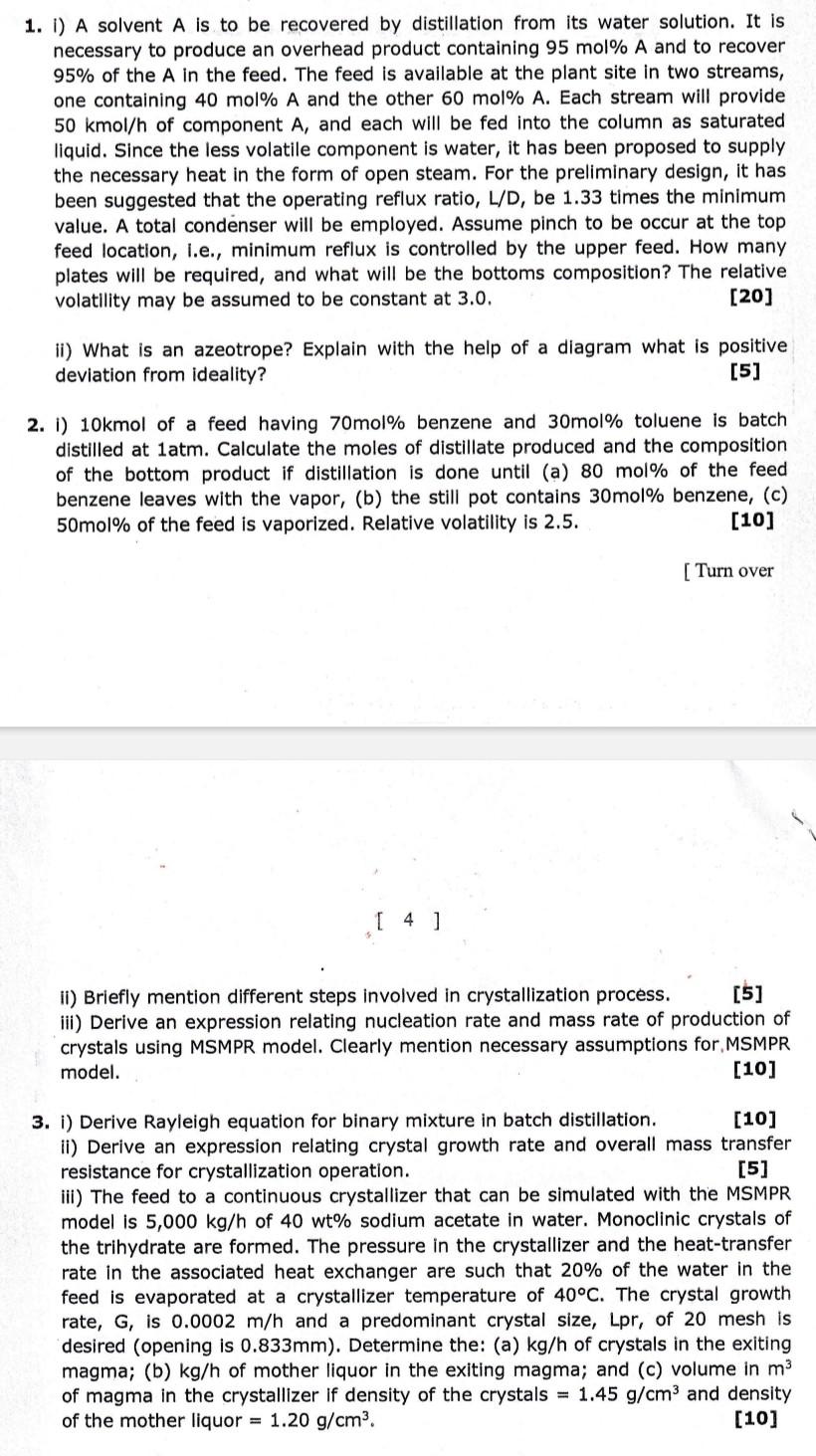
1. i) A solvent A is to be recovered by distillation from its water solution. It is necessary to produce an overhead product containing 95mol%A and to recover 95% of the A in the feed. The feed is available at the plant site in two streams, one containing 40mol%A and the other 60mol%A. Each stream will provide 50kmol/h of component A, and each will be fed into the column as saturated liquid. Since the less volatile component is water, it has been proposed to supply the necessary heat in the form of open steam. For the preliminary design, it has been suggested that the operating reflux ratio, L/D, be 1.33 times the minimum value. A total condenser will be employed. Assume pinch to be occur at the top feed location, l.e., minimum reflux is controlled by the upper feed. How many plates will be required, and what will be the bottoms composition? The relative volatility may be assumed to be constant at 3.0 . [20] ii) What is an azeotrope? Explain with the help of a diagram what is positive deviation from ideality? [5] 2. i) 10kmol of a feed having 70mol% benzene and 30mol% toluene is batch distilled at 1atm. Calculate the moles of distillate produced and the composition of the bottom product if distillation is done until (a) 80mol% of the feed benzene leaves with the vapor, (b) the still pot contains 30mol% benzene, (c) 50mol% of the feed is vaporized. Relative volatility is 2.5 . [10] [ Turn over ii) Briefly mention different steps involved in crystallization process. [5] iii) Derive an expression relating nucleation rate and mass rate of production of crystals using MSMPR model. Clearly mention necessary assumptions for,MSMPR model. [10] 3. i) Derive Rayleigh equation for binary mixture in batch distillation. [10] ii) Derive an expression relating crystal growth rate and overall mass transfer resistance for crystallization operation. [5] iii) The feed to a continuous crystallizer that can be simulated with the MSMPR model is 5,000kg/h of 40wt% sodium acetate in water. Monoclinic crystals of the trihydrate are formed. The pressure in the crystallizer and the heat-transfer rate in the associated heat exchanger are such that 20% of the water in the feed is evaporated at a crystallizer temperature of 40C. The crystal growth rate, G, is 0.0002m/h and a predominant crystal size, Lpr, of 20 mesh is desired (opening is 0.833mm ). Determine the: (a) kg/h of crystals in the exiting magma; (b) kg/h of mother liquor in the exiting magma; and (c) volume in m3 of magma in the crystallizer if density of the crystals =1.45g/cm3 and density of the mother liquor =1.20g/cm3. [10]
Step by Step Solution
There are 3 Steps involved in it

Get step-by-step solutions from verified subject matter experts