



Question: Please answer all the above questions correctly providing necessary, formulae, equations, expressions, diagrams, charts, graphs, tables and plots. 1. a) What is bimodal solubility curve
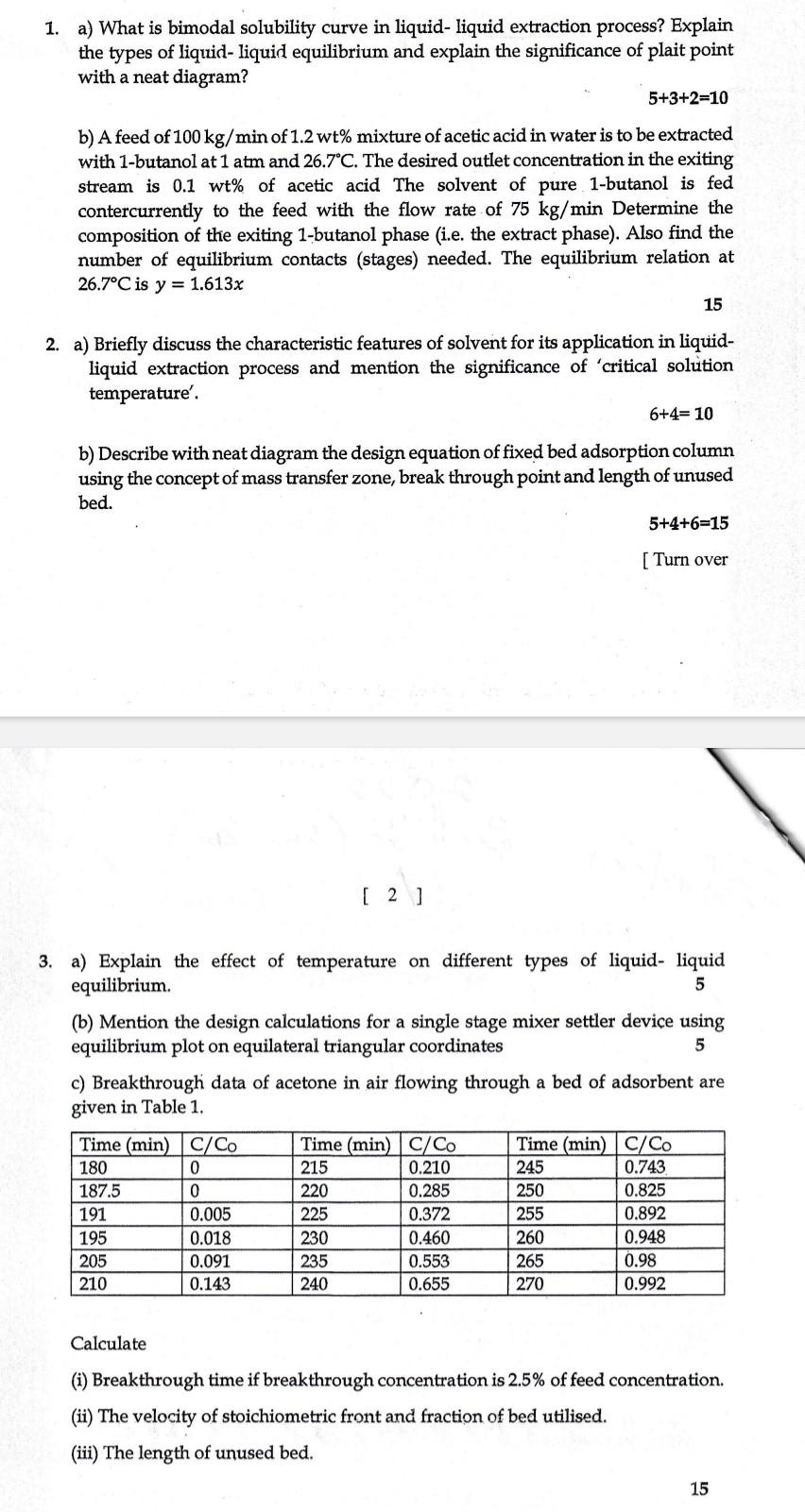
Please answer all the above questions correctly providing necessary, formulae, equations, expressions, diagrams, charts, graphs, tables and plots.
1. a) What is bimodal solubility curve in liquid- liquid extraction process? Explain the types of liquid- liquid equilibrium and explain the significance of plait point with a neat diagram? 5+3+2=10 b) A feed of 100kg/min of 1.2wt% mixture of acetic acid in water is to be extracted with 1-butanol at 1atm and 26.7C. The desired outlet concentration in the exiting stream is 0.1wt% of acetic acid The solvent of pure 1-butanol is fed contercurrently to the feed with the flow rate of 75kg/min Determine the composition of the exiting 1-butanol phase (i.e. the extract phase). Also find the number of equilibrium contacts (stages) needed. The equilibrium relation at 26.7C is y=1.613x 15 2. a) Briefly discuss the characteristic features of solvent for its application in liquidliquid extraction process and mention the significance of 'critical solution temperature'. 6+4=10 b) Describe with neat diagram the design equation of fixed bed adsorption column using the concept of mass transfer zone, break through point and length of unused bed. 5+4+6=15 [ Turn over 3. a) Explain the effect of temperature on different types of liquid- liquid equilibrium. 5 (b) Mention the design calculations for a single stage mixer settler device using equilibrium plot on equilateral triangular coordinates 5 c) Breakthrough data of acetone in air flowing through a bed of adsorbent are given in Table 1. Calculate (i) Breakthrough time if breakthrough concentration is 2.5% of feed concentration. (ii) The velocity of stoichiometric front and fraction of bed utilised. (iii) The length of unused bed
Step by Step Solution
There are 3 Steps involved in it

Get step-by-step solutions from verified subject matter experts