



Question: Please answer all the above questions correctly providing necessary formulae, equations, expressions, diagrams, charts, graphs, plots and tables. 03. To understand and analyze the basics
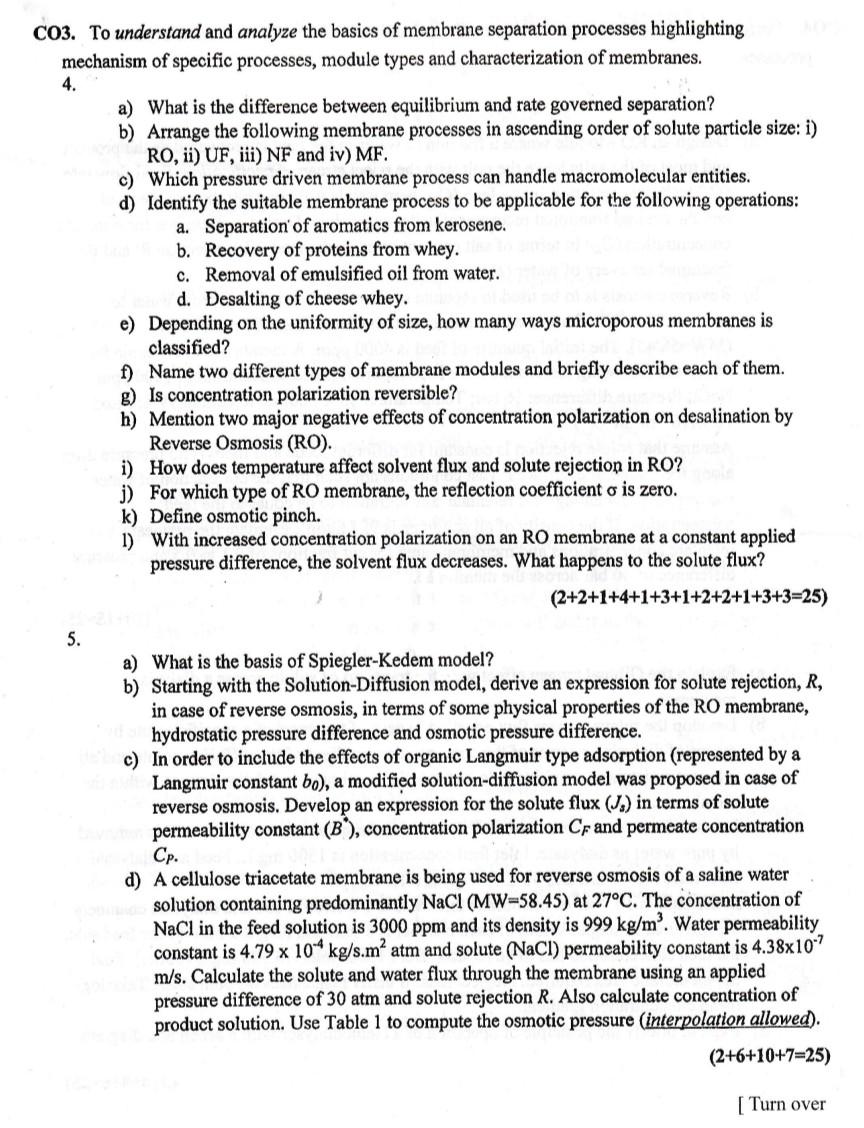
Please answer all the above questions correctly providing necessary formulae, equations, expressions, diagrams, charts, graphs, plots and tables.
03. To understand and analyze the basics of membrane separation processes highlighting mechanism of specific processes, module types and characterization of membranes. 4. a) What is the difference between equilibrium and rate governed separation? b) Arrange the following membrane processes in ascending order of solute particle size: i) RO, ii) UF, iii) NF and iv) MF. c) Which pressure driven membrane process can handle macromolecular entities. d) Identify the suitable membrane process to be applicable for the following operations: a. Separation of aromatics from kerosene. b. Recovery of proteins from whey. c. Removal of emulsified oil from water. d. Desalting of cheese whey. e) Depending on the uniformity of size, how many ways microporous membranes is classified? f) Name two different types of membrane modules and briefly describe each of them. g) Is concentration polarization reversible? h) Mention two major negative effects of concentration polarization on desalination by Reverse Osmosis (RO). i) How does temperature affect solvent flux and solute rejection in RO? j) For which type of RO membrane, the reflection coefficient is zero. k) Define osmotic pinch. 1) With increased concentration polarization on an RO membrane at a constant applied pressure difference, the solvent flux decreases. What happens to the solute flux? (2+2+1+4+1+3+1+2+2+1+3+3=25) 5. a) What is the basis of Spiegler-Kedem model? b) Starting with the Solution-Diffusion model, derive an expression for solute rejection, R, in case of reverse osmosis, in terms of some physical properties of the RO membrane, hydrostatic pressure difference and osmotic pressure difference. c) In order to include the effects of organic Langmuir type adsorption (represented by a Langmuir constant b0 ), a modified solution-diffusion model was proposed in case of reverse osmosis. Develop an expression for the solute flux (Js) in terms of solute permeability constant (B), concentration polarization CF and permeate concentration CP. d) A cellulose triacetate membrane is being used for reverse osmosis of a saline water solution containing predominantly NaCl(MW=58.45) at 27C. The concentration of NaCl in the feed solution is 3000ppm and its density is 999kg/m3. Water permeability constant is 4.79104kg/sm2 atm and solute (NaCl) permeability constant is 4.38107 m/s. Calculate the solute and water flux through the membrane using an applied pressure difference of 30atm and solute rejection R. Also calculate concentration of product solution. Use Table 1 to compute the osmotic pressure (interpolation allowed). (2+6+10+7=25)
Step by Step Solution
There are 3 Steps involved in it

Get step-by-step solutions from verified subject matter experts