



Question: Please answer all the above questions correctly providing necessary formulae, equations, expressions, diagrams, charts, graphs, plots and tables. 1. A non-catalytic first order heterogeneous reaction
Please answer all the above questions correctly providing necessary formulae, equations, expressions, diagrams, charts, graphs, plots and tables.
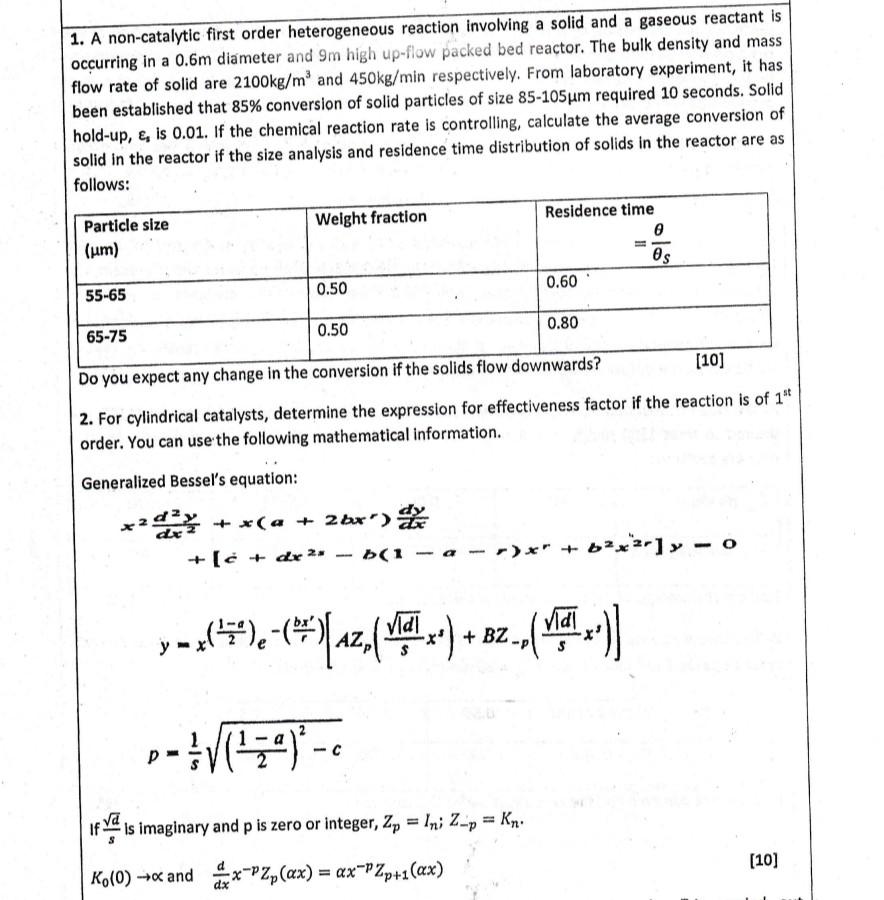
1. A non-catalytic first order heterogeneous reaction involving a solid and a gaseous reactant is occurring in a 0.6m diameter and 9m high up-flow packed bed reactor. The bulk density and mass flow rate of solid are 2100kg/m3 and 450kg/min respectively. From laboratory experiment, it has been established that 85% conversion of solid particles of size 85105m required 10 seconds. Solid hold-up, s is 0.01 . If the chemical reaction rate is controlling, calculate the average conversion of solid in the reactor if the size analysis and residence time distribution of solids in the reactor are as follows: Do you expect any change in the conversion if the sollas row aowriwaius: 2. For cylindrical catalysts, determine the expression for effectiveness factor if the reaction is of 1st order. You can use the following mathematical information. Generalized Bessel's equation: x2dx2d2y+x(a+2bxr)dxdy+[c+dx2xb(1a)xr+b2x2r]y0y=x(21a)e(rbx)[AZp(sdxs)+BZp(sdxs)]p=s1(21a)2c If sd is imaginary and p is zero or integer, Zp=In;Zp=Kn. K0(0)anddxdxpZp(x)=xpZp+1(x)
Step by Step Solution
There are 3 Steps involved in it

Get step-by-step solutions from verified subject matter experts