



Question: Please answer all the above questions correctly providing necessary formulae, equations, expressions, diagrams, charts, graphs, plots and tables. 3. a) Reverse osmosis plants operate at
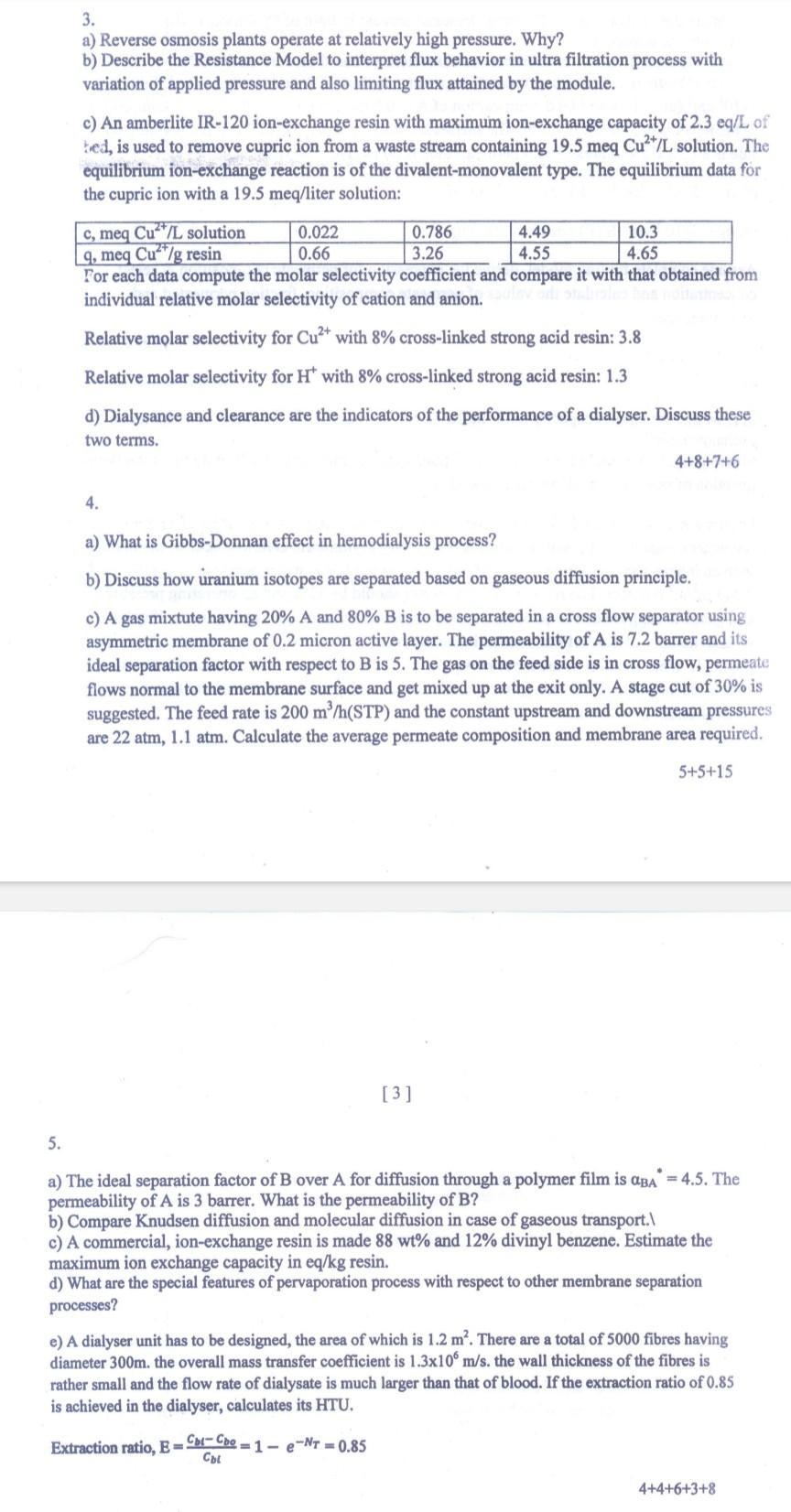
Please answer all the above questions correctly providing necessary formulae, equations, expressions, diagrams, charts, graphs, plots and tables.
3. a) Reverse osmosis plants operate at relatively high pressure. Why? b) Describe the Resistance Model to interpret flux behavior in ultra filtration process with variation of applied pressure and also limiting flux attained by the module. c) An amberlite IR-120 ion-exchange resin with maximum ion-exchange capacity of 2.3eq/L of equilibrium ion-exchange reaction is of the divalent-monovalent type. The equilibrium data for the cupric ion with a 19.5 meq/liter solution: For each data compute the molar selectivity coefficient and compare it with that obtained from individual relative molar selectivity of cation and anion. Relative molar selectivity for Cu2+ with 8% cross-linked strong acid resin: 3.8 Relative molar selectivity for H+with 8% cross-linked strong acid resin: 1.3 d) Dialysance and clearance are the indicators of the performance of a dialyser. Discuss these two terms. 4+8+7+6 4. a) What is Gibbs-Donnan effect in hemodialysis process? b) Discuss how uranium isotopes are separated based on gaseous diffusion principle. c) A gas mixtute having 20%A and 80%B is to be separated in a cross flow separator using asymmetric membrane of 0.2 micron active layer. The permeability of A is 7.2 barrer and its ideal separation factor with respect to B is 5 . The gas on the feed side is in cross flow, permeate flows normal to the membrane surface and get mixed up at the exit only. A stage cut of 30% is suggested. The feed rate is 200m3/h(STP) and the constant upstream and downstream pressures are 22atm,1.1atm. Calculate the average permeate composition and membrane area required. 5+5+15 [3] 5. a) The ideal separation factor of B over A for diffusion through a polymer film is BA=4.5. The permeability of A is 3 barrer. What is the permeability of B ? b) Compare Knudsen diffusion and molecular diffusion in case of gaseous transport.I c) A commercial, ion-exchange resin is made 88wt% and 12% divinyl benzene. Estimate the maximum ion exchange capacity in eq/kg resin. d) What are the special features of pervaporation process with respect to other membrane separation processes? e) A dialyser unit has to be designed, the area of which is 1.2m2. There are a total of 5000 fibres having diameter 300m. the overall mass transfer coefficient is 1.3106m/s. the wall thickness of the fibres is rather small and the flow rate of dialysate is much larger than that of blood. If the extraction ratio of 0.85 is achieved in the dialyser, calculates its HTU. Extraction ratio, E=CblCBUCbb=1eNT=0.85 3. a) Reverse osmosis plants operate at relatively high pressure. Why? b) Describe the Resistance Model to interpret flux behavior in ultra filtration process with variation of applied pressure and also limiting flux attained by the module. c) An amberlite IR-120 ion-exchange resin with maximum ion-exchange capacity of 2.3eq/L of equilibrium ion-exchange reaction is of the divalent-monovalent type. The equilibrium data for the cupric ion with a 19.5 meq/liter solution: For each data compute the molar selectivity coefficient and compare it with that obtained from individual relative molar selectivity of cation and anion. Relative molar selectivity for Cu2+ with 8% cross-linked strong acid resin: 3.8 Relative molar selectivity for H+with 8% cross-linked strong acid resin: 1.3 d) Dialysance and clearance are the indicators of the performance of a dialyser. Discuss these two terms. 4+8+7+6 4. a) What is Gibbs-Donnan effect in hemodialysis process? b) Discuss how uranium isotopes are separated based on gaseous diffusion principle. c) A gas mixtute having 20%A and 80%B is to be separated in a cross flow separator using asymmetric membrane of 0.2 micron active layer. The permeability of A is 7.2 barrer and its ideal separation factor with respect to B is 5 . The gas on the feed side is in cross flow, permeate flows normal to the membrane surface and get mixed up at the exit only. A stage cut of 30% is suggested. The feed rate is 200m3/h(STP) and the constant upstream and downstream pressures are 22atm,1.1atm. Calculate the average permeate composition and membrane area required. 5+5+15 [3] 5. a) The ideal separation factor of B over A for diffusion through a polymer film is BA=4.5. The permeability of A is 3 barrer. What is the permeability of B ? b) Compare Knudsen diffusion and molecular diffusion in case of gaseous transport.I c) A commercial, ion-exchange resin is made 88wt% and 12% divinyl benzene. Estimate the maximum ion exchange capacity in eq/kg resin. d) What are the special features of pervaporation process with respect to other membrane separation processes? e) A dialyser unit has to be designed, the area of which is 1.2m2. There are a total of 5000 fibres having diameter 300m. the overall mass transfer coefficient is 1.3106m/s. the wall thickness of the fibres is rather small and the flow rate of dialysate is much larger than that of blood. If the extraction ratio of 0.85 is achieved in the dialyser, calculates its HTU. Extraction ratio, E=CblCBUCbb=1eNT=0.85
Step by Step Solution
There are 3 Steps involved in it

Get step-by-step solutions from verified subject matter experts