Question: please answer each question with one and half paragraph minimum. be the gift of choice, and it also sought to make diamond jewelry culturally desirable
please answer each question with one and half paragraph minimum.
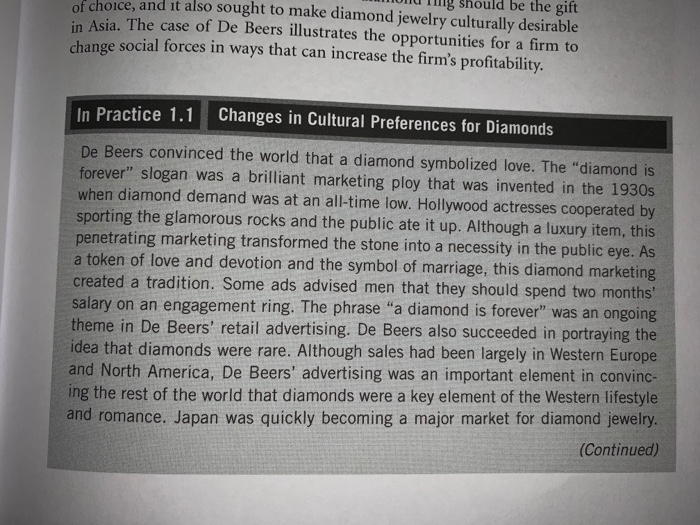
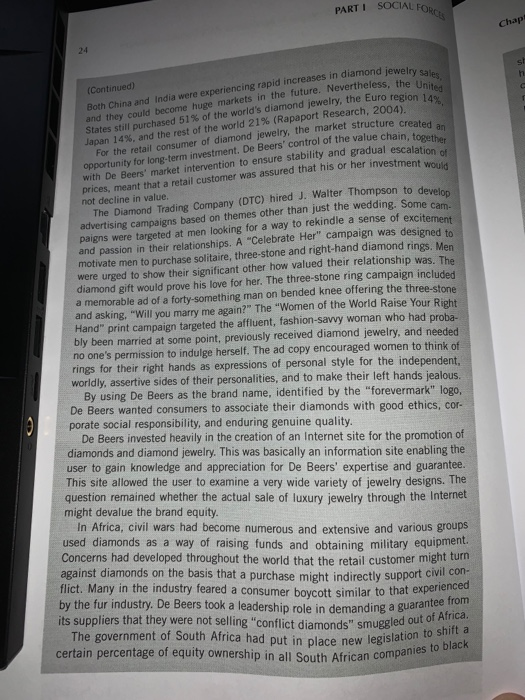
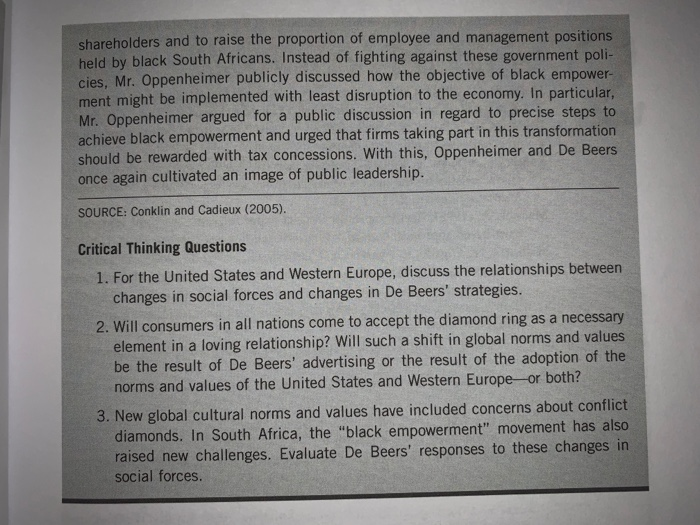
be the gift of choice, and it also sought to make diamond jewelry culturally desirable in Asia. The case of De Beers illustrates the opportunities for a firm to change social forces in ways that can increase the firm's profitability. In Practice 1.1 Changes in Cultural Preferences for Diamonds De Beers convinced the world that a diamond symbolized love. The "diamond is forever" slogan was a brilliant marketing ploy that was invented in the 1930s when diamond demand was at an all-time low. Hollywood actresses cooperated by sporting the glamorous rocks and the public ate it up. Although a luxury item, this penetrating marketing transformed the stone into a necessity in the public eye. As a token of love and devotion and the symbol of marriage, this diamond marketing created a tradition. Some ads advised men that they should spend two months' salary on an engagement ring. The phrase "a diamond is forever" was an ongoing theme in De Beers' retail advertising. De Beers also succeeded in portraying the idea that diamonds were rare. Although sales had been largely in Western Europe and North America, De Beers' advertising was an important element in convinc- ing the rest of the world that diamonds were a key element of the Western lifestyle and romance. Japan was quickly becoming a major market for diamond jewelry. (Continued) Both China and India were experiencing rapid increases in diamond jewelry sales States still purchased 51% of the world's diamond jewelry, the Euro region 14%, and they could become huge markets in the future. Nevertheless, the United For the retail consumer of diamond jewelry, the market structure created an opportunity for long-term investment. De Beers' control of the value chain, together with De Beers' market intervention to ensure stability and gradual escalation of The Diamond Trading Company (DTC) hired J. Walter Thompson to develop PARTI SOCIAL FORCES Chap 24 (Continued) Japan 14%, and the rest of the world 21% (Rapaport Research, 2004), prices, meant that a retail customer was assured that his or her investment wouls certain percentage of equity ownership in all South African companies to black advertising campaigns based on themes other than just the wedding. Some cam paigns were targeted at men looking for a way to rekindle a sense of excitement and passion in their relationships. A "Celebrate Her" campaign was designed to motivate men to purchase solitaire, three-stone and right-hand diamond rings. Men were urged to show their significant other how valued their relationship was. The diamond gift would prove his love for her. The three-stone ring campaign included a memorable ad of a forty-something man on bended knee offering the three-stone and asking. "Will you marry me again?" The "Women of the World Raise Your Right Hand" print campaign targeted the affluent, fashion-savvy woman who had proba- bly been married at some point, previously received diamond jewelry, and needed no one's permission to indulge herself. The ad copy encouraged women to think of rings for their right hands as expressions of personal style for the independent, worldly, assertive sides of their personalities, and to make their left hands jealous. By using De Beers as the brand name, identified by the "forevermark" logo. De Beers wanted consumers to associate their diamonds with good ethics, cor- 0 porate social responsibility, and enduring genuine quality. De Beers invested heavily in the creation of an Internet site for the promotion of diamonds and diamond jewelry. This was basically an information site enabling the user to gain knowledge and appreciation for De Beers' expertise and guarantee. This site allowed the user to examine a very wide variety of jewelry designs. The question remained whether the actual sale of luxury jewelry through the Internet might devalue the brand equity. In Africa, civil wars had become numerous and extensive and various groups used diamonds as a way of raising funds and obtaining military equipment. Concerns had developed throughout the world that the retail customer might turn against diamonds on the basis that a purchase might indirectly support civil con flict. Many in the industry feared a consumer boycott similar to that experienced its suppliers that they were not selling "conflict diamonds" smuggled out of Africa, by the fur industry. De Beers took a leadership role in demanding a guarantee from The government of South Africa had put in place new legislation to black shareholders and to raise the proportion of employee and management positions held by black South Africans. Instead of fighting against these government poli- cies, Mr. Oppenheimer publicly discussed how the objective of black empower- ment might be implemented with least disruption to the economy. In particular, Mr. Oppenheimer argued for a public discussion in regard to precise steps to achieve black empowerment and urged that firms taking part in this transformation should be rewarded with tax concessions. With this, Oppenheimer and De Beers once again cultivated an image of public leadership. SOURCE: Conklin and Cadieux (2005). Critical Thinking Questions 1. For the United States and Western Europe, discuss the relationships between changes in social forces and changes in De Beers' strategies. 2. Will consumers in all nations come to accept the diamond ring as a necessary element in a loving relationship? Will such a shift in global norms and values be the result of De Beers' advertising or the result of the adoption of the norms and values of the United States and Western Europe or both? 3. New global cultural norms and values have included concerns about conflict diamonds. In South Africa, the "black empowerment" movement has also raised new challenges. Evaluate De Beers' responses to these changes in social forces









 Study Help