







Question: Please, answer in python. Debyes theory of solids gives the heat capacity of a solid at temperature T to be , where V is the
Please, answer in python.
Debyes theory of solids gives the heat capacity of a solid at temperature T to be
 ,
,
where V is the volume of the solid, is the number density of atoms, kB is Boltzmanns con- stant, and D is the so-called Debye temperature, a property of solids that depends on their density and speed of sound.
a) Write a Python function cv(T) that calculates CV for a given value of the temperature, for a sample consisting of 1000 cubic centimeters of solid aluminum, which has a number density of = 6.022 1028 m3 and a Debye temperature of D = 428 K. Use Gaussian quadrature to evaluate the integral, with N = 50 sample points
b) Use your function to make a graph of the heat capacity as a function of temperature from T = 5 K to T = 500 K.
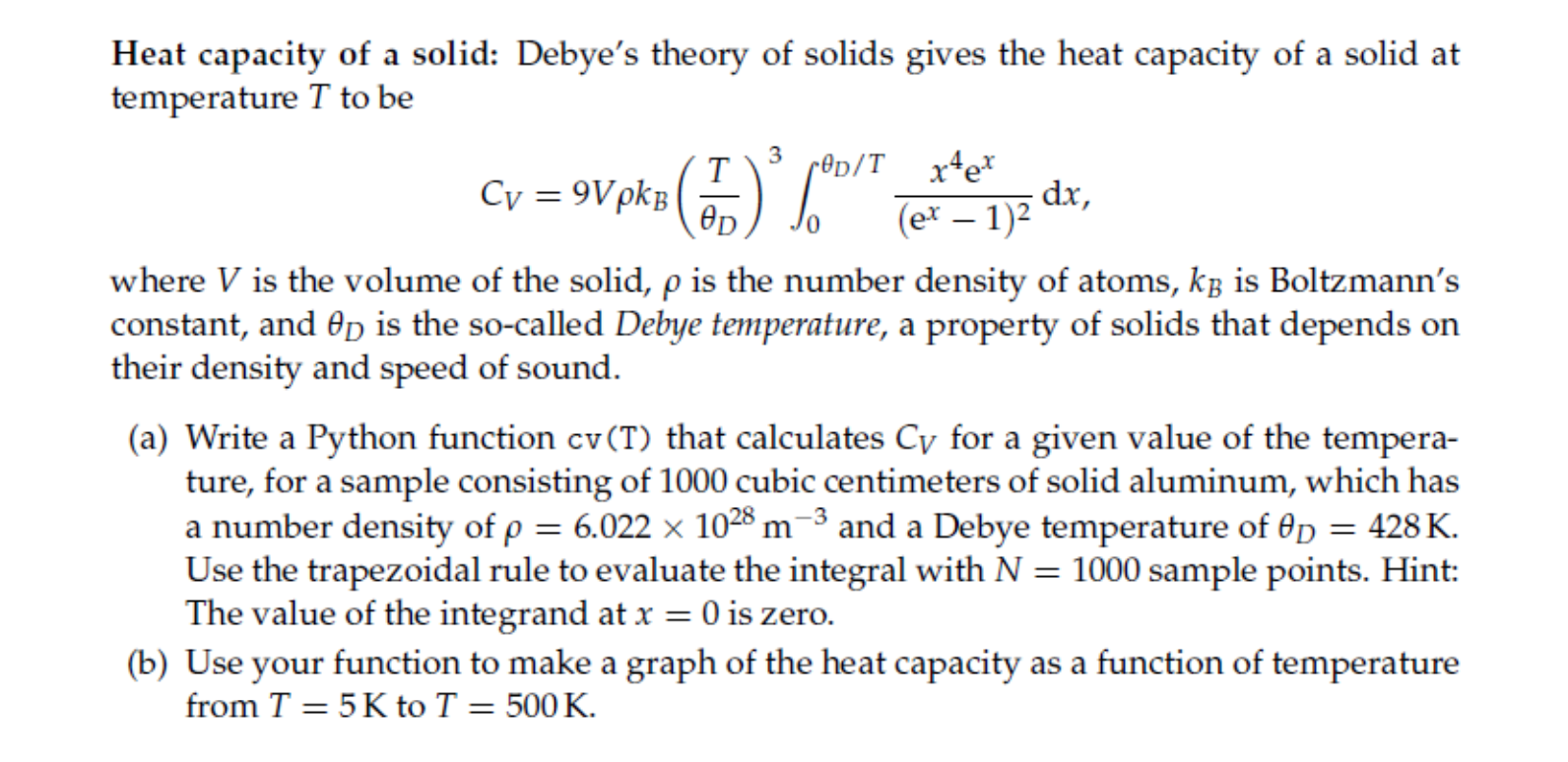
Heat capacity of a solid: Debye's theory of solids gives the heat capacity of a solid at temperature T to be T pop/T x4e? Cy = 9Vpkb dx, Op (er 1)2 where V is the volume of the solid, p is the number density of atoms, kp is Boltzmann's constant, and ep is the so-called Debye temperature, a property of solids that depends on their density and speed of sound. (a) Write a Python function cv(T) that calculates Cy for a given value of the tempera- ture, for a sample consisting of 1000 cubic centimeters of solid aluminum, which has a number density of p = 6.022 x 1028 m-3 and a Debye temperature of Op = 428 K. Use the trapezoidal rule to evaluate the integral with N = 1000 sample points. Hint: The value of the integrand at x = 0 is zero. (b) Use your function to make a graph of the heat capacity as a function of temperature from T = 5K to T = 500 K
Step by Step Solution
There are 3 Steps involved in it

Get step-by-step solutions from verified subject matter experts
 Study Help