



Question: Please answer Q1 and Q4 only with 80-100 words per each. Do not copy and paste the existing answers on Chegg Groupe Danone, based in
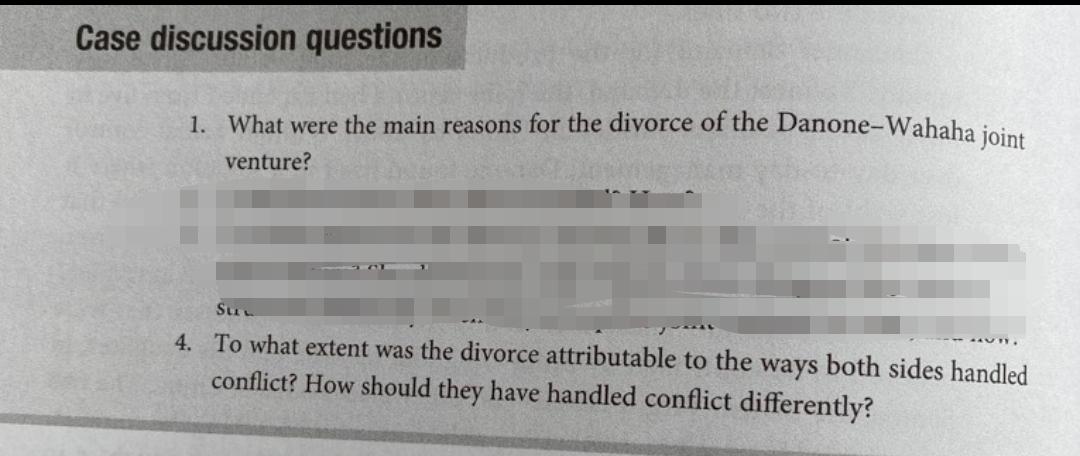 Please answer Q1 and Q4 only with 80-100 words per each.
Do not copy and paste the existing answers on Chegg
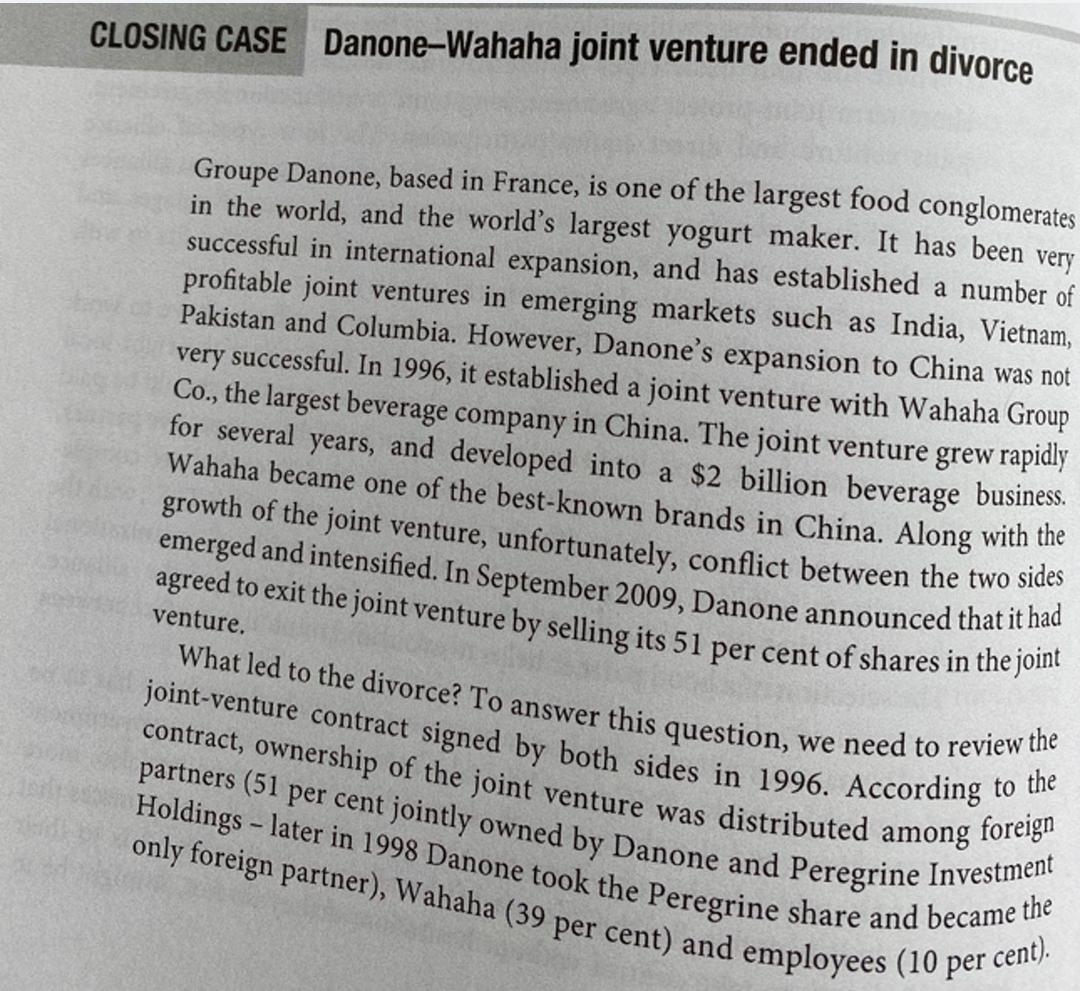
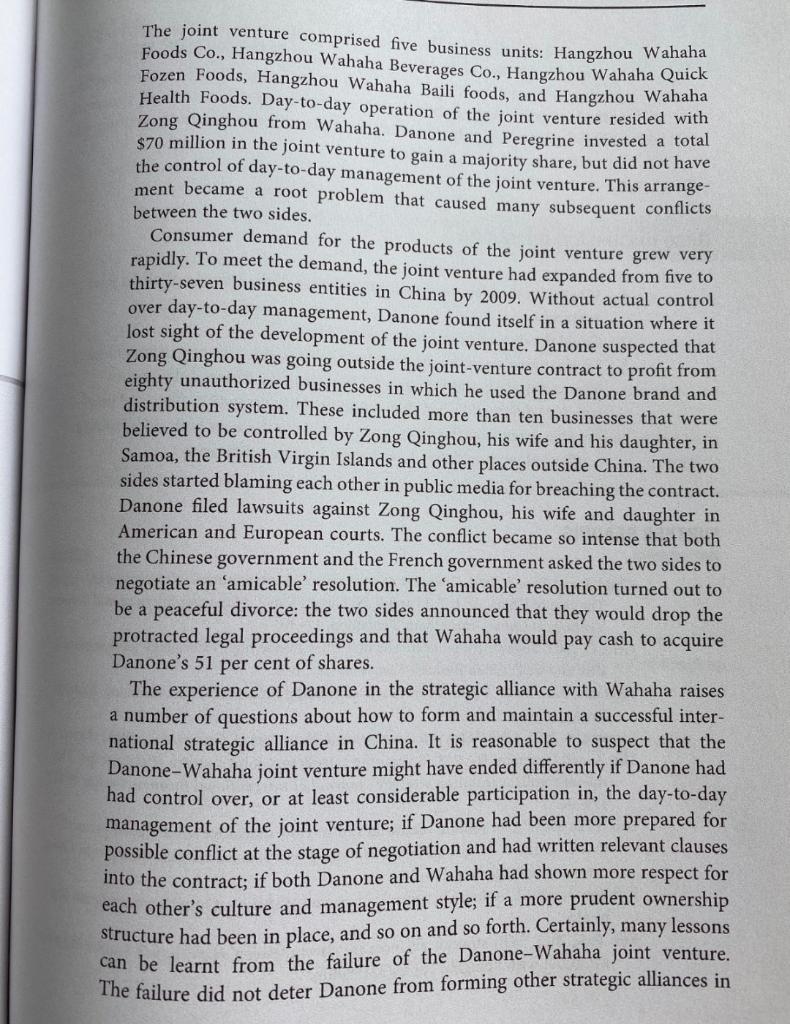
Groupe Danone, based in France, is one of the largest food conglomerates in the world, and the world's largest yogurt maker. It has been very successful in international expansion, and has established a number of profitable joint ventures in emerging markets such as India, Vietnam, Pakistan and Columbia. However, Danone's expansion to China was not very successful. In 1996, it established a joint venture with Wahaha Group Co., the largest beverage company in China. The joint venture grew rapidly for several years, and developed into a $2 billion beverage business. Wahaha became one of the best-known brands in China. Along with the growth of the joint venture, unfortunately, conflict between the two sides emerged and intensified. In September 2009, Danone announced that it had agreed to exit the joint venture by selling its 51 per cent of shares in the joint venture. What led to the divorce? To answer this question, we need to review the joint-venture contract signed by both sides in 1996. According to the contract, ownership of the joint venture was distributed among foreign partners (51 per cent jointly owned by Danone and Peregrine Investment Holdings - later in 1998 Danone took the Peregrine share and became the only foreign partner), Wahaha ( 39 per cent) and emplovees ( 10 per cent). The joint venture comprised five business units: Hangzhou Wahaha Foods Co., Hangzhou Wahaha Beverages Co., Hangzhou Wahaha Quick Fozen Foods, Hangzhou Wahaha Baili foods, and Hangzhou Wahaha Health Foods. Day-to-day operation of the joint venture resided with Zong Qinghou from Wahaha. Danone and Peregrine invested a total $70 million in the joint venture to gain a majority share, but did not have the control of day-to-day management of the joint venture. This arrangement became a root problem that caused many subsequent conflicts between the two sides. Consumer demand for the products of the joint venture grew very rapidly. To meet the demand, the joint venture had expanded from five to thirty-seven business entities in China by 2009 . Without actual control over day-to-day management, Danone found itself in a situation where it lost sight of the development of the joint venture. Danone suspected that Zong Qinghou was going outside the joint-venture contract to profit from eighty unauthorized businesses in which he used the Danone brand and distribution system. These included more than ten businesses that were believed to be controlled by Zong Qinghou, his wife and his daughter, in Samoa, the British Virgin Islands and other places outside China. The two sides started blaming each other in public media for breaching the contract. Danone filed lawsuits against Zong Qinghou, his wife and daughter in American and European courts. The conflict became so intense that both the Chinese government and the French government asked the two sides to negotiate an 'amicable' resolution. The 'amicable' resolution turned out to be a peaceful divorce: the two sides announced that they would drop the protracted legal proceedings and that Wahaha would pay cash to acquire Danone's 51 per cent of shares. The experience of Danone in the strategic alliance with Wahaha raises a number of questions about how to form and maintain a successful international strategic alliance in China. It is reasonable to suspect that the Danone-Wahaha joint venture might have ended differently if Danone had had control over, or at least considerable participation in, the day-to-day management of the joint venture; if Danone had been more prepared for possible conflict at the stage of negotiation and had written relevant clauses into the contract; if both Danone and Wahaha had shown more respect for each other's culture and management style; if a more prudent ownership structure had been in place, and so on and so forth. Certainly, many lessons can be learnt from the failure of the Danone-Wahaha joint venture. The failure did not deter Danone from forming other strategic alliances in Case discussion questions 1. What were the main reasons for the divorce of the Danone-Wahaha joint venture? 4. To what extent was the divorce attributable to the ways both sides handled conflict? How should they have handled conflict differently
Step by Step Solution
There are 3 Steps involved in it

Get step-by-step solutions from verified subject matter experts