







Question: Please answer questions for Dirty Pools Case Study. 4 , GIven the concerns raised in the case regarding various infractions, what do pool operators and
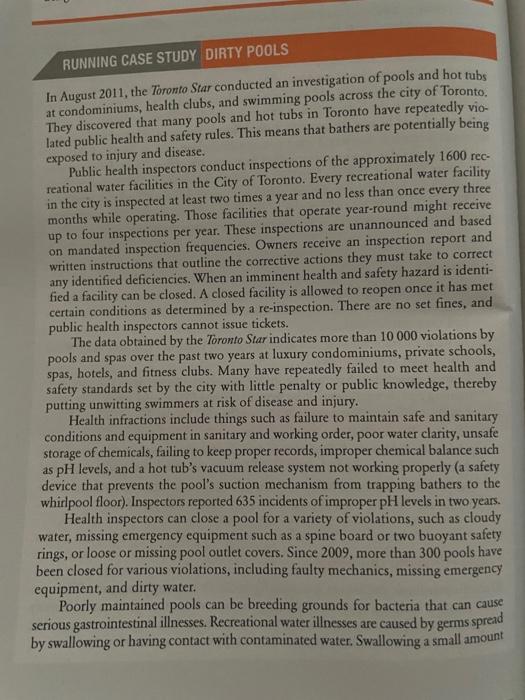
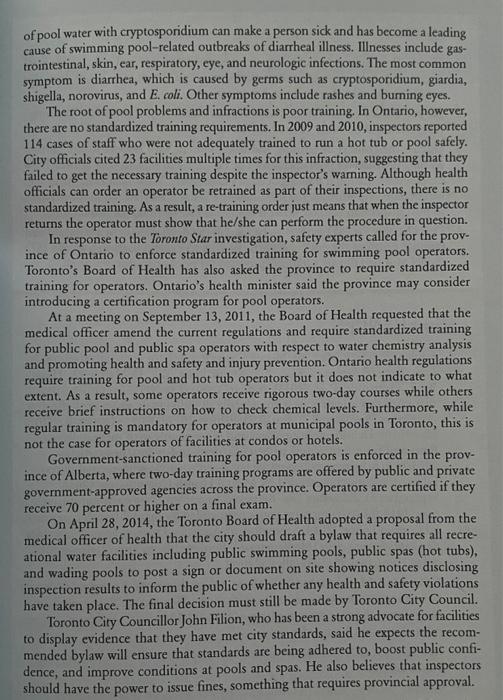
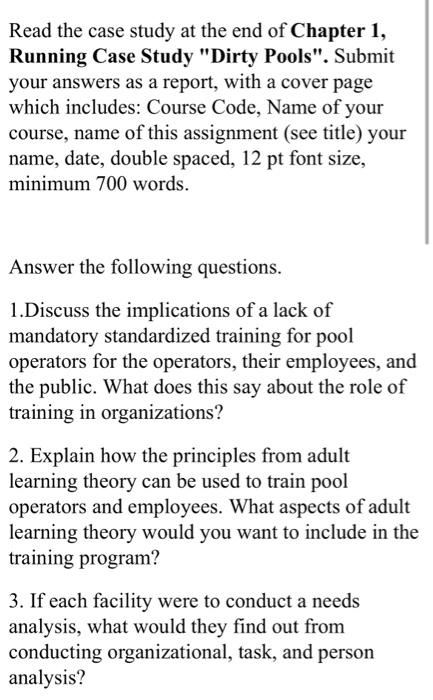
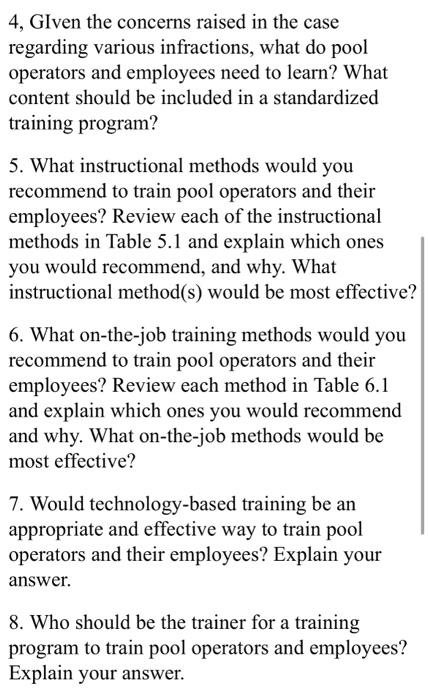
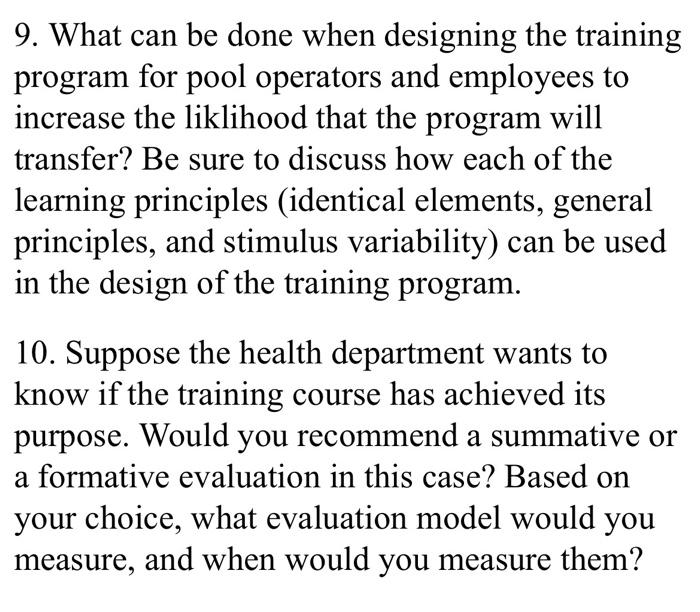
4 , GIven the concerns raised in the case regarding various infractions, what do pool operators and employees need to learn? What content should be included in a standardized training program? 5. What instructional methods would you recommend to train pool operators and their employees? Review each of the instructional methods in Table 5.1 and explain which ones you would recommend, and why. What instructional method(s) would be most effective? 6. What on-the-job training methods would you recommend to train pool operators and their employees? Review each method in Table 6.1 and explain which ones you would recommend and why. What on-the-job methods would be most effective? 7. Would technology-based training be an appropriate and effective way to train pool operators and their employees? Explain your answer. 8. Who should be the trainer for a training program to train pool operators and employees? Explain your answer. In August 2011, the Toronto Star conducted an investigation of pools and hot tubs at condominiums, health clubs, and swimming pools across the city of Toronto. They discovered that many pools and hot tubs in Toronto have repeatedly violated public health and safety rules. This means that bathers are potentially being exposed to injury and disease. Public health inspectors conduct inspections of the approximately 1600rec reational water facilities in the City of Toronto. Every recreational water facility in the city is inspected at least two times a year and no less than once every three months while operating. Those facilities that operate year-round might receive up to four inspections per year. These inspections are unannounced and based on mandated inspection frequencies. Owners receive an inspection report and written instructions that outline the corrective actions they must take to correct any identified deficiencies. When an imminent health and safety hazard is identified a facility can be closed. A closed facility is allowed to reopen once it has met certain conditions as determined by a re-inspection. There are no set fines, and public health inspectors cannot issue tickets. The data obtained by the Toronto Star indicates more than 10000 violations by pools and spas over the past two years at luxury condominiums, private schools, spas, hotels, and fitness clubs. Many have repeatedly failed to meet health and safety standards set by the city with little penalty or public knowledge, thereby putting unwitting swimmers at risk of disease and injury. Health infractions include things such as failure to maintain safe and sanitary conditions and equipment in sanitary and working order, poor water clarity, unsafe storage of chemicals, failing to keep proper records, improper chemical balance such as pH levels, and a hot tub's vacuum release system not working properly (a safety device that prevents the pool's suction mechanism from trapping bathers to the whirpool floor). Inspectors reported 635 incidents of improper pH levels in two years. Health inspectors can close a pool for a variety of violations, such as cloudy water, missing emergency equipment such as a spine board or two buoyant safety rings, or loose or missing pool outlet covers. Since 2009 , more than 300 pools have been closed for various violations, including faulty mechanics, missing emergency equipment, and dirty water. Poorly maintained pools can be breeding grounds for bacteria that can cause serious gastrointestinal illnesses. Recreational water illnesses are caused by germs sprend by swallowing or having contact with contaminated water. Swallowing a small amount 9. What can be done when designing the training program for pool operators and employees to increase the liklihood that the program will transfer? Be sure to discuss how each of the learning principles (identical elements, general principles, and stimulus variability) can be used in the design of the training program. 10. Suppose the health department wants to know if the training course has achieved its purpose. Would you recommend a summative or a formative evaluation in this case? Based on your choice, what evaluation model would you measure, and when would you measure them? Read the case study at the end of Chapter 1, Running Case Study "Dirty Pools". Submit your answers as a report, with a cover page which includes: Course Code, Name of your course, name of this assignment (see title) your name, date, double spaced, 12pt font size, minimum 700 words. Answer the following questions. 1.Discuss the implications of a lack of mandatory standardized training for pool operators for the operators, their employees, and the public. What does this say about the role of training in organizations? 2. Explain how the principles from adult learning theory can be used to train pool operators and employees. What aspects of adult learning theory would you want to include in the training program? 3. If each facility were to conduct a needs analysis, what would they find out from conducting organizational, task, and person analysis? of pool water with cryptosporidium can make a person sick and has become a leading cause of swimming pool-related outbreaks of diarrheal illness. Illnesses include gastrointestinal, skin, ear, respiratory, eye, and neurologic infections. The most common symptom is diarrhea, which is caused by germs such as cryptosporidium, giardia, shigella, norovirus, and E. coli. Other symptoms include rashes and burning eyes. The root of pool problems and infractions is poor training. In Ontario, however, there are no standardized training requirements. In 2009 and 2010 , inspectors reported 114 cases of staff who were not adequately trained to run a hot tub or pool safely. City officials cited 23 facilities multiple times for this infraction, suggesting that they failed to get the necessary training despite the inspector's warning. Although health officials can order an operator be retrained as part of their inspections, there is no standardized training. As a result, a re-training order just means that when the inspector returns the operator must show that he/she can perform the procedure in question. In response to the Toronto Star investigation, safety experts called for the province of Ontario to enforce standardized training for swimming pool operators. Toronto's Board of Health has also asked the province to require standardized training for operators. Ontario's health minister said the province may consider introducing a certification program for pool operators. At a meeting on September 13,2011, the Board of Health requested that the medical officer amend the current regulations and require standardized training for public pool and public spa operators with respect to water chemistry analysis and promoting health and safety and injury prevention. Ontario health regulations require training for pool and hot tub operators but it does not indicate to what extent. As a result, some operators receive rigorous two-day courses while others receive brief instructions on how to check chemical levels. Furthermore, while regular training is mandatory for operators at municipal pools in Toronto, this is not the case for operators of facilities at condos or hotels. Government-sanctioned training for pool operators is enforced in the province of Alberta, where two-day training programs are offered by public and private government-approved agencies across the province. Operators are certified if they receive 70 percent or higher on a final exam. On April 28,2014, the Toronto Board of Health adopted a proposal from the medical officer of health that the city should draft a bylaw that requires all recreational water facilities including public swimming pools, public spas (hot tubs), and wading pools to post a sign or document on site showing notices disclosing inspection results to inform the public of whether any health and safety violations have taken place. The final decision must still be made by Toronto City Council. Toronto City Councillor John Filion, who has been a strong advocate for facilities to display evidence that they have met city standards, said he expects the recommended bylaw will ensure that standards are being adhered to, boost public confidence, and improve conditions at pools and spas. He also believes that inspectors should have the power to issue fines, something that requires provincial approval
Step by Step Solution
There are 3 Steps involved in it

Get step-by-step solutions from verified subject matter experts
 Study Help