







Question: PLEASE ANSWER THE ENTIRE QUESTION. It is not helpful if you only answer part of it! 5. Option pricing - Single-period binomial approach The value
PLEASE ANSWER THE ENTIRE QUESTION. It is not helpful if you only answer part of it! 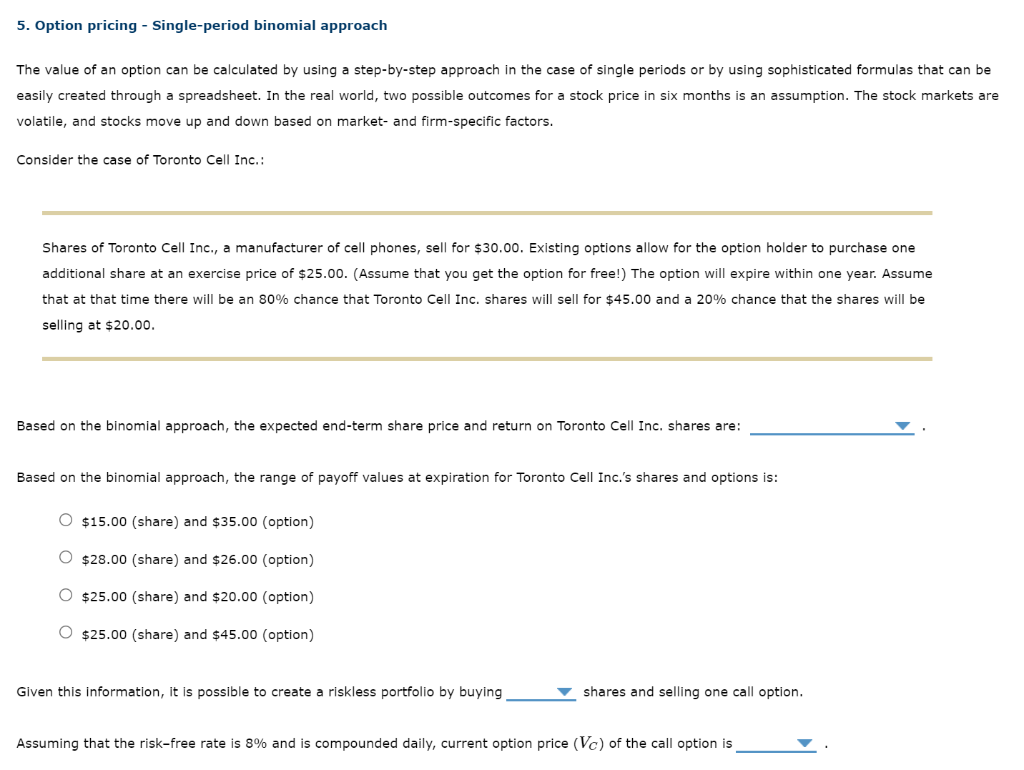
5. Option pricing - Single-period binomial approach The value of an option can be calculated by using a step-by-step approach in the case of single periods or by using sophisticated formulas that can be easily created through a spreadsheet. In the real world, two possible outcomes for a stock price in six months is an assumption. The stock markets are volatile, and stocks move up and down based on market- and firm-specific factors. Consider the case of Toronto Cell Inc.: Shares of Toronto Cell Inc., a manufacturer of cell phones, sell for $30.00. Existing options allow for the option holder to purchase one additional share at an exercise price of $25.00. (Assume that you get the option for free!) The option will expire within one year. Assume that at that time there will be an 80% chance that Toronto Cell Inc. shares will sell for $45.00 and a 20% chance that the shares will be selling at $20.00. Based on the binomial approach, the expected end-term share price and return on Toronto Cell Inc. shares are: Based on the binomial approach, the range of payoff values at expiration for Toronto Cell Inc.'s shares and options is: O $15.00 (share) and $35.00 (option) $28.00 (share) and $26.00 (option) O $25.00 (share) and $20.00 (option) O $25.00 (share) and $45.00 (option) Given this information, it is possible to create a riskless portfolio by buying shares and selling one call option. Assuming that the risk-free rate is 8% and is compounded daily, current option price (Vc) of the call option is
Step by Step Solution
There are 3 Steps involved in it

Get step-by-step solutions from verified subject matter experts
 Study Help