







Question: Please Answer the following question. The excel file link is the following: https://docs.google.com/spreadsheets/d/1cHqzzTL3-32wk8cvTx_CgZXy-8lSaA-oE2M0Qfc_e20/edit?usp=sharing |||. Time series momentum: risk balanced. For each instrument, first estimate the
Please Answer the following question. The excel file link is the following:
https://docs.google.com/spreadsheets/d/1cHqzzTL3-32wk8cvTx_CgZXy-8lSaA-oE2M0Qfc_e20/edit?usp=sharing
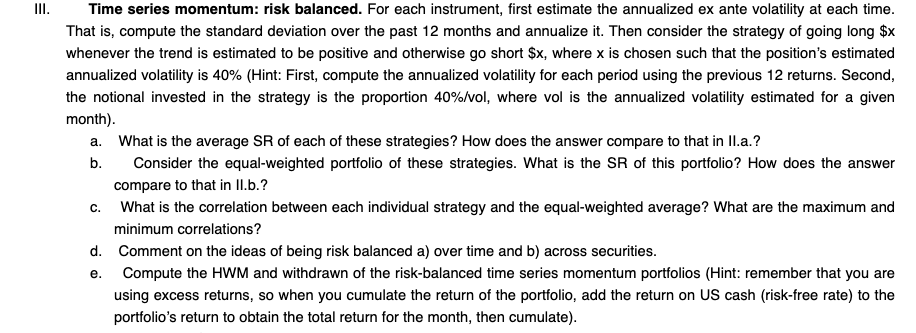
|||. Time series momentum: risk balanced. For each instrument, first estimate the annualized ex ante volatility at each time. That is. compute the standard deviation over the past 12 months and annualize it. Then consider the strategy of going long $3: whenever the trend is estimated to be positive and otherwise go short $x, where x is chosen such that the position's estimated annualized volatility is 40% (Hint: Flrst, compute the annualized volatility for each period using the previous 12 returns. Second, the notional invested in the strategy is the proportion 40%ivol, where vol is the annualized volatility estimated for a given month}. a. What is the average SF! of each of these strategies? How does the answer compare to that in ||.a.? b. Consider the equal-weigth portfolio of these strategies. What is the SR of this pertfolio? How does the answer compare to that in ||.b.'? c. What is the correlation between each individual strategy and the equal-weighted average? What are the maximum and minimum correlations? d. Comment on the ideas of being risk balanced a) over time and b) across securities. e. Compute the HWM and withdrawn of the risk-balanced time series momentum portfolios (Hint: remember that you are using excess returns. so when you cumulate the return of the portfolio, add the return on US cash {risk-free rate] to the portfolio's return to obtain the total retum for the month, then cumulate}
Step by Step Solution
There are 3 Steps involved in it

Get step-by-step solutions from verified subject matter experts
 Study Help