



Question: Please, answer the question of the first image with the information of the other images. 2) In order to create an appropriate ethical environment for
Please, answer the question of the first image with the information of the other images.
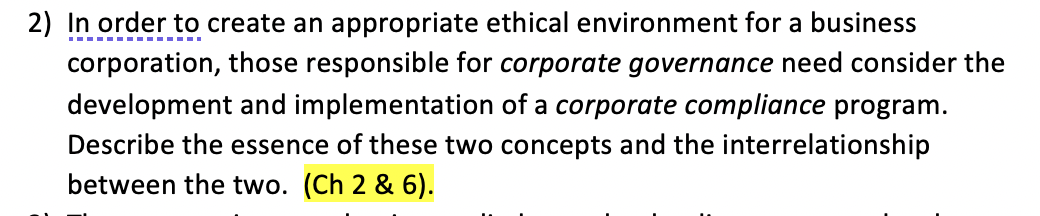
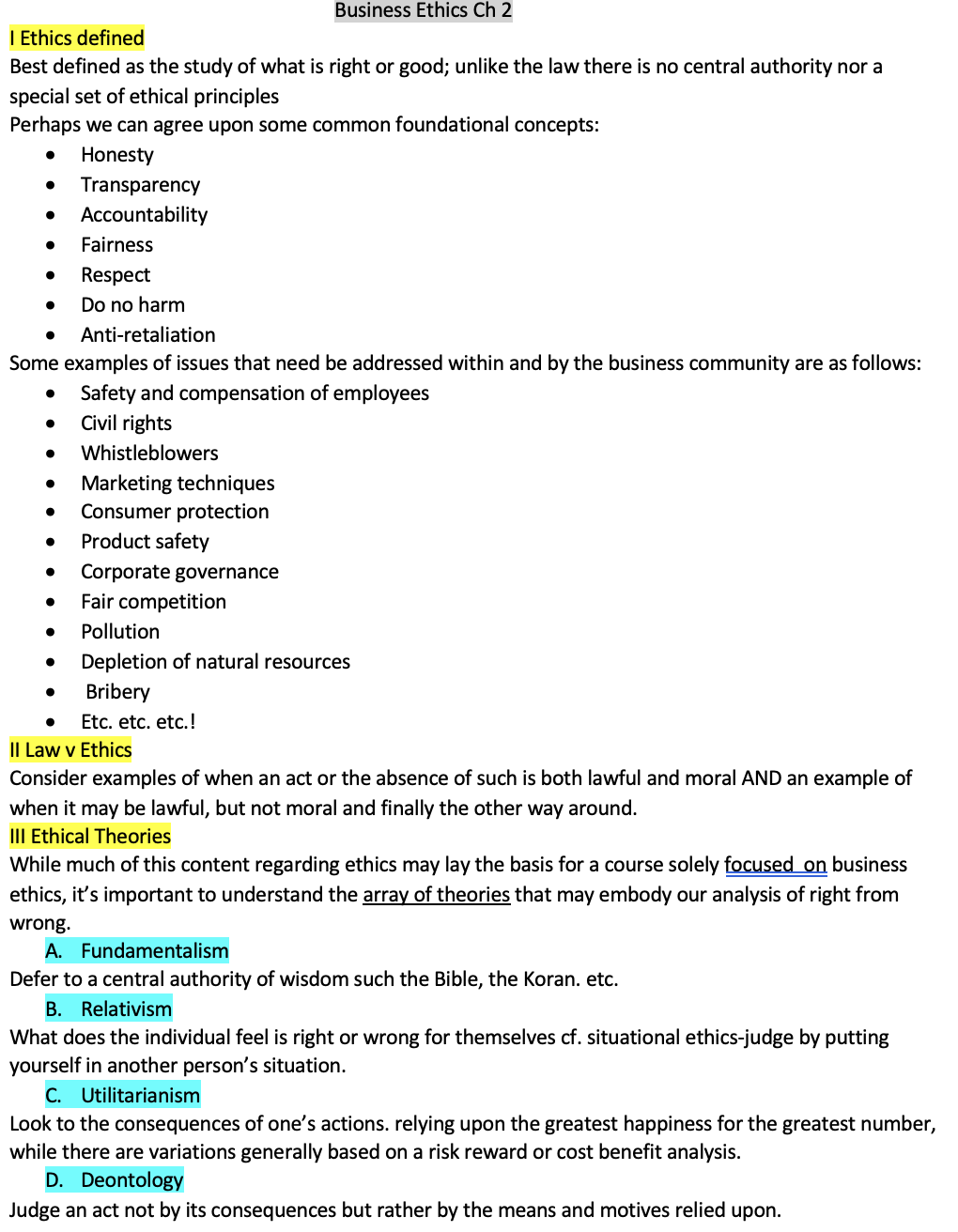
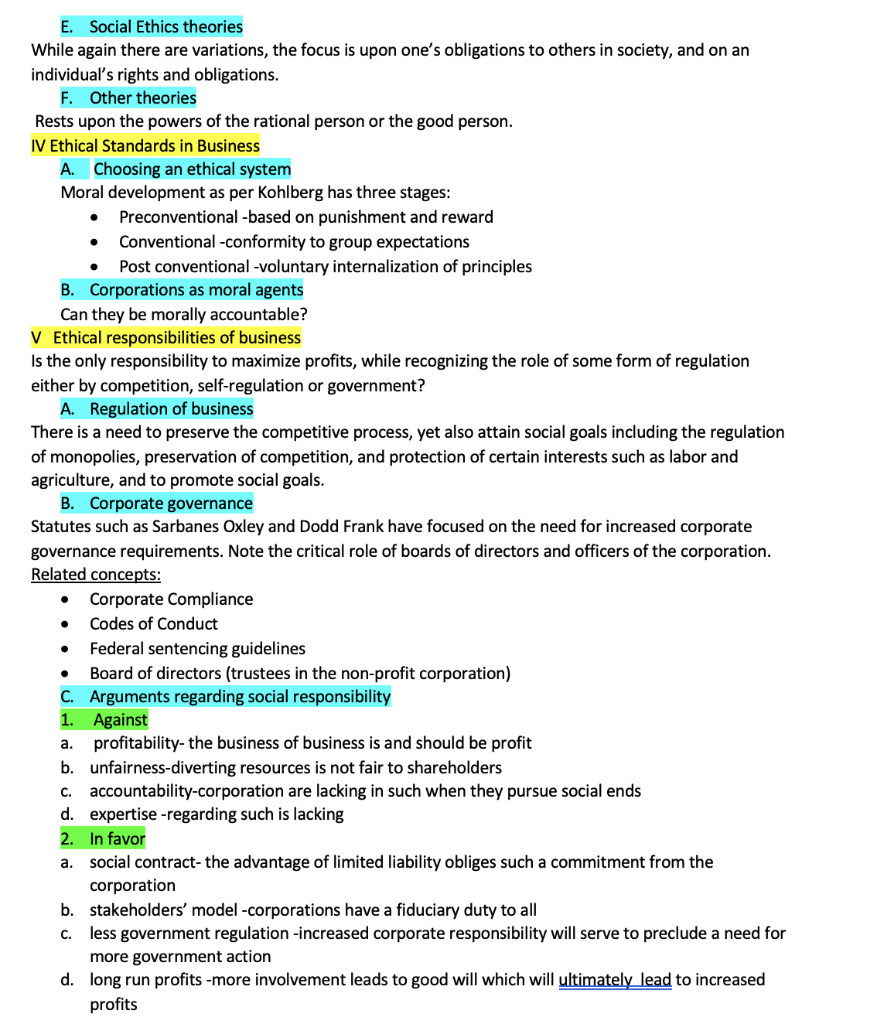
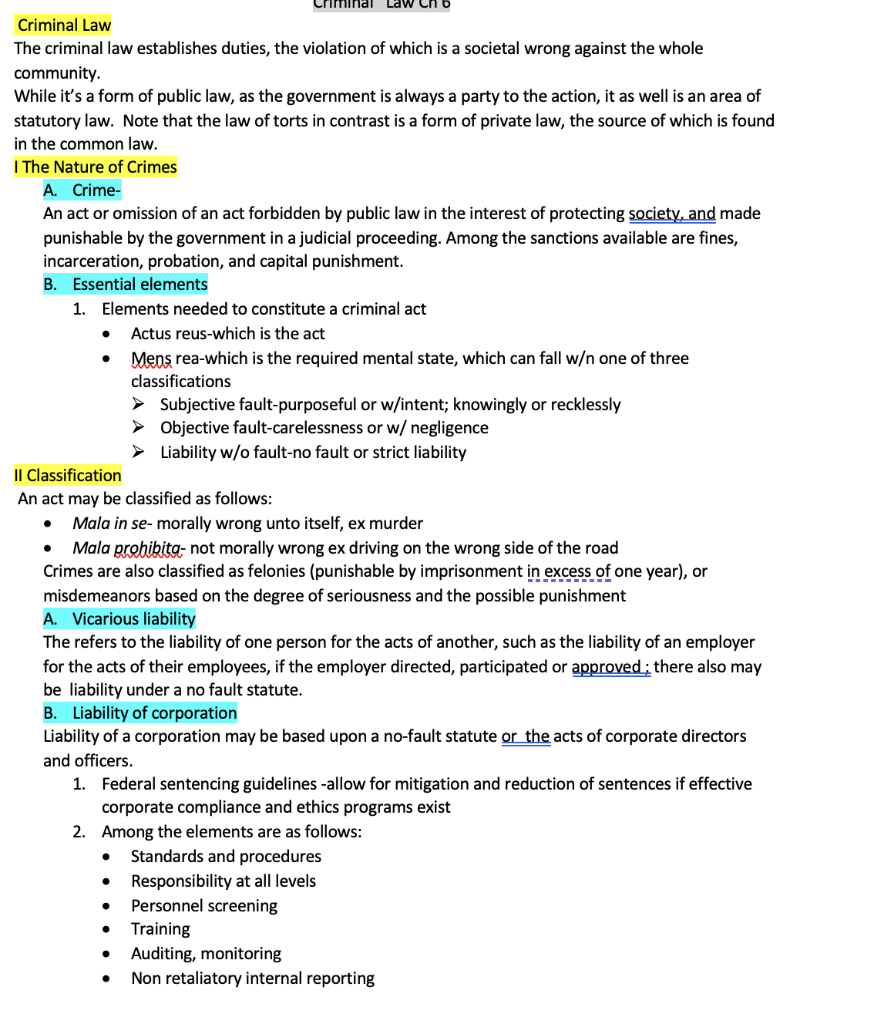
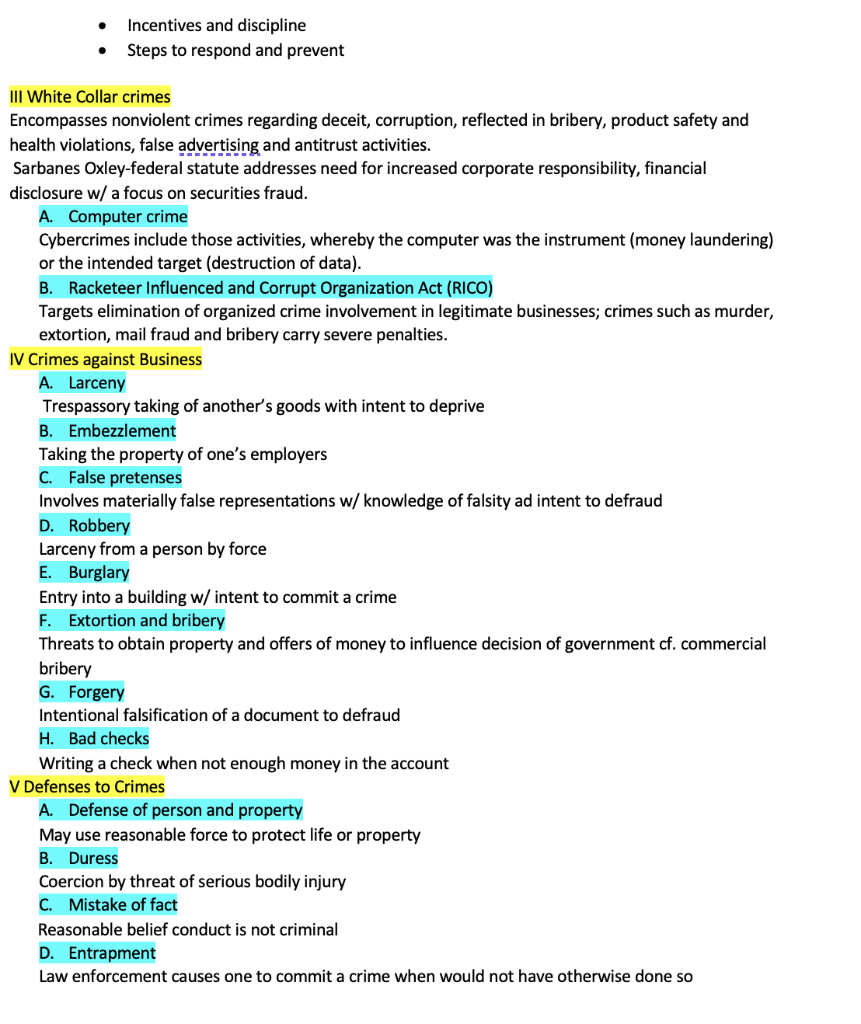
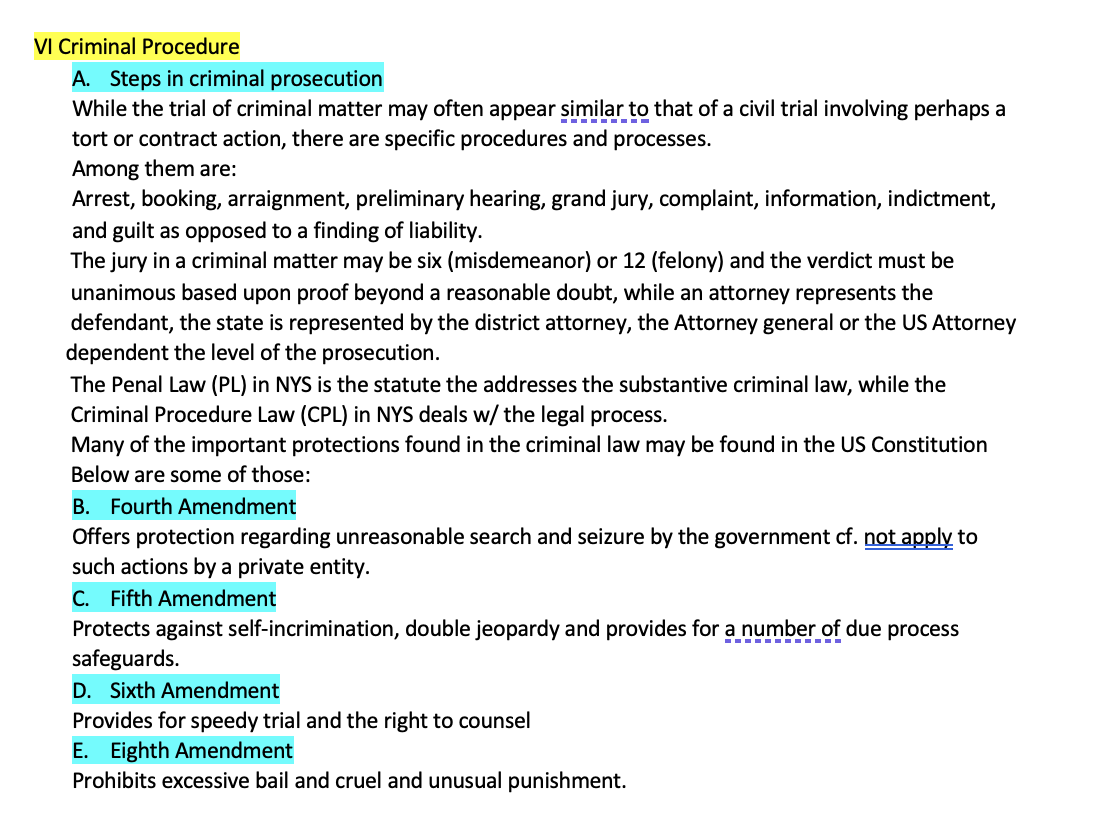
2) In order to create an appropriate ethical environment for a business corporation, those responsible for corporate governance need consider the development and implementation of a corporate compliance program. Describe the essence of these two concepts and the interrelationship between the two. (Ch 2 & 6). Business Ethics Ch 2 I Ethics defined Best defined as the study of what is right or good; unlike the law there is no central authority nor a special set of ethical principles Perhaps we can agree upon some common foundational concepts: Honesty Transparency Accountability Fairness Respect Do no harm Anti-retaliation Some examples of issues that need be addressed within and by the business community are as follows: Safety and compensation of employees Civil rights Whistleblowers Marketing techniques Consumer protection Product safety Corporate governance Fair competition Pollution Depletion of natural resources Bribery Etc. etc. etc.! Il Law v Ethics Consider examples of when an act or the absence of such is both lawful and moral AND an example of when it may be lawful, but not moral and finally the other way around. III Ethical Theories While much of this content regarding ethics may lay the basis for a course solely focused on business ethics, it's important to understand the array of theories that may embody our analysis of right from wrong. A. Fundamentalism Defer to a central authority of wisdom such the Bible, the Koran. etc. B. Relativism What does the individual feel is right or wrong for themselves cf. situational ethics-judge by putting yourself in another person's situation. C. Utilitarianism Look to the consequences of one's actions. relying upon the greatest happiness for the greatest number, while there are variations generally based on a risk reward or cost benefit analysis. D. Deontology Judge an act not by its consequences but rather by the means and motives relied upon. E. Social Ethics theories While again there are variations, the focus is upon one's obligations to others in society, and on an individual's rights and obligations. F. Other theories Rests upon the powers of the rational person or the good person. IV Ethical Standards in Business A. Choosing an ethical system Moral development as per Kohlberg has three stages: Preconventional -based on punishment and reward Conventional -conformity to group expectations Post conventional -voluntary internalization of principles B. Corporations as moral agents Can they be morally accountable? V Ethical responsibilities of business Is the only responsibility to maximize profits, while recognizing the role of some form of regulation either by competition, self-regulation or government? A. Regulation of business There is a need to preserve the competitive process, yet also attain social goals including the regulation of monopolies, preservation of competition, and protection of certain interests such as labor and agriculture, and to promote social goals. B. Corporate governance Statutes such as Sarbanes Oxley and Dodd Frank have focused on the need for increased corporate governance requirements. Note the critical role of boards of directors and officers of the corporation. Related concepts: Corporate Compliance Codes of Conduct Federal sentencing guidelines Board of directors (trustees in the non-profit corporation) C. Arguments regarding social responsibility 1. Against a. profitability- the business of business is and should be profit b. unfairness-diverting resources is not fair to shareholders c. accountability-corporation are lacking in such when they pursue social ends d. expertise -regarding such is lacking 2. In favor a. social contract- the advantage of limited liability obliges such a commitment from the corporation b. stakeholders' model -corporations have a fiduciary duty to all c. less government regulation -increased corporate responsibility will serve to preclude a need for more government action d. long run profits -more involvement leads to good will which will ultimately lead to increased profits riminal Law Ch Criminal Law The criminal law establishes duties, the violation of which is a societal wrong against the whole community. While it's a form of public law, as the government is always a party to the action, it as well is an area of statutory law. Note that the law of torts in contrast is a form of private law, the source of which is found in the common law. I The Nature of Crimes A. Crime- An act or omission of an act forbidden by public law in the interest of protecting society, and made punishable by the government in a judicial proceeding. Among the sanctions available are fines, incarceration, probation, and capital punishment. B. Essential elements 1. Elements needed to constitute a criminal act Actus reus-which is the act Mens rea-which is the required mental state, which can fall w one of three classifications > Subjective fault-purposeful or w/intent; knowingly or recklessly > Objective fault-carelessness or w/ negligence Liability w/o fault-no fault or strict liability II Classification An act may be classified as follows: Mala in se- morally wrong unto itself, ex murder Mala prohibita- not morally wrong ex driving on the wrong side of the road Crimes are also classified as felonies (punishable by imprisonment in excess of one year), or misdemeanors based on the degree of seriousness and the possible punishment A. Vicarious liability The refers to the liability of one person for the acts of another, such as the liability of an employer for the acts of their employees, if the employer directed, participated or approved; there also may be liability under a no fault statute. B. Liability of corporation Liability of a corporation may be based upon a no-fault statute or the acts of corporate directors and officers. 1. Federal sentencing guidelines -allow for mitigation and reduction of sentences if effective corporate compliance and ethics programs exist 2. Among the elements are as follows: Standards and procedures Responsibility at all levels Personnel screening Training Auditing, monitoring Non retaliatory internal reporting Incentives and discipline Steps to respond and prevent III White Collar crimes Encompasses nonviolent crimes regarding deceit, corruption, reflected in bribery, product safety and health violations, false advertising and antitrust activities. Sarbanes Oxley-federal statute addresses need for increased corporate responsibility, financial disclosure w/ a focus on securities fraud. A. Computer crime Cybercrimes include those activities, whereby the computer was the instrument (money laundering) or the intended target (destruction of data). B. Racketeer Influenced and Corrupt Organization Act (RICO) Targets elimination of organized crime involvement in legitimate businesses; crimes such as murder, extortion, mail fraud and bribery carry severe penalties. IV Crimes against Business A. Larceny Trespassory taking of another's goods with intent to deprive B. Embezzlement Taking the property of one's employers C. False pretenses Involves materially false representations w/ knowledge of falsity ad intent to defraud D. Robbery Larceny from a person by force E. Burglary Entry into a building w/ intent to commit a crime F. Extortion and bribery Threats to obtain property and offers of money to influence decision of government cf. commercial bribery G. Forgery Intentional falsification of a document to defraud H. Bad checks Writing a check when not enough money in the account V Defenses to Crimes A. Defense of person and property May use reasonable force to protect life or property B. Duress Coercion by threat of serious bodily injury C. Mistake of fact Reasonable belief conduct is not criminal D. Entrapment Law enforcement causes one to commit a crime when would not have otherwise done so VI Criminal Procedure A. Steps in criminal prosecution While the trial of criminal matter may often appear similar to that of a civil trial involving perhaps a tort or contract action, there are specific procedures and processes. Among them are: Arrest, booking, arraignment, preliminary hearing, grand jury, complaint, information, indictment, and guilt as opposed to a finding of liability. The jury in a criminal matter may be six (misdemeanor) or 12 (felony) and the verdict must be unanimous based upon proof beyond a reasonable doubt, while an attorney represents the defendant, the state is represented by the district attorney, the Attorney general or the US Attorney dependent the level of the prosecution. The Penal Law (PL) in NYS is the statute the addresses the substantive criminal law, while the Criminal Procedure Law (CPL) in NYS deals w/ the legal process. Many of the important protections found in the criminal law may be found in the US Constitution Below are some of those: B. Fourth Amendment Offers protection regarding unreasonable search and seizure by the government cf. not apply to such actions by a private entity. C. Fifth Amendment Protects against self-incrimination, double jeopardy and provides for a number of due process safeguards. D. Sixth Amendment Provides for speedy trial and the right to counsel E. Eighth Amendment Prohibits excessive bail and cruel and unusual punishment
Step by Step Solution
There are 3 Steps involved in it

Get step-by-step solutions from verified subject matter experts