







Question: Please anwser (e) and (g) A random variable X is said to have a generalised Pareto distribution GP(), where 0 > 0, if its cumulative
Please anwser (e) and (g)
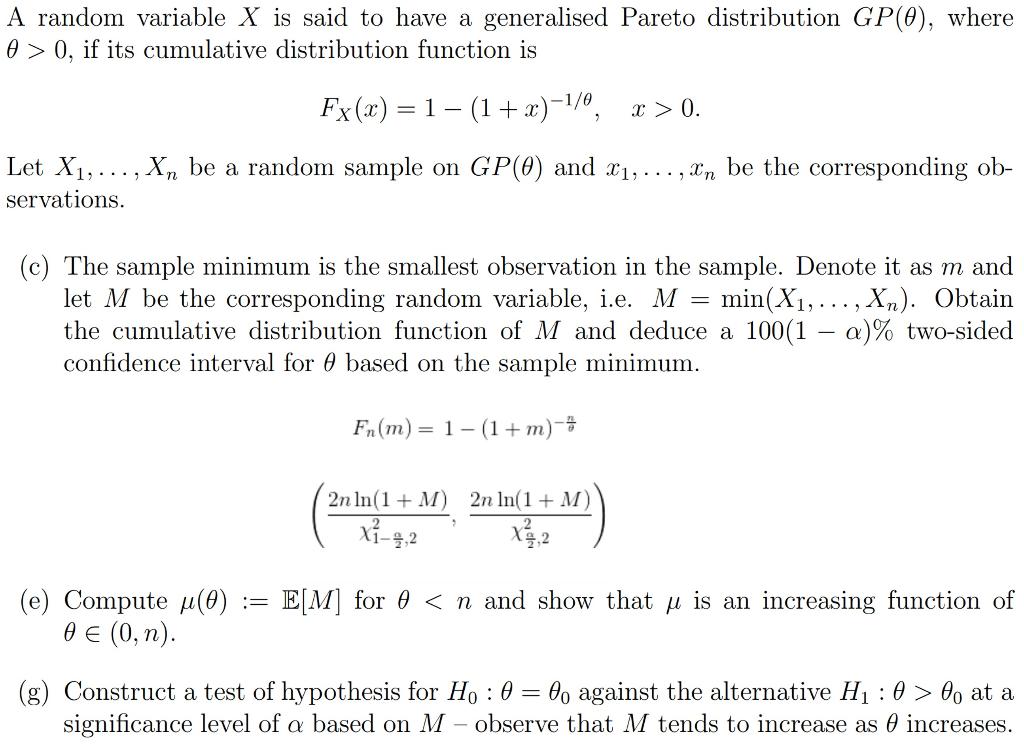
A random variable X is said to have a generalised Pareto distribution GP(), where 0 > 0, if its cumulative distribution function is Fx(x) = 1 (1 + x)=1/0, x > 0. = Let X1, ... , Xn be a random sample on GP(0) and 21,..., In be the corresponding ob- servations. (c) The sample minimum is the smallest observation in the sample. Denote it as m and let M be the corresponding random variable, i.e. M = min(X1, ..., Xn). Obtain the cumulative distribution function of M and deduce a 100(1 a)% two-sided confidence interval for 0 based on the sample minimum. Fn(m) = 1 -(1 + m)* 2n ln(1 + M) 2n ln(1 + M) xi-22 (e) Compute u(0) := E[M] for 0 , at a significance level of a based on M - observe that M tends to increase as 0 increases. A random variable X is said to have a generalised Pareto distribution GP(), where 0 > 0, if its cumulative distribution function is Fx(x) = 1 (1 + x)=1/0, x > 0. = Let X1, ... , Xn be a random sample on GP(0) and 21,..., In be the corresponding ob- servations. (c) The sample minimum is the smallest observation in the sample. Denote it as m and let M be the corresponding random variable, i.e. M = min(X1, ..., Xn). Obtain the cumulative distribution function of M and deduce a 100(1 a)% two-sided confidence interval for 0 based on the sample minimum. Fn(m) = 1 -(1 + m)* 2n ln(1 + M) 2n ln(1 + M) xi-22 (e) Compute u(0) := E[M] for 0 , at a significance level of a based on M - observe that M tends to increase as 0 increases
Step by Step Solution
There are 3 Steps involved in it

Get step-by-step solutions from verified subject matter experts
 Study Help