







Question: Please clearly explain/answer the problem, and show any calculation if necessary. In this exercise, we examine how resource hazards, control hazards, and ISA design can
Please clearly explain/answer the problem, and show any calculation if necessary. 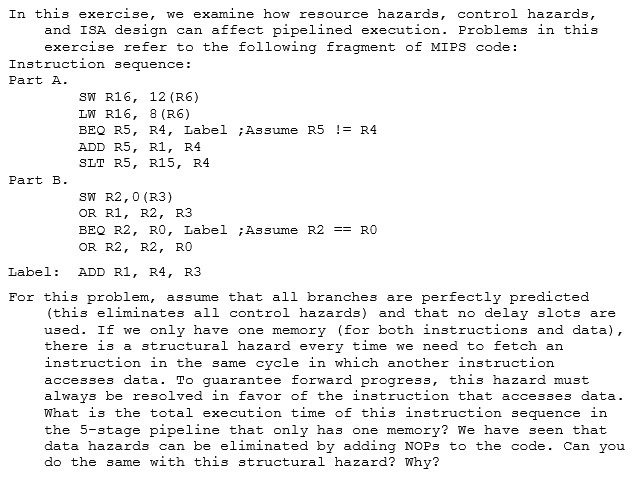
In this exercise, we examine how resource hazards, control hazards, and ISA design can affect pipelined execution. Problems in this exercise refer to the following fragment of MIPS code: Instruction sequence: SW R16, 12(R6) LW R16, 8 (R6) BEQ R5, R4, Label;Assume R5 != R4 ADD R5, R1, R4 SLT R5, R15, R4 SW R2, 0 (R3) OR R1, R2, R3 BEQ R2, RO, Label;Assume R2 == RO OR R2, R2, RO Label: ADD R1, R4, R3 For this problem, assume that all branches are perfectly predicted (this eliminates all control hazards) and that no delay slots are used. If we only have one memory (for both instructions and data), there is a structural hazard every time we need to fetch an instruction in the same cycle in which another instruction accesses data. To guarantee forward progress, this hazard must always be resolved in favor of the instruction that accesses data. What is the total execution time of this instruction sequence in the 5-stage pipeline that only has one memory? We have seen that data hazards can be eliminated by adding NOPs to the code. Can you do the same with this structural hazard? Why
Step by Step Solution
There are 3 Steps involved in it

Get step-by-step solutions from verified subject matter experts
 Study Help