Question: Please complete the asked questions in this Case study from the textbook (Ha-Brookshire. Global Sourcing in the Textile and Apparel Industry). CASE STUDY 7: Leave
Please complete the asked questions in this Case study from the textbook (Ha-Brookshire. Global Sourcing in the Textile and Apparel Industry).
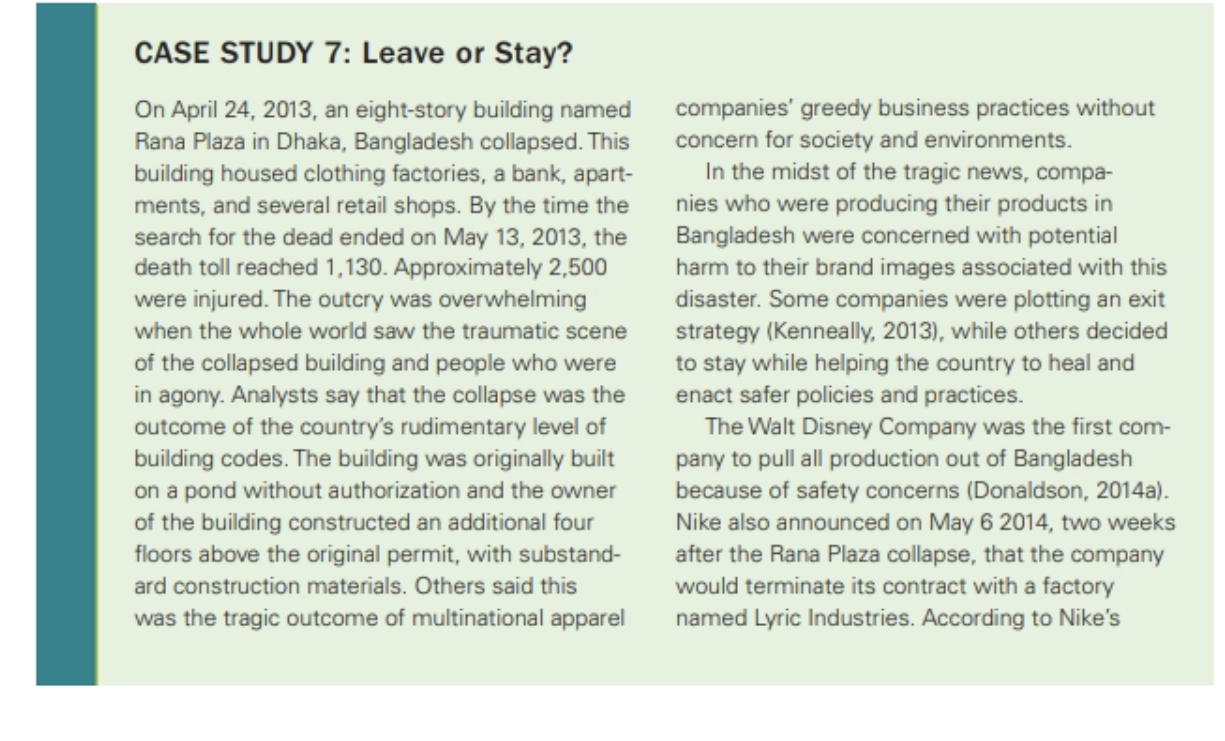
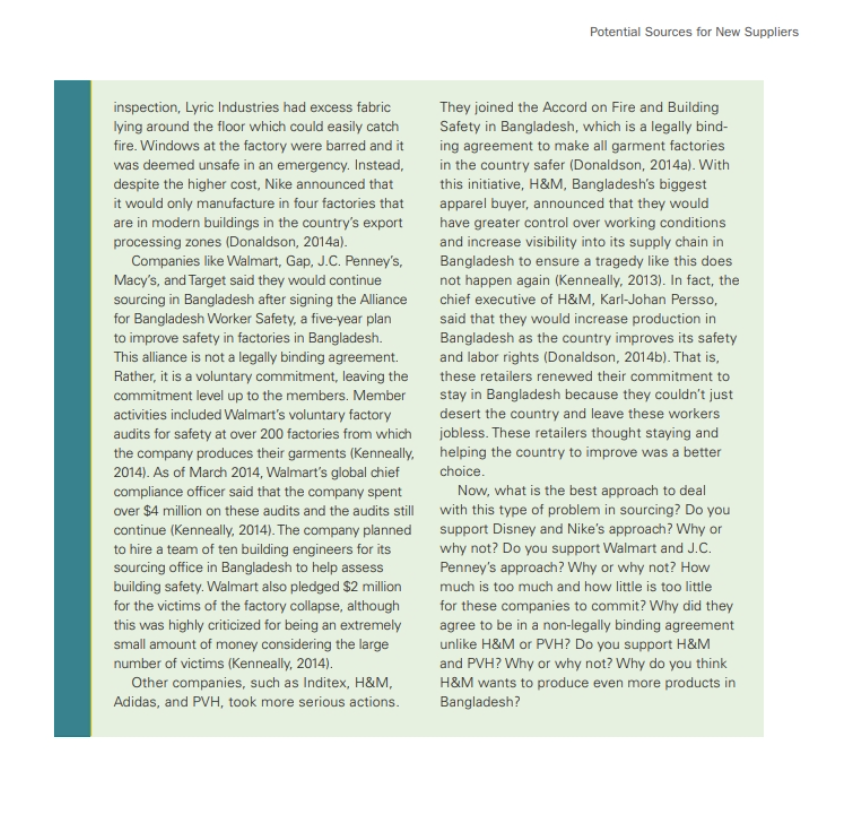
CASE STUDY 7: Leave or Stay? On April 24, 2013, an eight-story building named Rana Plaza in Dhaka, Bangladesh collapsed. This building housed clothing factories, a bank, apart- ments, and several retail shops. By the time the search for the dead ended on May 13, 2013, the death toll reached 1,130. Approximately 2,500 were injured. The outcry was overwhelming when the whole world saw the traumatic scene of the collapsed building and people who were in agony. Analysts say that the collapse was the outcome of the country's rudimentary level of building codes. The building was originally built on a pond without authorization and the owner of the building constructed an additional four floors above the original permit, with substand- ard construction materials. Others said this was the tragic outcome of multinational apparel companies' greedy business practices without concern for society and environments. In the midst of the tragic news, compa- nies who were producing their products in Bangladesh were concerned with potential harm to their brand images associated with this disaster. Some companies were plotting an exit strategy (Kenneally, 2013), while others decided to stay while helping the country to heal and enact safer policies and practices. The Walt Disney Company was the first com- pany to pull all production out of Bangladesh because of safety concerns (Donaldson, 2014a). Nike also announced on May 6 2014, two weeks after the Rana Plaza collapse, that the company would terminate its contract with a factory named Lyric Industries. According to Nike's Potential Sources for New Suppliers inspection, Lyric Industries had excess fabric They joined the Accord on Fire and Building lying around the floor which could easily catch Safety in Bangladesh, which is a legally bind- fire. Windows at the factory were barred and it ing agreement to make all garment factories was deemed unsafe in an emergency. Instead, in the country safer (Donaldson, 2014a). With despite the higher cost, Nike announced that this initiative, H&M, Bangladesh's biggest it would only manufacture in four factories that apparel buyer, announced that they would are in modern buildings in the country's export have greater control over working conditions processing zones (Donaldson, 2014a). and increase visibility into its supply chain in Companies like Walmart, Gap, J.C. Penney's, Bangladesh to ensure a tragedy like this does Macy's, and Target said they would continue not happen again (Kenneally, 2013). In fact, the sourcing in Bangladesh after signing the Alliance chief executive of H&M, Karl-Johan Persso, for Bangladesh Worker Safety, a five-year plan said that they would increase production in to improve safety in factories in Bangladesh. Bangladesh as the country improves its safety This alliance is not a legally binding agreement. and labor rights (Donaldson, 2014b). That is, Rather, it is a voluntary commitment, leaving the these retailers renewed their commitment to commitment level up to the members. Member stay in Bangladesh because they couldn't just activities included Walmart's voluntary factory desert the country and leave these workers audits for safety at over 200 factories from which jobless. These retailers thought staying and the company produces their garments (Kenneally, helping the country to improve was a better 2014). As of March 2014, Walmart's global chief choice. compliance officer said that the company spent Now, what is the best approach to deal over $4 million on these audits and the audits still with this type of problem in sourcing? Do you continue (Kenneally, 2014). The company planned support Disney and Nike's approach? Why or to hire a team of ten building engineers for its why not? Do you support Walmart and J.C. sourcing office in Bangladesh to help assess Penney's approach? Why or why not? How building safety. Walmart also pledged $2 million much is too much and how little is too little for the victims of the factory collapse, although for these companies to commit? Why did they this was highly criticized for being an extremely agree to be in a non-legally binding agreement small amount of money considering the large unlike H&M or PVH? Do you support H&M number of victims (Kenneally, 2014). and PVH? Why or why not? Why do you think Other companies, such as Inditex, H&M, H&M wants to produce even more products in Adidas, and PVH, took more serious actions. Bangladesh? CASE STUDY 7: Leave or Stay? On April 24, 2013, an eight-story building named Rana Plaza in Dhaka, Bangladesh collapsed. This building housed clothing factories, a bank, apart- ments, and several retail shops. By the time the search for the dead ended on May 13, 2013, the death toll reached 1,130. Approximately 2,500 were injured. The outcry was overwhelming when the whole world saw the traumatic scene of the collapsed building and people who were in agony. Analysts say that the collapse was the outcome of the country's rudimentary level of building codes. The building was originally built on a pond without authorization and the owner of the building constructed an additional four floors above the original permit, with substand- ard construction materials. Others said this was the tragic outcome of multinational apparel companies' greedy business practices without concern for society and environments. In the midst of the tragic news, compa- nies who were producing their products in Bangladesh were concerned with potential harm to their brand images associated with this disaster. Some companies were plotting an exit strategy (Kenneally, 2013), while others decided to stay while helping the country to heal and enact safer policies and practices. The Walt Disney Company was the first com- pany to pull all production out of Bangladesh because of safety concerns (Donaldson, 2014a). Nike also announced on May 6 2014, two weeks after the Rana Plaza collapse, that the company would terminate its contract with a factory named Lyric Industries. According to Nike's Potential Sources for New Suppliers inspection, Lyric Industries had excess fabric They joined the Accord on Fire and Building lying around the floor which could easily catch Safety in Bangladesh, which is a legally bind- fire. Windows at the factory were barred and it ing agreement to make all garment factories was deemed unsafe in an emergency. Instead, in the country safer (Donaldson, 2014a). With despite the higher cost, Nike announced that this initiative, H&M, Bangladesh's biggest it would only manufacture in four factories that apparel buyer, announced that they would are in modern buildings in the country's export have greater control over working conditions processing zones (Donaldson, 2014a). and increase visibility into its supply chain in Companies like Walmart, Gap, J.C. Penney's, Bangladesh to ensure a tragedy like this does Macy's, and Target said they would continue not happen again (Kenneally, 2013). In fact, the sourcing in Bangladesh after signing the Alliance chief executive of H&M, Karl-Johan Persso, for Bangladesh Worker Safety, a five-year plan said that they would increase production in to improve safety in factories in Bangladesh. Bangladesh as the country improves its safety This alliance is not a legally binding agreement. and labor rights (Donaldson, 2014b). That is, Rather, it is a voluntary commitment, leaving the these retailers renewed their commitment to commitment level up to the members. Member stay in Bangladesh because they couldn't just activities included Walmart's voluntary factory desert the country and leave these workers audits for safety at over 200 factories from which jobless. These retailers thought staying and the company produces their garments (Kenneally, helping the country to improve was a better 2014). As of March 2014, Walmart's global chief choice. compliance officer said that the company spent Now, what is the best approach to deal over $4 million on these audits and the audits still with this type of problem in sourcing? Do you continue (Kenneally, 2014). The company planned support Disney and Nike's approach? Why or to hire a team of ten building engineers for its why not? Do you support Walmart and J.C. sourcing office in Bangladesh to help assess Penney's approach? Why or why not? How building safety. Walmart also pledged $2 million much is too much and how little is too little for the victims of the factory collapse, although for these companies to commit? Why did they this was highly criticized for being an extremely agree to be in a non-legally binding agreement small amount of money considering the large unlike H&M or PVH? Do you support H&M number of victims (Kenneally, 2014). and PVH? Why or why not? Why do you think Other companies, such as Inditex, H&M, H&M wants to produce even more products in Adidas, and PVH, took more serious actions. Bangladesh









 Study Help