Question: Please complete the asked questions in this Case study from the textbook (Ha-Brookshire. Global Sourcing in the Textile and Apparel Industry). CASE STUDY 9: Recall
Please complete the asked questions in this Case study from the textbook (Ha-Brookshire. Global Sourcing in the Textile and Apparel Industry).
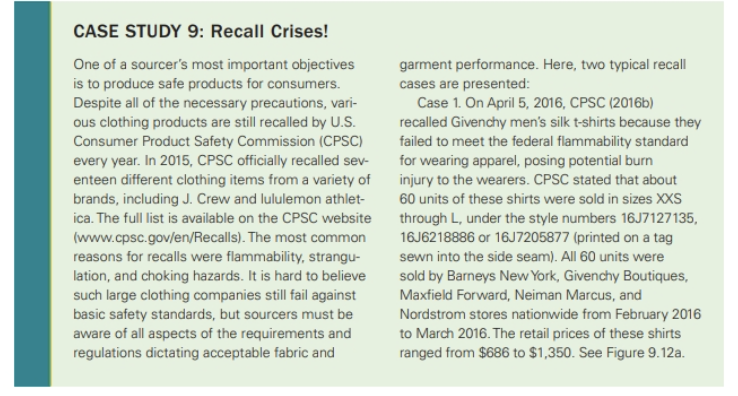
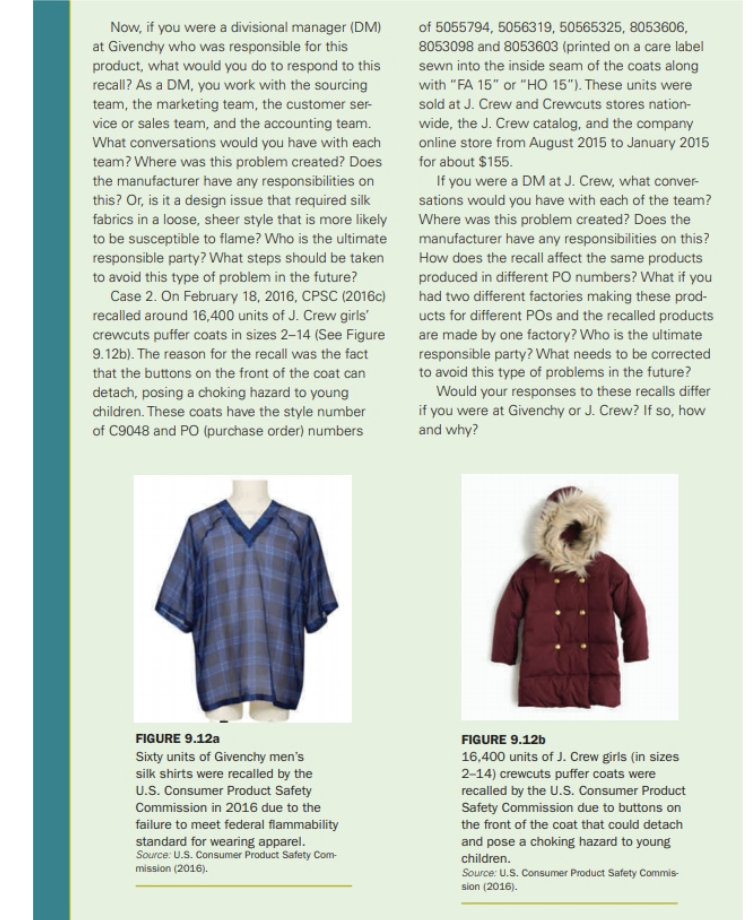
CASE STUDY 9: Recall Crises! One of a sourcer's most important objectives is to produce safe products for consumers. Despite all of the necessary precautions, vari- ous clothing products are still recalled by U.S. Consumer Product Safety Commission (CPSC) every year. In 2015, CPSC officially recalled sev- enteen different clothing items from a variety of brands, including J.Crew and lululemon athlet- ica. The full list is available on the CPSC website (www.cpsc.gov/en/Recalls). The most common reasons for recalls were flammability, strangu- lation, and choking hazards. It is hard to believe such large clothing companies still fail against basic safety standards, but sourcers must be aware of all aspects of the requirements and regulations dictating acceptable fabric and garment performance. Here, two typical recall cases are presented: Case 1. On April 5, 2016, CPSC (2016) recalled Givenchy men's silk t-shirts because they failed to meet the federal flammability standard for wearing apparel, posing potential burn injury to the wearers. CPSC stated that about 60 units of these shirts were sold in sizes XXS through L, under the style numbers 16J7127135, 16J6218886 or 16J7205877 (printed on a tag sewn into the side seam). All 60 units were sold by Barneys New York, Givenchy Boutiques, Maxfield Forward, Neiman Marcus, and Nordstrom stores nationwide from February 2016 to March 2016. The retail prices of these shirts ranged from $686 to $1,350. See Figure 9.12a. Now, if you were a divisional manager (DM) at Givenchy who was responsible for this product, what would you do to respond to this recall? As a DM, you work with the sourcing team, the marketing team, the customer ser vice or sales team, and the accounting team. What conversations would you have with each team? Where was this problem created? Does the manufacturer have any responsibilities on this? Or, is it a design issue that required silk fabrics in a loose, sheer style that is more likely to be susceptible to flame? Who is the ultimate responsible party? What steps should be taken to avoid this type of problem in the future? Case 2. On February 18, 2016, CPSC (2016) recalled around 16,400 units of J.Crew girls' crewcuts puffer coats in sizes 2-14 (See Figure 9.12b). The reason for the recall was the fact that the buttons on the front of the coat can detach, posing a choking hazard to young children. These coats have the style number of C9048 and PO (purchase order) numbers of 5055794, 5056319,50565325, 8053606, 8053098 and 8053603 (printed on a care label sewn into the inside seam of the coats along with "FA 15" or "HO 15"). These units were sold at J. Crew and Crewcuts stores nation- wide, the J.Crew catalog, and the company online store from August 2015 to January 2015 for about $155. If you were a DM at J. Crew, what conver- sations would you have with each of the team? Where was this problem created? Does the manufacturer have any responsibilities on this? How does the recall affect the same products produced in different PO numbers? What if you had two different factories making these prod- ucts for different POs and the recalled products are made by one factory? Who is the ultimate responsible party? What needs to be corrected to avoid this type of problems in the future? Would your responses to these recalls differ if you were at Givenchy or J.Crew? If so, how and why? FIGURE 9.12a Sixty units of Givenchy men's silk shirts were recalled by the U.S. Consumer Product Safety Commission in 2016 due to the failure to meet federal flammability standard for wearing apparel. Source: U.S. Consumer Product Safety Com- mission (2016). FIGURE 9.12b 16,400 units of J.Crew girls (in sizes 2-14) crewcuts puffer coats were recalled by the U.S. Consumer Product Safety Commission due to buttons on the front of the coat that could detach and pose a choking hazard to young children. Source: U.S. Consumer Product Safety Commis- sion (2016)









 Study Help