







Question: Please do it as an information systems student Q1. Within your major degree, investigate and analyze different careers/ entrepreneurship. List five of these options Q2.
Please do it as an information systems student 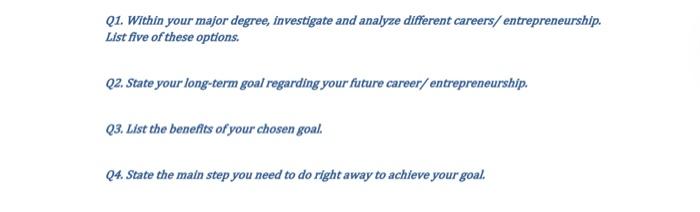
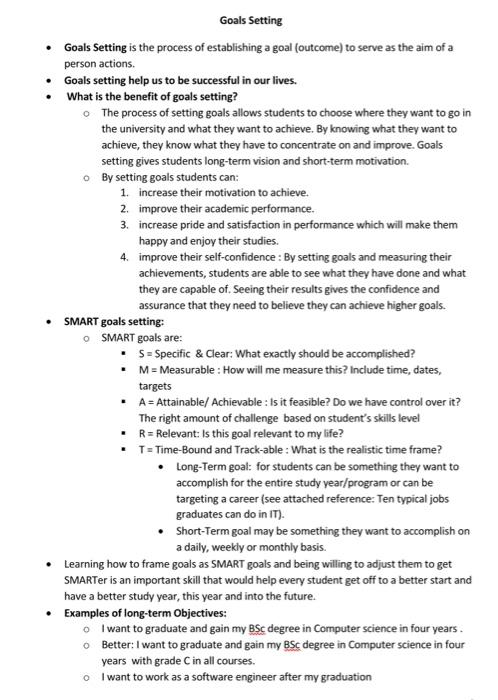
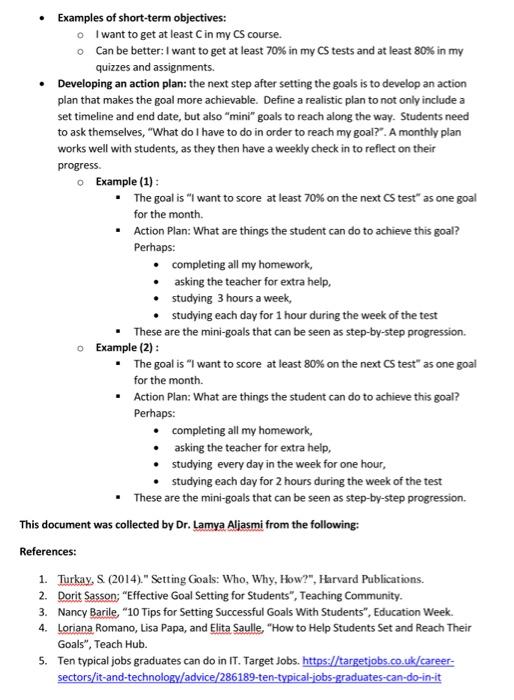
Q1. Within your major degree, investigate and analyze different careers/ entrepreneurship. List five of these options Q2. State your long-term goal regarding your future career/ entrepreneurship. 03. List the benefits of your chosen goal. Q4. State the main step you need to do right away to achieve your goal. . Goals Setting Goals Setting is the process of establishing a goal (outcome) to serve as the aim of a person actions. Goals setting help us to be successful in our lives. What is the benefit of goals setting? The process of setting goals allows students to choose where they want to go in the university and what they want to achieve. By knowing what they want to achieve, they know what they have to concentrate on and improve. Goals setting gives students long-term vision and short-term motivation o By setting goals students can: 1. increase their motivation to achieve. 2. improve their academic performance. 3. increase pride and satisfaction in performance which will make them happy and enjoy their studies. 4. improve their self-confidence : By setting goals and measuring their achievements, students are able to see what they have done and what they are capable of. Seeing their results gives the confidence and assurance that they need to believe they can achieve higher goals. SMART goals setting: SMART goals are: S = Specific & Clear: What exactly should be accomplished? M = Measurable : How will me measure this? Include time, dates, targets A = Attainable/ Achievable : Is it feasible? Do we have control over it? The right amount of challenge based on student's skills level R = Relevant: Is this goal relevant to my life? T=Time-Bound and Track-able : What is the realistic time frame? Long-Term goal: for students can be something they want to accomplish for the entire study year/program or can be targeting a career (see attached reference: Ten typical jobs graduates can do in IT). Short-Term goal may be something they want to accomplish on a daily, weekly or monthly basis. Learning how to frame goals as SMART goals and being willing to adjust them to get SMARTer is an important skill that would help every student get off to a better start and have a better study year, this year and into the future. Examples of long-term Objectives: o I want to graduate and gain my BSc degree in Computer science in four years. o Better: I want to graduate and gain my BSc degree in Computer science in four years with grade C in all courses. I want to work as a software engineer after my graduation O Examples of short-term objectives: o I want to get at least Cin my CS course. o can be better:I want to get at least 70% in my CS tests and at least 80% in my quizzes and assignments. Developing an action plan: the next step after setting the goals is to develop an action plan that makes the goal more achievable. Define a realistic plan to not only include a set timeline and end date, but also "mini" goals to reach along the way. Students need to ask themselves, "What do I have to do in order to reach my goal?". A monthly plan works well with students, as they then have a weekly check in to reflect on their progress Example (1): The goal is "I want to score at least 70% on the next CS test" as one goal for the month. Action Plan: What are things the student can do to achieve this goal? Perhaps: completing all my homework, asking the teacher for extra help, studying 3 hours a week, studying each day for 1 hour during the week of the test These are the mini-goals that can be seen as step-by-step progression. Example (2) The goal is "I want to score at least 80% on the next CS test" as one goal for the month. Action Plan: What are things the student can do to achieve this goal? Perhaps: completing all my homework, asking the teacher for extra help, studying every day in the week for one hour, studying each day for 2 hours during the week of the test These are the mini-goals that can be seen as step-by-step progression. This document was collected by Dr. Lamya Aljasmi from the following: References: 1. Turkay, S (2014)." Setting Goals: Who, Why, How?", Harvard Publications. 2. Dorit Sasson; "Effective Goal Setting for Students", Teaching Community. 3. Nancy Barile, "10 Tips for Setting Successful Goals With Students", Education Week. 4. Loriana Romano, Lisa Papa, and Elita Saulle, "How to Help Students Set and Reach Their Goals", Teach Hub. 5. Ten typical jobs graduates can do in IT. Target Jobs. https://targetjobs.co.uk/career- sectors/it-and-technology/advice/286189-ten-typical-jobs-graduates-can-do-in-it Step by Step Solution
There are 3 Steps involved in it
1 Expert Approved Answer
Step: 1 Unlock

Question Has Been Solved by an Expert!
Get step-by-step solutions from verified subject matter experts
Step: 2 Unlock
Step: 3 Unlock
 Study Help