







Question: Please do this without using fsolve to evaluate the function. A pin-fin array is an example of a heat sink design that can be used
Please do this without using fsolve to evaluate the function. 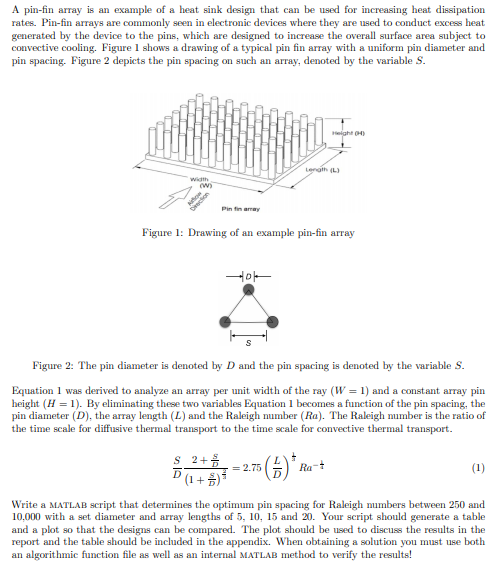
A pin-fin array is an example of a heat sink design that can be used for increasing heat dissipation rates. Pin-fin arrays are commonly seen in electronic devices where they are used to conduct excess heat generated by the device to the pins, which are designed to increase the overall surface area subject to convective cooling. Figure 1 shows a drawing of a typical pin fin array with a uniform pin diameter and pin spacing. Figure 2 depicts the pin spacing on such an array, denoted by the variable S. Height) Length (L) Pinis may Figure 1: Drawing of an example pin-fin array S Figure 2: The pin diameter is denoted by D and the pin spacing is denoted by the variable S. Equation 1 was derived to analyze an array per unit width of the ray (W = 1) and a constant array pin height (H =1). By eliminating these two variables Equation 1 becomes a function of the pin spacing the pin diameter (D), the array length (L) and the Raleigh number (Ra). The Raleigh mimber is the ratio of the time scale for diffusive thermal transport to the time scale for convective thermal transport. 275 ()* S2+ $ = 2.75 Ra-+ D D (1) (1+) Write a MATLAB script that determines the optimum pin spacing for Raleigh numbers between 250 and 10.000 with a set diameter and array lengths of 5, 10, 15 and 20. Your script should generate a table and a plot so that the designs can be compared. The plot should be used to discuss the results in the report and the table should be included in the appendix. When obtaining a solution you must use both an algorithmic function file as well as an internal MATLAB method to verify the results
Step by Step Solution
There are 3 Steps involved in it

Get step-by-step solutions from verified subject matter experts
 Study Help