







Question: please download and zoom it ,without case study you cant provide the ans o FILE TOOLS VIEW Spring-2020-2021-Agro-based-Product-Marketing-Case-3.docx (Protected View) - Microsoft Word PROTECTED VIEW
please download and zoom it ,without case study you cant provide the ans
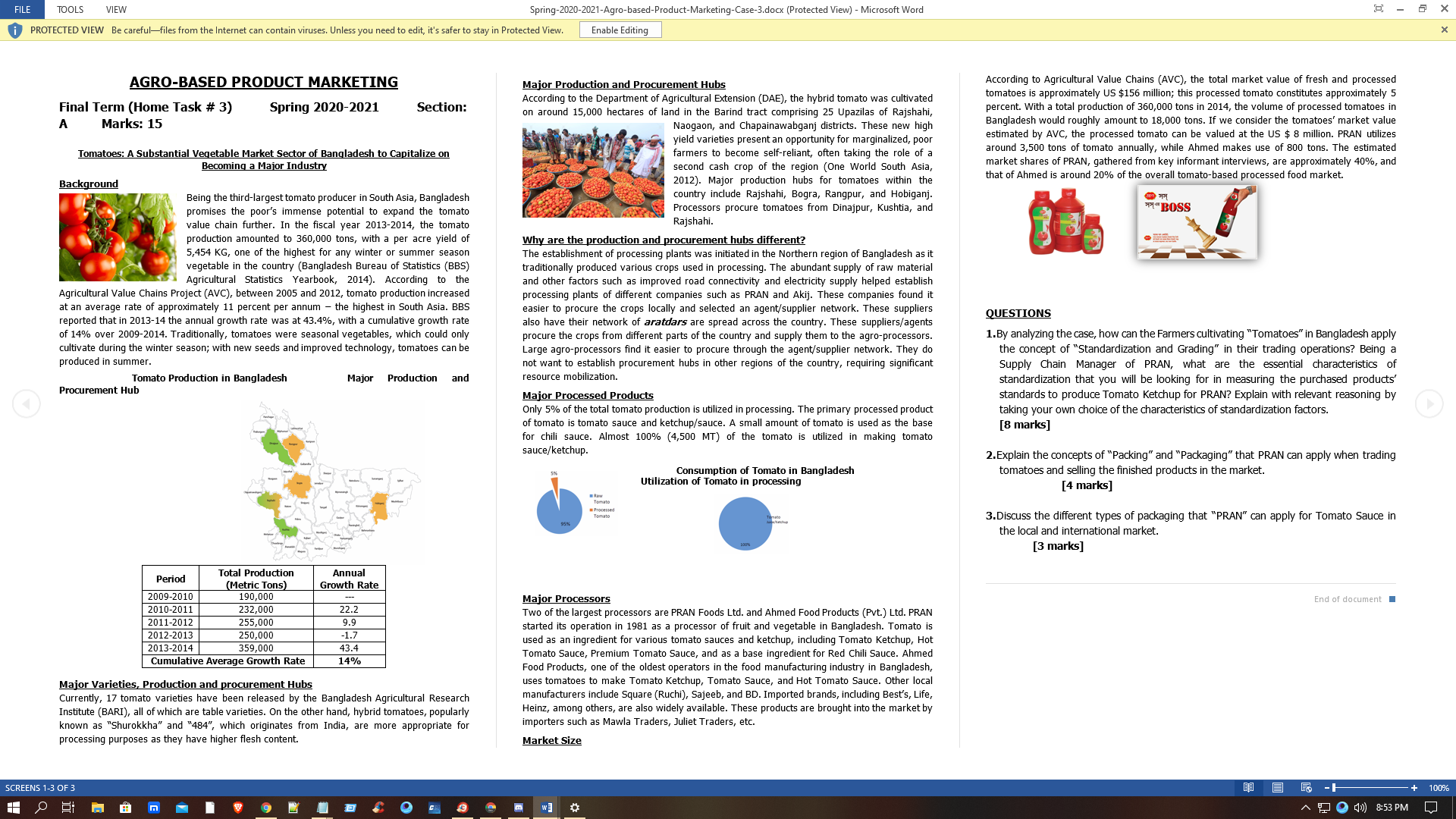
o FILE TOOLS VIEW Spring-2020-2021-Agro-based-Product-Marketing-Case-3.docx (Protected View) - Microsoft Word PROTECTED VIEW Be carefulfiles from the Internet can contain viruses. Unless you need to edit, it's safer to stay in Protected View. Enable Editing AGRO-BASED PRODUCT MARKETING Final Term (Home Task # 3) Spring 2020-2021 Marks: 15 Section: According to Agricultural Value Chains (AVC), the total market value of fresh and processed tomatoes is approximately US $156 million; this processed tomato constitutes approximately 5 percent. With a total production of 360,000 tons in 2014, the volume of processed tomatoes in Bangladesh would roughly amount to 18,000 tons. If we consider the tomatoes' market value estimated by AVC, the processed tomato can be valued at the US $ 8 million. PRAN utilizes around 3,500 tons of tomato annually, while Ahmed makes use of 800 tons. The estimated market shares of PRAN, gathered from key informant interviews, are approximately 40%, and that of Ahmed is around 20% of the overall tomato-based processed food market. **BOSS Tomatoes: A Substantial Vegetable Market Sector of Bangladesh to Capitalize on Becoming a Major Industry Background Being the third-largest tomato producer in South Asia, Bangladesh promises the poor's immense potential to expand the tomato value chain further. In the fiscal year 2013-2014, the tomato production amounted to 360,000 tons, with a per acre yield of 5,454 KG, one of the highest for any winter or summer season vegetable in the country (Bangladesh Bureau of Statistics (BBS) Agricultural Statistics Yearbook, 2014). According to the Agricultural Value Chains Project (AVC), between 2005 and 2012, tomato production increased at an average rate of approximately 11 percent per annum - the highest in South Asia. BBS reported that in 2013-14 the annual growth rate was at 43.4%, with a cumulative growth rate of 14% over 2009-2014. Traditionally, tomatoes were seasonal vegetables, which could only cultivate during the winter season; with new seeds and improved technology, tomatoes can be produced in summer. Tomato Production in Bangladesh Major Production and Procurement Hub Major Production and Procurement Hubs According to the Department of Agricultural Extension (DAE), the hybrid tomato was cultivated on around 15,000 hectares of land in the Barind tract comprising 25 Upazilas of Rajshahi, Naogaon, and Chapainawabganj districts. These new high yield varieties present an opportunity for marginalized, poor farmers to become self-reliant, often taking the role of a second cash crop of the region One World South Asia, 2012). Major production hubs for tomatoes within the country include Rajshahi, Bogra, Rangpur, and Hobiganj. Processors procure tomatoes from Dinajpur, Kushtia, and Rajshahi. Why are the production and procurement hubs different? The establishment of processing plants was initiated in the Northern region of Bangladesh as it traditionally produced various crops used in processing. The abundant supply of raw material and other factors such as improved road connectivity and electricity supply helped establish processing plants of different companies such as PRAN and Akij. These companies found it easier to procure the crops locally and selected an agent/supplier network. These suppliers also have their network of aratdars are spread across the country. These suppliers/agents procure the crops from different parts of the country and supply them to the agro-processors. Large agro-processors find it easier to procure through the agent/supplier network. They do not want to establish procurement hubs in other regions of the country, requiring significant resource mobilization. Major Processed Products Only 5% of the total tomato production is utilized in processing. The primary processed product of tomato is tomato sauce and ketchup/sauce. A small amount of tomato is used as the base for chili sauce. Almost 100% (4,500 MT) of the tomato is utilized in making tomato sauce/ketchup Consumption of Tomato in Bangladesh Utilization of Tomato in processing QUESTIONS 1.By analyzing the case, how can the Farmers cultivating "Tomatoes" in Bangladesh apply the concept of "Standardization and Grading" in their trading operations? Being a Supply Chain Manager of PRAN, what are the essential characteristics of standardization that you will be looking for in measuring the purchased products' standards to produce Tomato Ketchup for PRAN? Explain with relevant reasoning by taking your own choice of the characteristics of standardization factors. [8 marks] 2.Explain the concepts of "Packing" and "Packaging" that PRAN can apply when trading tomatoes and selling the finished products in the market. [4 marks] Tomato Processed 3.Discuss the different types of packaging that "PRAN" can apply for Tomato Sauce in the local and international market. [3 marks] Annual Growth Rate End of document Total Production Period (Metric Tons) 2009-2010 190,000 2010-2011 232,000 2011-2012 255,000 2012-2013 250,000 2013-2014 359,000 Cumulative Average Growth Rate 22.2 9.9 -1.7 43.4 14% Major Processors Two of the largest processors are PRAN Foods Ltd. and Ahmed Food Products (Pvt.) Ltd. PRAN started its operation in 1981 as a processor of fruit and vegetable in Bangladesh. Tomato is used as an ingredient for various tomato sauces and ketchup, including Tomato Ketchup, Hot Tomato Sauce, Premium Tomato Sauce, and as a base ingredient for Red Chili Sauce. Ahmed Food Products, one of the oldest operators in the food manufacturing industry in Bangladesh, uses tomatoes to make Tomato Ketchup, Tomato Sauce, and Hot Tomato Sauce. Other local manufacturers include Square (Ruchi), Sajeeb, and BD. Imported brands, including Best's, Life, Heinz, among others, are also widely available. These products are brought into the market by importers such as Mawla Traders, Juliet Traders, etc. Market Size Major Varieties, Production and procurement Hubs Currently, 17 tomato varieties have been released by the Bangladesh Agricultural Research Institute (BARI), all of which are table varieties. On the other hand, hybrid tomatoes, popularly known as "Shurokkha" and "484", which originates from India, are more appropriate for processing purposes as they have higher flesh content. SCREENS 1-3 OF 3 100% wStep by Step Solution
There are 3 Steps involved in it
1 Expert Approved Answer
Step: 1 Unlock

Question Has Been Solved by an Expert!
Get step-by-step solutions from verified subject matter experts
Step: 2 Unlock
Step: 3 Unlock
 Study Help