







Question: Please EXPLAIN and solve EACH / ALL part(s) in Question #4 ! DOUBLE CHECK YOUR WORK AND ANSWER(S) . PLEASE NEATLY SHOW ALL WORK, EXPLANATIONS
Please EXPLAIN and solve EACH/ALL part(s) in Question #4!
DOUBLE CHECK YOUR WORK AND ANSWER(S).
PLEASE NEATLY SHOW ALL WORK, EXPLANATIONS, & CALCULATIONS STEP-BY-STEP USING PEN AND PAPER! I AM NEW TO CHEMISTRY! I AM A COMPLETE NEWBIE!
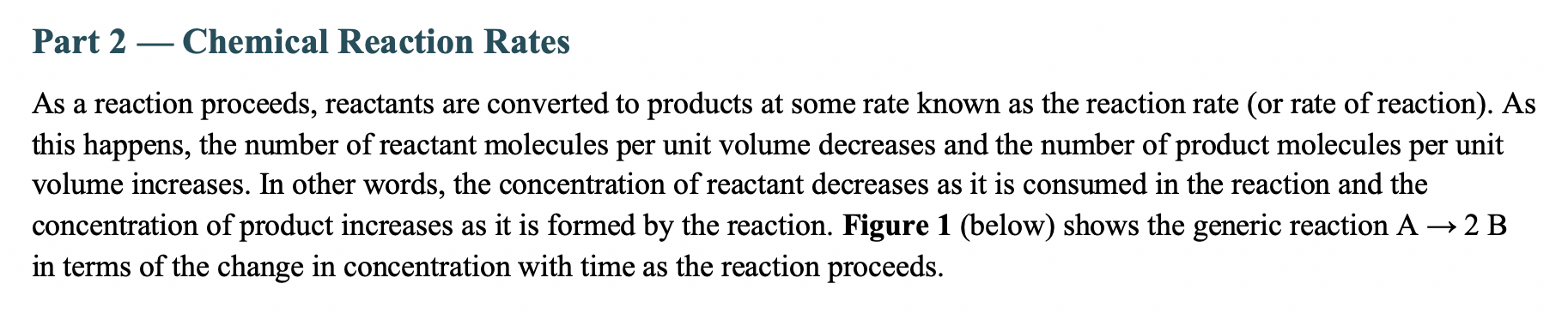
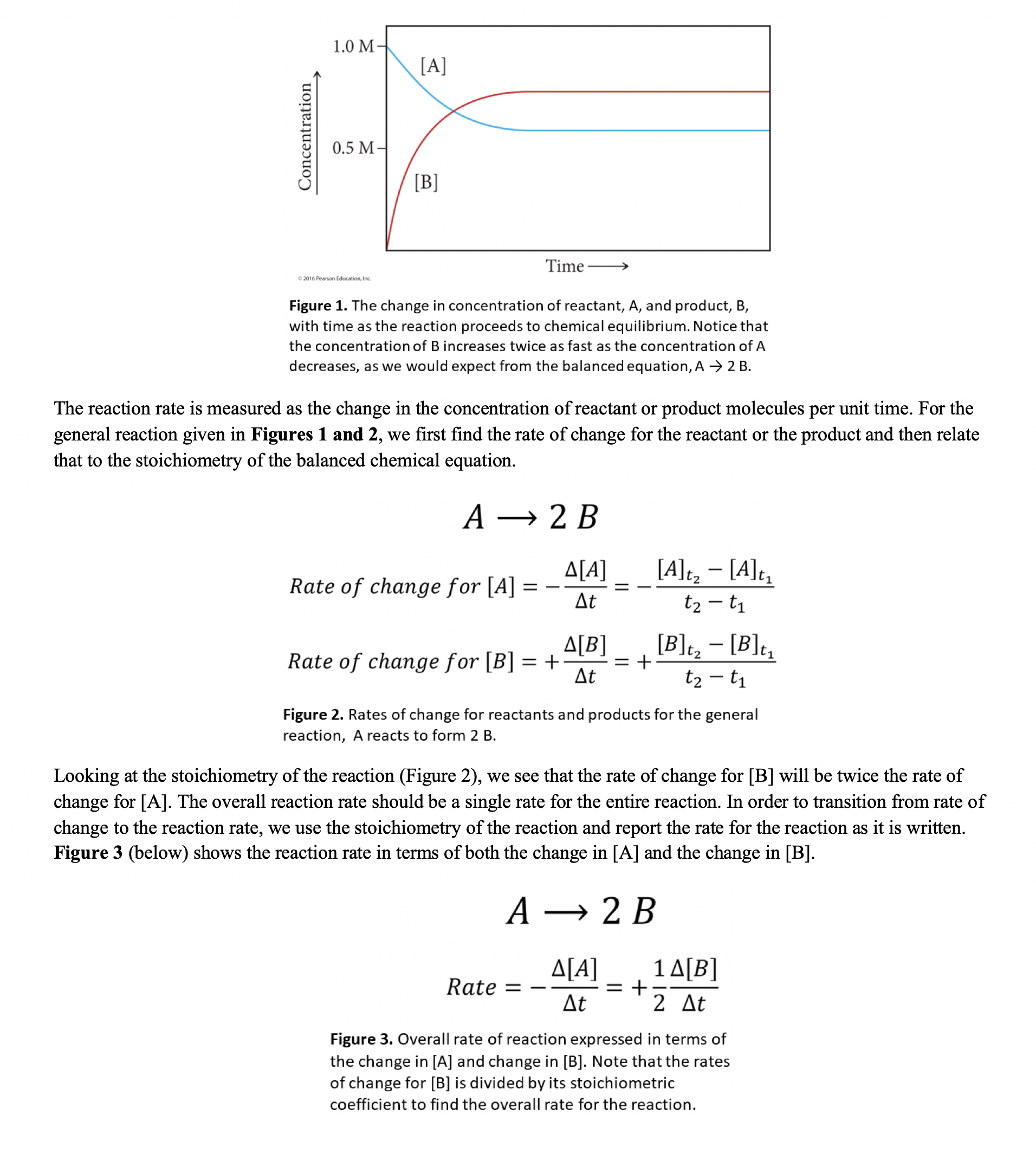
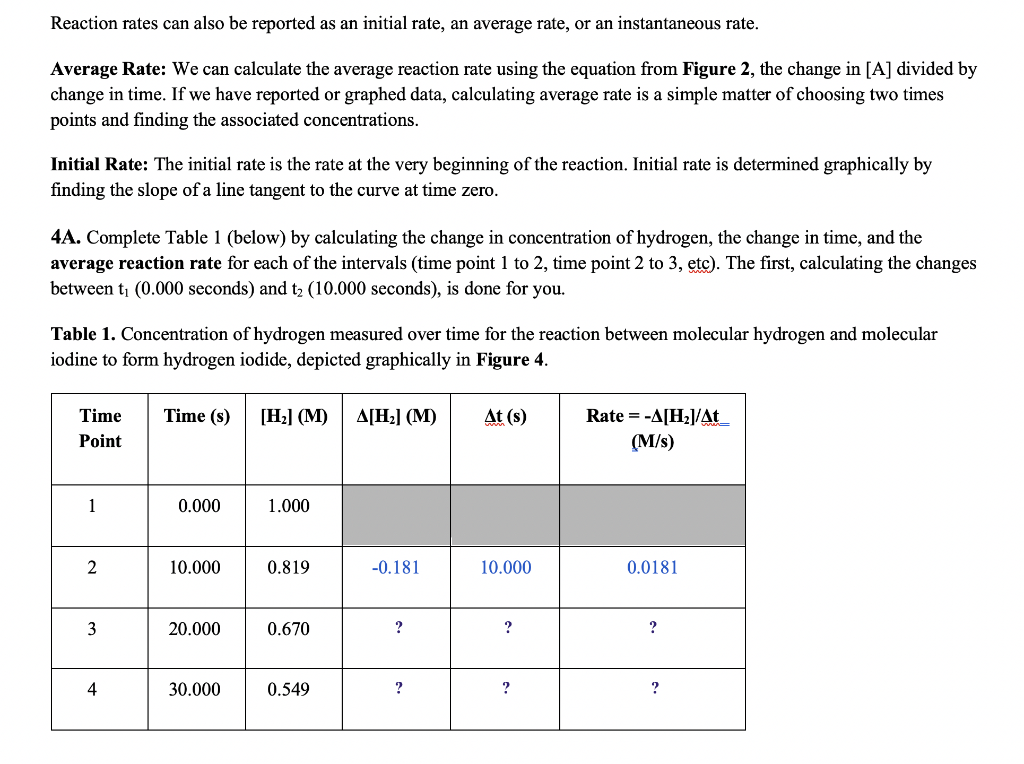
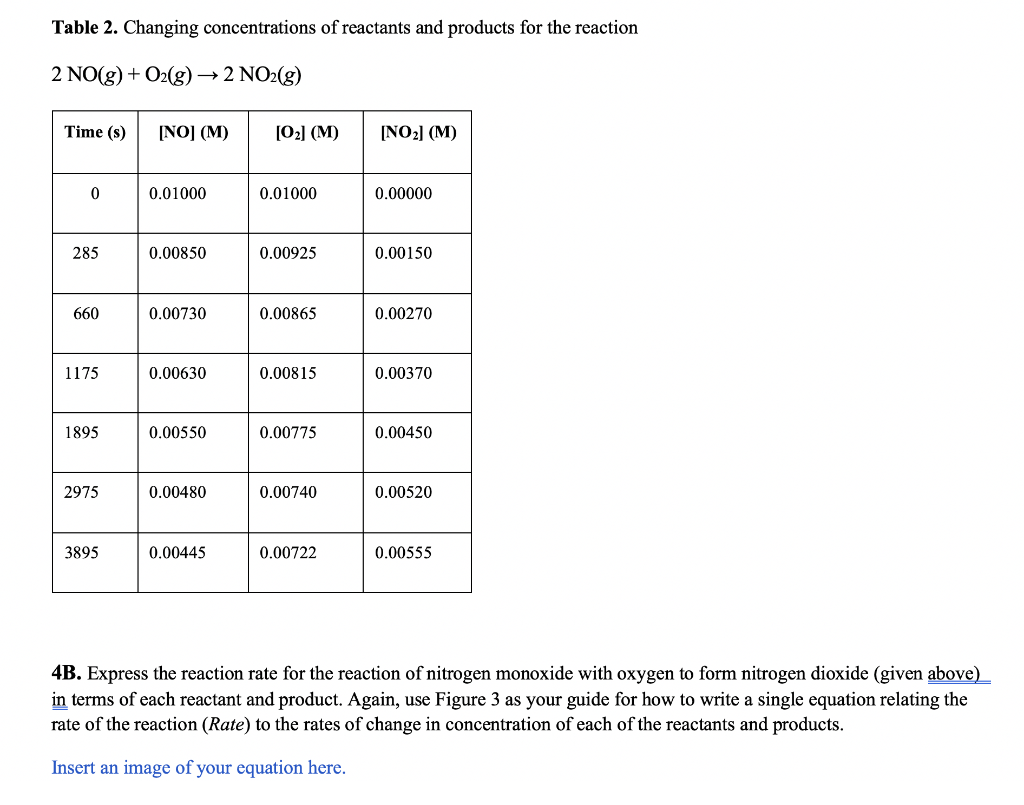
Part 2 - Chemical Reaction Rates As a reaction proceeds, reactants are converted to products at some rate known as the reaction rate (or rate of reaction). As this happens, the number of reactant molecules per unit volume decreases and the number of product molecules per unit volume increases. In other words, the concentration of reactant decreases as it is consumed in the reaction and the concentration of product increases as it is formed by the reaction. Figure 1 (below) shows the generic reaction A2B in terms of the change in concentration with time as the reaction proceeds. Figure 1. The change in concentration of reactant, A, and product, B, with time as the reaction proceeds to chemical equilibrium. Notice that the concentration of B increases twice as fast as the concentration of A decreases, as we would expect from the balanced equation, A2B. The reaction rate is measured as the change in the concentration of reactant or product molecules per unit time. For the general reaction given in Figures 1 and 2, we first find the rate of change for the reactant or the product and then relate that to the stoichiometry of the balanced chemical equation. A2BRateofchangefor[A]=t[A]=t2t1[A]t2[A]t1Rateofchangefor[B]=+t[B]=+t2t1[B]t2[B]t1 Figure 2. Rates of change for reactants and products for the general reaction, A reacts to form 2 B. Looking at the stoichiometry of the reaction (Figure 2), we see that the rate of change for [B] will be twice the rate of change for [A]. The overall reaction rate should be a single rate for the entire reaction. In order to transition from rate of change to the reaction rate, we use the stoichiometry of the reaction and report the rate for the reaction as it is written. Figure 3 (below) shows the reaction rate in terms of both the change in [A] and the change in [B]. A2BRate=t[A]=+21t[B] Figure 3. Overall rate of reaction expressed in terms of the change in [A] and change in [B]. Note that the rates of change for [B] is divided by its stoichiometric coefficient to find the overall rate for the reaction. Reaction rates can also be reported as an initial rate, an average rate, or an instantaneous rate. Average Rate: We can calculate the average reaction rate using the equation from Figure 2, the change in [A] divided by change in time. If we have reported or graphed data, calculating average rate is a simple matter of choosing two times points and finding the associated concentrations. Initial Rate: The initial rate is the rate at the very beginning of the reaction. Initial rate is determined graphically by finding the slope of a line tangent to the curve at time zero. 4A. Complete Table 1 (below) by calculating the change in concentration of hydrogen, the change in time, and the average reaction rate for each of the intervals (time point 1 to 2 , time point 2 to 3 , etc). The first, calculating the changes between t1(0.000 seconds) and t2(10.000 seconds), is done for you. Table 1. Concentration of hydrogen measured over time for the reaction between molecular hydrogen and molecular iodine to form hydrogen iodide, depicted graphically in Figure 4. Table 2. Changing concentrations of reactants and products for the reaction 2NO(g)+O2(g)2NO2(g) 4B. Express the reaction rate for the reaction of nitrogen monoxide with oxygen to form nitrogen dioxide (given above) in terms of each reactant and product. Again, use Figure 3 as your guide for how to write a single equation relating the rate of the reaction (Rate) to the rates of change in concentration of each of the reactants and products. Insert an image of your equation here
Step by Step Solution
There are 3 Steps involved in it

Get step-by-step solutions from verified subject matter experts
 Study Help