







Question: Please EXPLAIN and solve EACH / ALL part(s) in Question #2 ! DOUBLE CHECK YOUR WORK AND ANSWER(S) . PLEASE NEATLY SHOW ALL WORK, EXPLANATIONS
Please EXPLAIN and solve EACH/ALL part(s) in Question #2!
DOUBLE CHECK YOUR WORK AND ANSWER(S).
PLEASE NEATLY SHOW ALL WORK, EXPLANATIONS, & CALCULATIONS STEP-BY-STEP USING PEN AND PAPER! I AM NEWTO CHEMISTRY! I AM A COMPLETE NEWBIE!
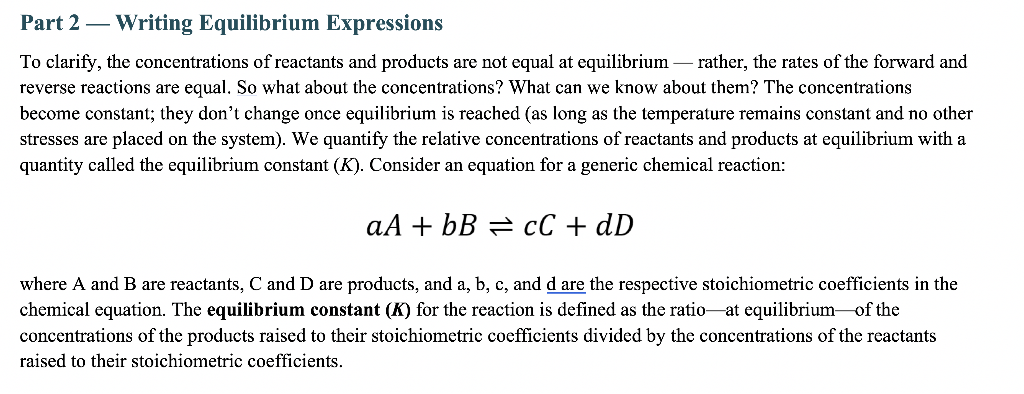
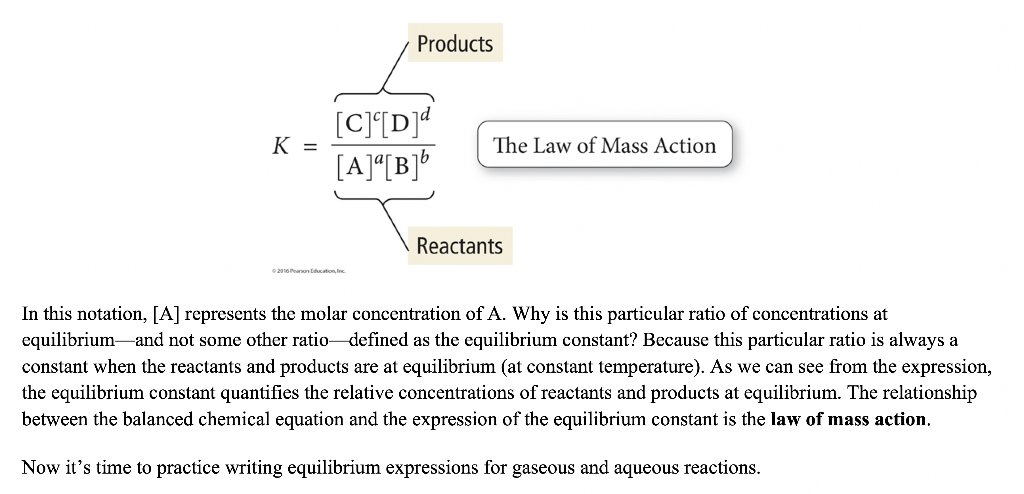
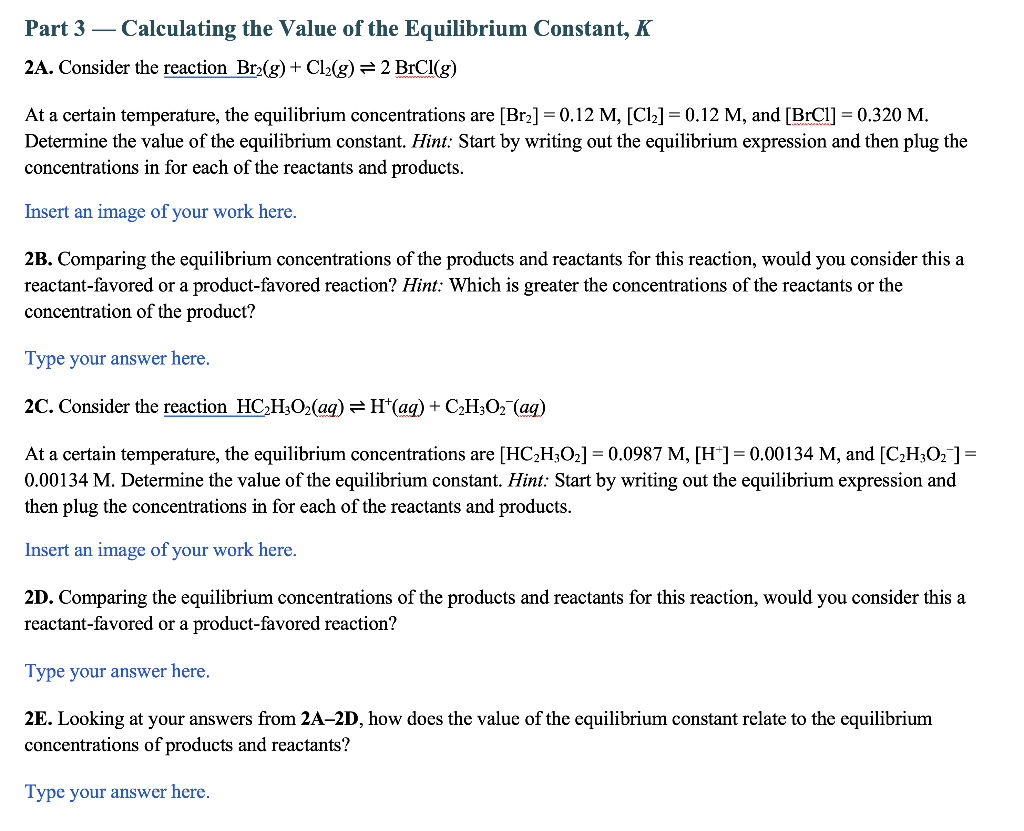
Part 2 - Writing Equilibrium Expressions To clarify, the concentrations of reactants and products are not equal at equilibrium - rather, the rates of the forward and reverse reactions are equal. So what about the concentrations? What can we know about them? The concentrations become constant; they don't change once equilibrium is reached (as long as the temperature remains constant and no other stresses are placed on the system). We quantify the relative concentrations of reactants and products at equilibrium with a quantity called the equilibrium constant (K). Consider an equation for a generic chemical reaction: aA+bBcC+dD where A and B are reactants, C and D are products, and a,b,c, and d are the respective stoichiometric coefficients in the chemical equation. The equilibrium constant (K) for the reaction is defined as the ratio-at equilibrium-of the concentrations of the products raised to their stoichiometric coefficients divided by the concentrations of the reactants raised to their stoichiometric coefficients. In this notation, [A] represents the molar concentration of A. Why is this particular ratio of concentrations at equilibrium-and not some other ratio-defined as the equilibrium constant? Because this particular ratio is always a constant when the reactants and products are at equilibrium (at constant temperature). As we can see from the expression, the equilibrium constant quantifies the relative concentrations of reactants and products at equilibrium. The relationship between the balanced chemical equation and the expression of the equilibrium constant is the law of mass action. Now it's time to practice writing equilibrium expressions for gaseous and aqueous reactions. Part 3 - Calculating the Value of the Equilibrium Constant, K 2A. Consider the reaction Br2(g)+Cl2(g)2BrCl(g) At a certain temperature, the equilibrium concentrations are [Br2]=0.12M,[Cl2]=0.12M, and [BrCl]=0.320M. Determine the value of the equilibrium constant. Hint: Start by writing out the equilibrium expression and then plug the concentrations in for each of the reactants and products. Insert an image of your work here. 2B. Comparing the equilibrium concentrations of the products and reactants for this reaction, would you consider this a reactant-favored or a product-favored reaction? Hint: Which is greater the concentrations of the reactants or the concentration of the product? Type your answer here. 2C. Consider the reaction HC2H3O2(aq)H+(aq)+C2H3O2(aq) At a certain temperature, the equilibrium concentrations are [HC2H3O2]=0.0987M,[H+]=0.00134M, and [C2H3O2]= 0.00134 M. Determine the value of the equilibrium constant. Hint: Start by writing out the equilibrium expression and then plug the concentrations in for each of the reactants and products. Insert an image of your work here. 2D. Comparing the equilibrium concentrations of the products and reactants for this reaction, would you consider this a reactant-favored or a product-favored reaction? Type your answer here. 2E. Looking at your answers from 2AA-D, how does the value of the equilibrium constant relate to the equilibrium concentrations of products and reactants? Type your answer here
Step by Step Solution
There are 3 Steps involved in it

Get step-by-step solutions from verified subject matter experts
 Study Help