







Question: Please explain how to solve question 3 4 and 5 with an explanation Problem 2. This problem takes you through the formal definition of risk
Please explain how to solve question 3 4 and 5 with an explanation
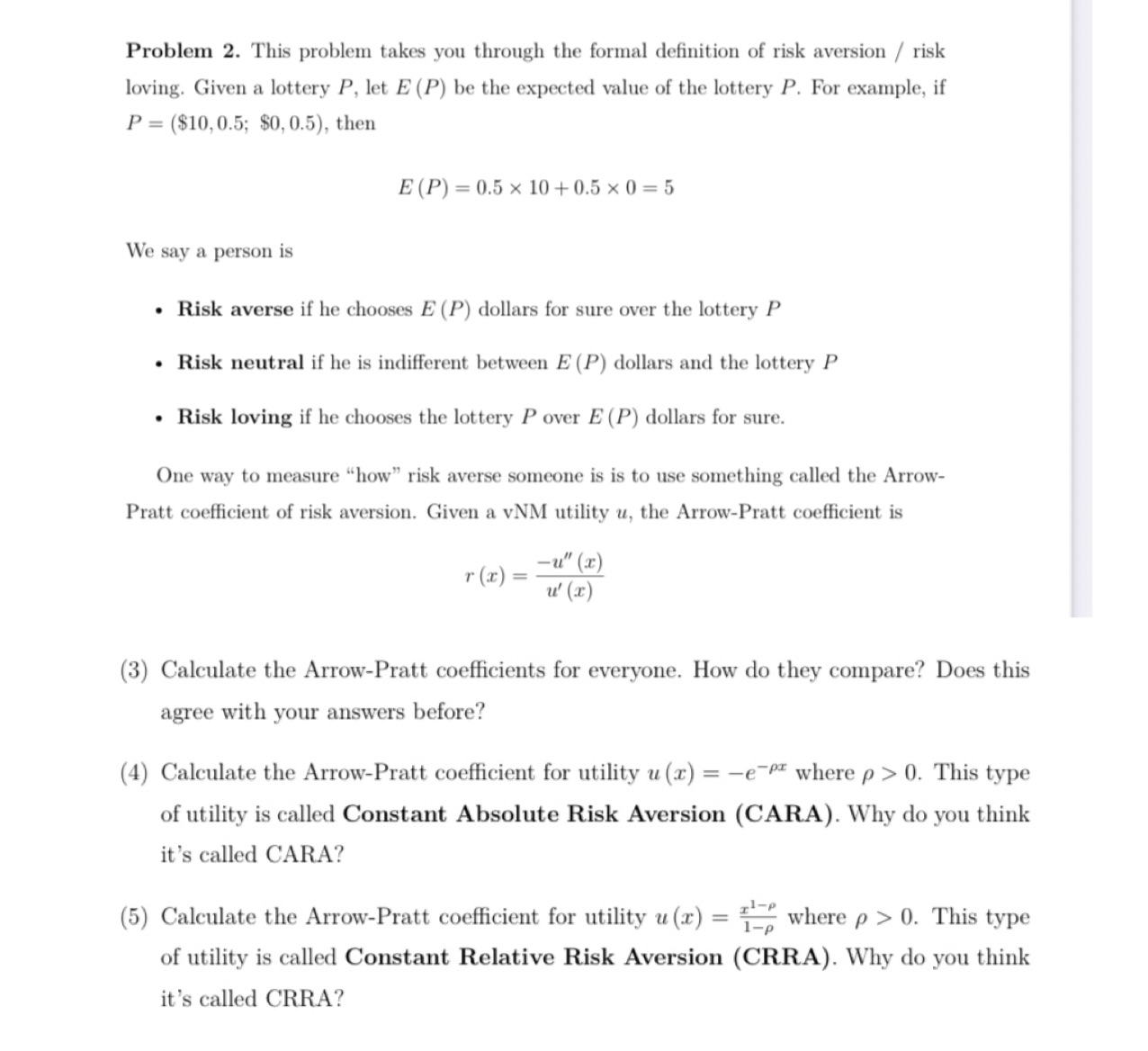
Problem 2. This problem takes you through the formal definition of risk aversion / risk loving. Given a lottery P, let E (P) be the expected value of the lottery P. For example, if P = ($10, 0.5; $0, 0.5), then E(P) = 0.5 x 10 + 0.5 x 0 = 5 We say a person is . Risk averse if he chooses E (P) dollars for sure over the lottery P . Risk neutral if he is indifferent between E (P) dollars and the lottery P . Risk loving if he chooses the lottery P over E (P) dollars for sure. One way to measure "how" risk averse someone is is to use something called the Arrow- Pratt coefficient of risk aversion. Given a vNM utility u, the Arrow-Pratt coefficient is r (x) = U(x) u' (I) (3) Calculate the Arrow-Pratt coefficients for everyone. How do they compare? Does this agree with your answers before? (4) Calculate the Arrow-Pratt coefficient for utility u (x) = -e-oz where p > 0. This type of utility is called Constant Absolute Risk Aversion (CARA). Why do you think it's called CARA? (5) Calculate the Arrow-Pratt coefficient for utility u (r) = _ where p > 0. This type of utility is called Constant Relative Risk Aversion (CRRA). Why do you think it's called CRRA
Step by Step Solution
There are 3 Steps involved in it

Get step-by-step solutions from verified subject matter experts
 Study Help