







Question: Please explain how you got the answer for further understanding Problem 3 You're the leader of the infrastructure team of a popular-enough startup. You're concerned
Please explain how you got the answer for further understanding
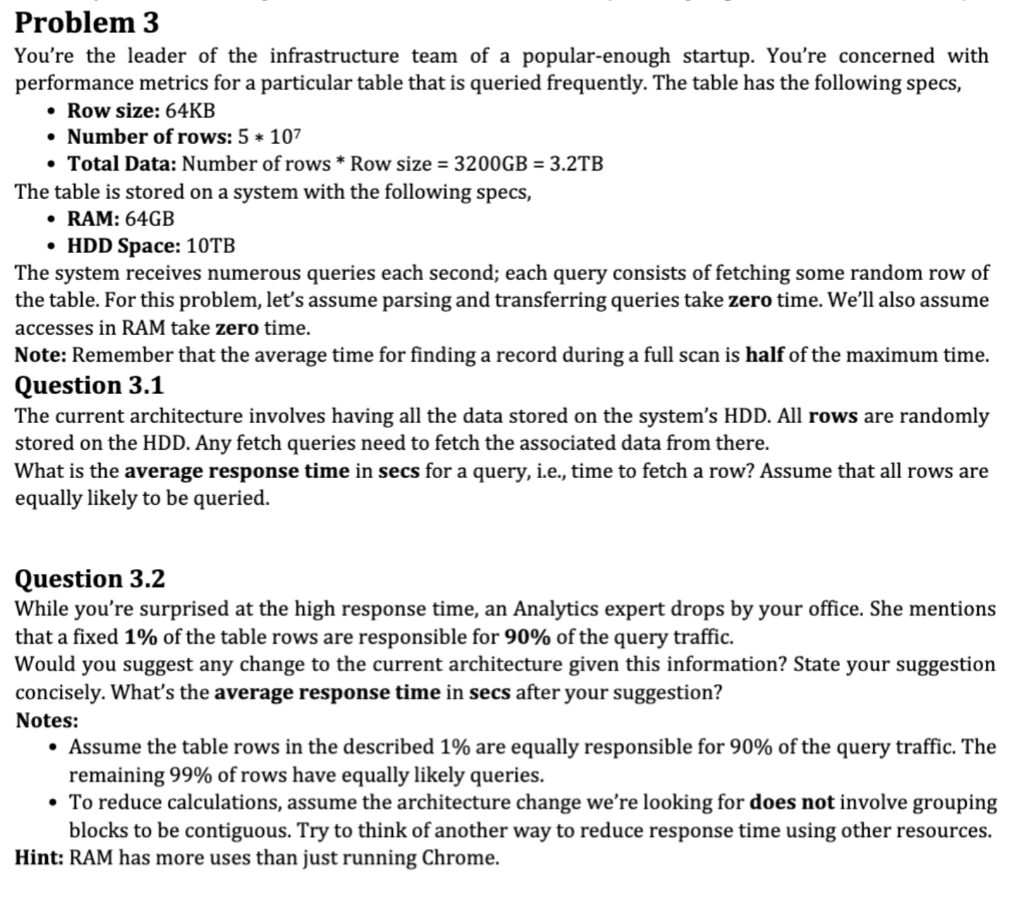
Problem 3 You're the leader of the infrastructure team of a popular-enough startup. You're concerned with performance metrics for a particular table that is queried frequently. The table has the following specs, - Row size: 64KB - Number of rows: 5107 - Total Data: Number of rows * Row size =3200GB=3.2TB The table is stored on a system with the following specs, - RAM: 64GB - HDD Space: 10TB The system receives numerous queries each second; each query consists of fetching some random row of the table. For this problem, let's assume parsing and transferring queries take zero time. We'll also assume accesses in RAM take zero time. Note: Remember that the average time for finding a record during a full scan is half of the maximum time. Question 3.1 The current architecture involves having all the data stored on the system's HDD. All rows are randomly stored on the HDD. Any fetch queries need to fetch the associated data from there. What is the average response time in secs for a query, i.e., time to fetch a row? Assume that all rows are equally likely to be queried. Question 3.2 While you're surprised at the high response time, an Analytics expert drops by your office. She mentions that a fixed 1% of the table rows are responsible for 90% of the query traffic. Would you suggest any change to the current architecture given this information? State your suggestion concisely. What's the average response time in secs after your suggestion? Notes: - Assume the table rows in the described 1% are equally responsible for 90% of the query traffic. The remaining 99% of rows have equally likely queries. - To reduce calculations, assume the architecture change we're looking for does not involve grouping blocks to be contiguous. Try to think of another way to reduce response time using other resources. Hint: RAM has more uses than just running Chrome
Step by Step Solution
There are 3 Steps involved in it

Get step-by-step solutions from verified subject matter experts
 Study Help