







Question: Please give an answer to question set 1(problem 1) Fred's Frustrating Firms This semester, we've been talking about things a middle-manager can do to assure
Please give an answer to question set 1(problem 1) 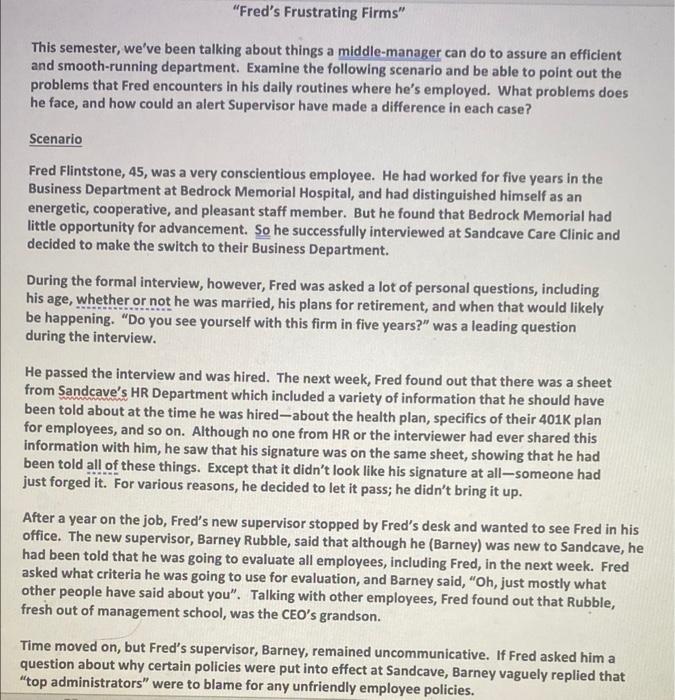
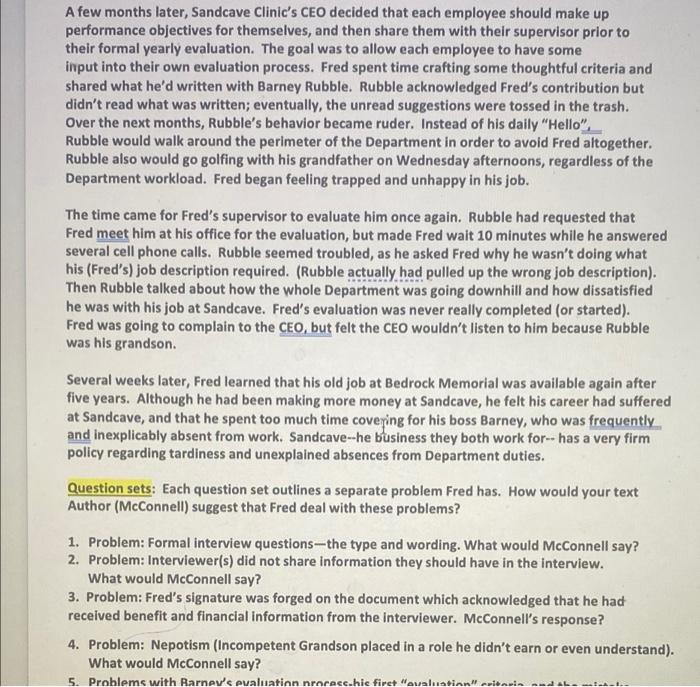
"Fred's Frustrating Firms" This semester, we've been talking about things a middle-manager can do to assure an efficient and smooth-running department. Examine the following scenario and be able to point out the problems that Fred encounters in his daily routines where he's employed. What problems does he face, and how could an alert Supervisor have made a difference in each case? Scenario Fred Flintstone, 45, was a very conscientious employee. He had worked for five years in the Business Department at Bedrock Memorial Hospital, and had distinguished himself as an energetic, cooperative, and pleasant staff member. But he found that Bedrock Memorial had little opportunity for advancement. So he successfully interviewed at Sandcave Care Clinic and decided to make the switch to their business Department. During the formal interview, however, Fred was asked a lot of personal questions, including his age, whether or not he was married, his plans for retirement, and when that would likely be happening. "Do you see yourself with this firm in five years?" was a leading question during the interview. He passed the interview and was hired. The next week, Fred found out that there was a sheet from Sandcave's HR Department which included a variety of information that he should have been told about at the time he was hired-about the health plan, specifics of their 401K plan for employees, and so on. Although no one from HR or the interviewer had ever shared this information with him, he saw that his signature was on the same sheet, showing that he had been told all of these things. Except that it didn't look like his signature at all-someone had just forged it. For various reasons, he decided to let it pass; he didn't bring it up. After a year on the job, Fred's new supervisor stopped by Fred's desk and wanted to see Fred in his office. The new supervisor, Barney Rubble, said that although he (Barney) was new to Sandcave, he had been told that he was going to evaluate all employees, including Fred, in the next week. Fred asked what criteria he was going to use for evaluation, and Barney said, "Oh, just mostly what other people have said about you". Talking with other employees, Fred found out that Rubble, fresh out of management school, was the CEO's grandson. Time moved on, but Fred's supervisor, Barney, remained uncommunicative. If Fred asked him a question about why certain policies were put into effect at Sandcave, Barney vaguely replied that "top administrators" were to blame for any unfriendly employee policies. A few months later, Sandcave Clinic's CEO decided that each employee should make up performance objectives for themselves, and then share them with their supervisor prior to their formal yearly evaluation. The goal was to allow each employee to have some input into their own evaluation process. Fred spent time crafting some thoughtful criteria and shared what he'd written with Barney Rubble. Rubble acknowledged Fred's contribution but didn't read what was written; eventually, the unread suggestions were tossed in the trash. Over the next months, Rubble's behavior became ruder. Instead of his daily "Hello", Rubble would walk around the perimeter of the Department in order to avoid Fred altogether. Rubble also would go golfing with his grandfather on Wednesday afternoons, regardless of the Department workload. Fred began feeling trapped and unhappy in his job. The time came for Fred's supervisor to evaluate him once again. Rubble had requested that Fred meet him at his office for the evaluation, but made Fred walt 10 minutes while he answered several cell phone calls. Rubble seemed troubled, as he asked Fred why he wasn't doing what his (Fred's) job description required. (Rubble actually had pulled up the wrong job description). Then Rubble talked about how the whole Department was going downhill and how dissatisfied he was with his job at Sandcave. Fred's evaluation was never really completed (or started). Fred was going to complain to the CEO, but felt the CEO wouldn't listen to him because Rubble was his grandson. Several weeks later, Fred learned that his old job at Bedrock Memorial was available again after five years. Although he had been making more money at Sandcave, he felt his career had suffered at Sandcave, and that he spent too much time covering for his boss Barney, who was frequently and inexplicably absent from work. Sandcave-he business they both work for-- has a very firm policy regarding tardiness and unexplained absences from Department duties. Question sets: Each question set outlines a separate problem Fred has. How would your text Author (McConnell) suggest that Fred deal with these problems? 1. Problem: Formal interview questions--the type and wording. What would McConnell say? 2. Problem: Interviewer(s) did not share information they should have in the interview. What would McConnell say? 3. Problem: Fred's signature was forged on the document which acknowledged that he had received benefit and financial information from the interviewer. McConnell's response? 4. Problem: Nepotism (Incompetent Grandson placed in a role he didn't earn or even understand). What would McConnell say? 5. Problems with Rarney's evaluatinn nocacc.hic firet Wavahistianllavitni A Step by Step Solution
There are 3 Steps involved in it
1 Expert Approved Answer
Step: 1 Unlock

Question Has Been Solved by an Expert!
Get step-by-step solutions from verified subject matter experts
Step: 2 Unlock
Step: 3 Unlock
 Study Help