







Question: please give me a new answer for question 1. less than 100 words 486 Parts Cases Coca-Cola's Strategy Coca-Cola, the iconic American soda maker, has
please give me a new answer for question 1. less than 100 words
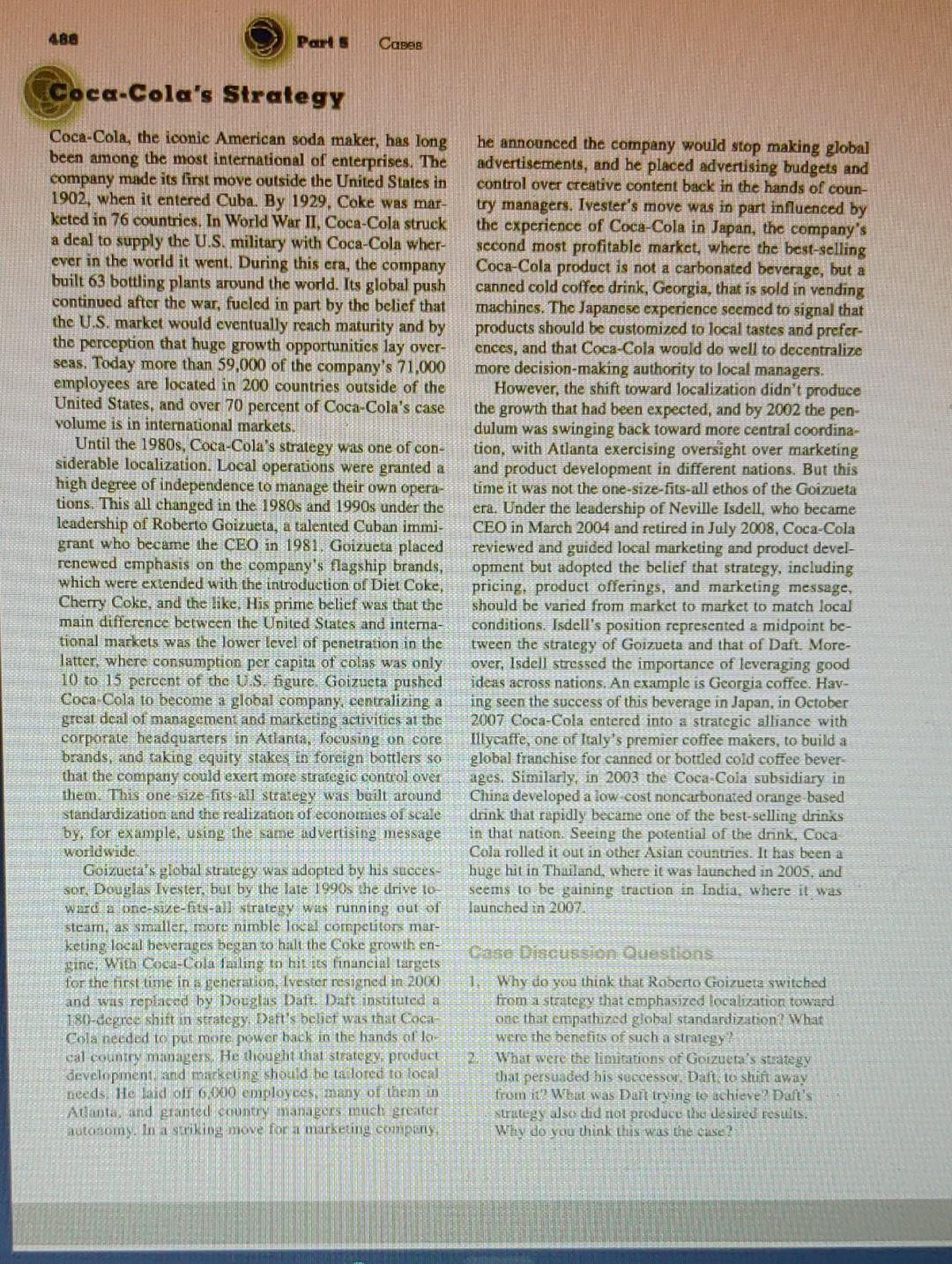
486 Parts Cases Coca-Cola's Strategy Coca-Cola, the iconic American soda maker, has long been among the most international of enterprises. The company made its first move outside the United States in 1902, when it entered Cuba. By 1929. Coke was mar- keted in 76 countries. In World War II, Coca-Cola struck a deal to supply the U.S. military with Coca-Cola wher- ever in the world it went. During this cra, the company built 63 bottling plants around the world. Its global push continued after the war, fueled in part by the belief that the U.S. market would eventually reach maturity and by the perception that huge growth opportunities lay over- seas. Today more than 59,000 of the company's 71,000 employees are located in 200 countries outside of the United States, and over 70 percent of Coca-Cola's case volume is in international markets. Until the 1980s, Coca-Cola's strategy was one of con- siderable localization. Local operations were granted a high degree of independence to manage their own opera- tions. This all changed in the 1980s and 1990s under the leadership of Roberto Goizueta, a talented Cuban immi- grant who became the CEO in 1981. Goizueta placed renewed emphasis on the company's flagship brands, which were extended with the introduction of Diet Coke, Cherry Coke, and the like. His prime belief was that the main difference between the United States and interna- tional markets was the lower level of penetration in the latter where consumption per capita of colas was only 10 to 15 percent of the U.S. figure Goizueta pushed Coca Cola to become a global company, centralizing a great deal of management and marketing activities at the corporate headquarters in Atlanta, focusing on core brands, and taking equity stakes in foreign bottlers so that the company could exert more strategic control ovet them. This one-size-fits-all strategy was built around standardization and the realization of economies of scale by, for example, using the same advertising message worldwide Goizueta's global strategy was adopted by his succes- sor, Douglas Ivester, but by the late 1990s the drive 10- werd a one-size-fits-all strategy was running out of steam, as smaller more nimble local competitors mar- keting local beverages began to halt the Coke growth en- gine. With Coca-Cola lailmg to hit its financial targets for the first time in a generation, Ivester resigned in 2004) and was replaced by Douglas Daft. Daft instituted a 180-degree shift in strategy. Daft's bclict was that Coca- Cola needed to put more power back in the hands allo- cal country managers He thought that strategy, product development and marketing should be tailored to local needs He laid or 6.000 employees, many of them in Atlanta, and granted country managers much greater autonomy. In a striking move for a marketing company he announced the company would stop making global advertisements, and he placed advertising budgets and control over creative content back in the hands of coun- try managers. Ivester's move was in part influenced by the experience of Coca-Cola in Japan, the company's second most profitable market, where the best-selling Coca-Cola product is not a carbonated beverage, but a canned cold coffee drink, Georgia, that is sold in vending machines. The Japanese experience seemed to signal that products should be customized to local tastes and prefer- caces, and that Coca-Cola would do well to decentralize more decision-making authority to local managers, However, the shift toward localization didn't produce the growth that had been expected, and by 2002 the pen- dulum was swinging back toward more central coordina- tion, with Atlanta exercising oversight over marketing and product development in different nations. But this time it was not the one-size-fits-all ethos of the Goizueta era. Under the leadership of Neville Isdell, who became CEO in March 2004 and retired in July 2008, Coca-Cola reviewed and guided local marketing and product devel- opment but adopted the belief that strategy, including pricing, product offerings, and marketing message, should be varied from market to market to match local conditions. Isdell's position represented a midpoint be- tween the strategy of Goizueta and that of Daft. More- over, Isdell stressed the importance of leveraging good ideas across nations. An example is Georgia coffee. Hav- ing seen the success of this beverage in Japan, in October 2007 Coca-Cola entered into a strategic alliance with Illycaffe, one of Italy's premier coffee makers, to build a global franchise for canned or bottled cold coffee bever- ages. Similarly, in 2003 the Coca Cola subsidiary in China developed a low cost noncarbonated orange based drink that rapidly became one of the best-selling drinks in that nation. Seeing the potential of the drink, Coca- Cola rolled it out in other Asian countries. It has been a huge hit in Thailand, where it was launched in 2005, and seems to be gaining traction in India, where it was launched in 2007 Casa Discussion Questions 1 Why do you think that Roberto Goizueta switched from a strategy that emphasized localization toward one that empathized global standardization? What were the benefits of such a strategy 2 What were the limitations of Goizuera's strately that persuaded his successer. Daft to shift away from it? What was Dull trying to achieve? Daft's strulegy also did not predace the desired results. Why do you think this was the useStep by Step Solution
There are 3 Steps involved in it
1 Expert Approved Answer
Step: 1 Unlock

Question Has Been Solved by an Expert!
Get step-by-step solutions from verified subject matter experts
Step: 2 Unlock
Step: 3 Unlock
 Study Help