







Question: Please help! Clear hand writing only Please 1. fThe theory of homogeneous linear equations is not limited to only second order equations. It works for
Please help!
Clear hand writing only Please
1.
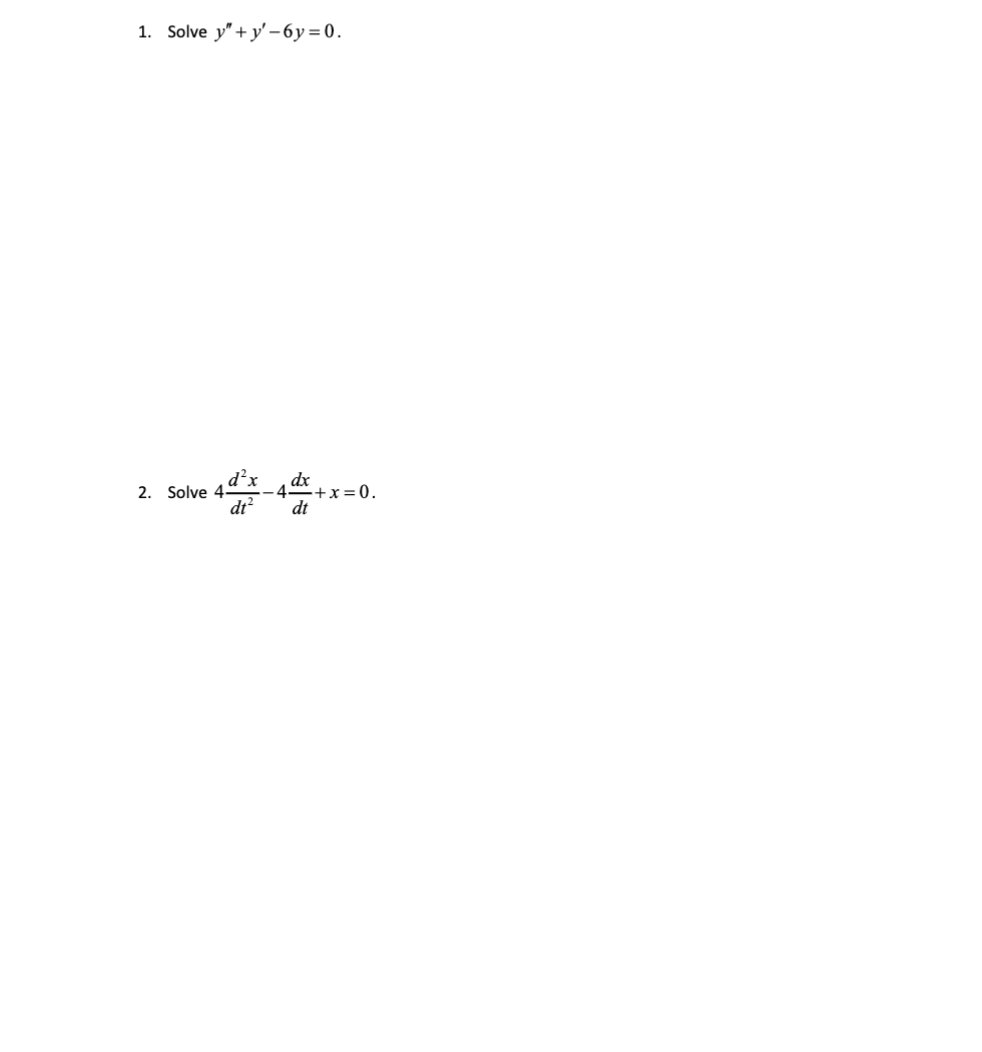
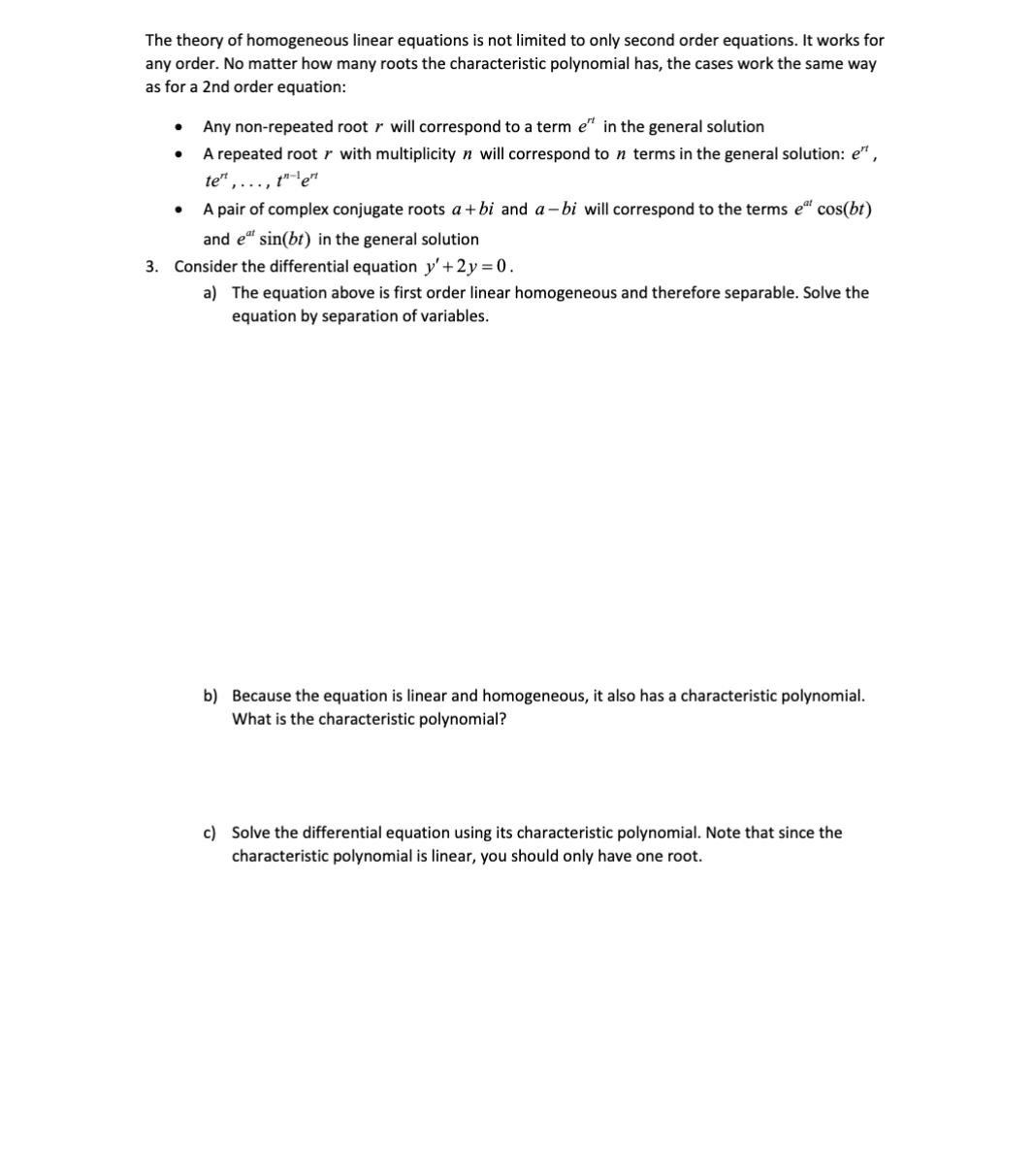
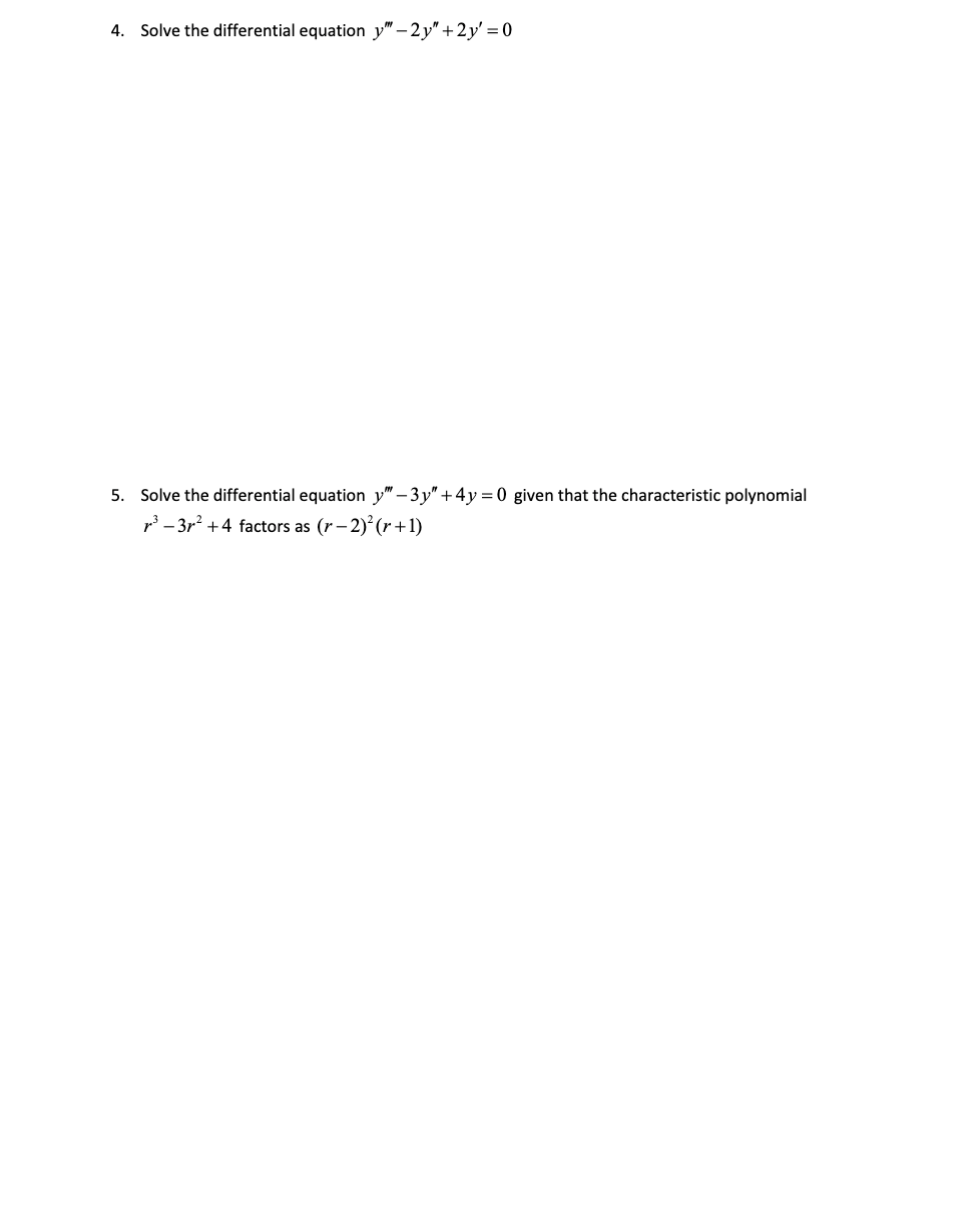
\fThe theory of homogeneous linear equations is not limited to only second order equations. It works for any order. No matter how many roots the characteristic polynomial has, the cases work the same way as for a 2nd order equation: a Any nonrepeated root r will correspond to a term e" in the general solution a A repeated root :- with multiplicity n will correspond to :1 terms in the general solution: .9" , n ' I\" I :1 re ,. . . e a A pair of complex conjugate roots a + bf and a bi will correspond to the terms e'" 005(2):) and e'" sin(br) in the general solution 3. Consider the differential equation y' + 2y = 0 . a} The equation above is first order linear homogeneous and therefore separable. Solve the equation by separation of variables. b} Because the equation is linear and homogeneous, it also has a characteristic polynomial. What is the characteristic polynomial? c) Solve the differential equation using its characteristic polynomial. Note that since the characteristic polynomial is linear, you should only have one root. 4. Solve the differential equation y" -2y"+ 2y' =0 5. Solve the differential equation y" -3y" + 4y =0 given that the characteristic polynomial 13 -3r2 +4 factors as (r -2)?(r +1)
Step by Step Solution
There are 3 Steps involved in it

Get step-by-step solutions from verified subject matter experts
 Study Help