



Question: Please help Clear handwriting Consider the two differential equations: mx'+bx'+kx=F(r) L+ R] +1: 50) d: C where m, b, and k are constants for a
![Please helpClear handwriting Consider the two differential equations: mx'+bx'+kx=F(r) L+ R]](https://s3.amazonaws.com/si.experts.images/answers/2024/06/6676ccbdc53a2_6936676ccbda1700.jpg)
Please help
Clear handwriting
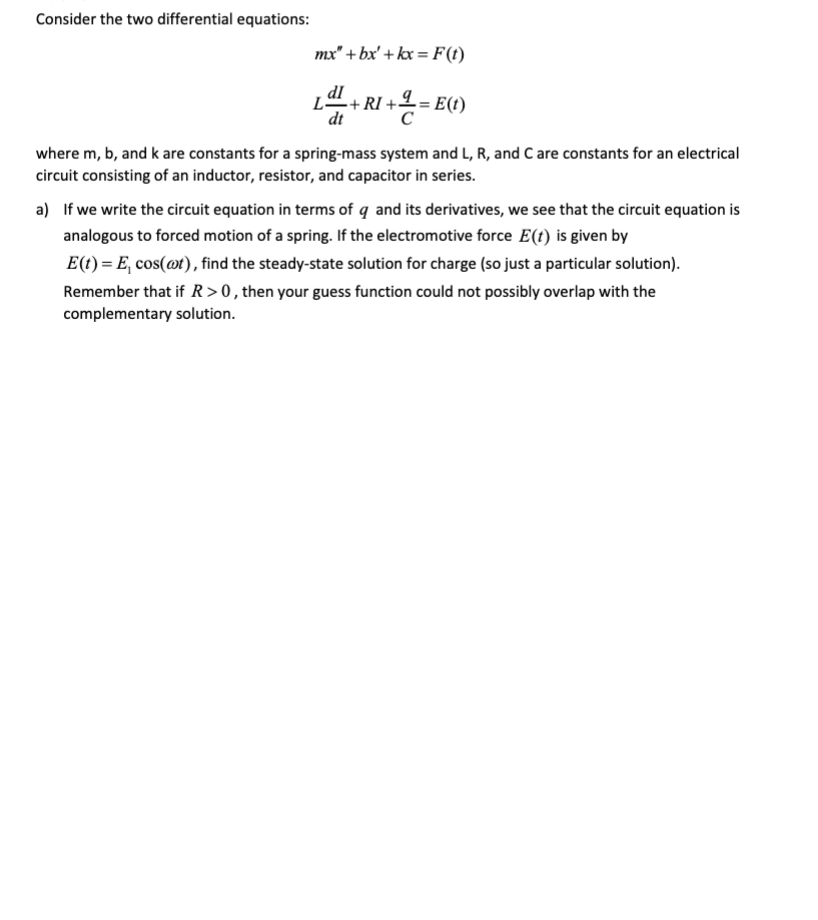
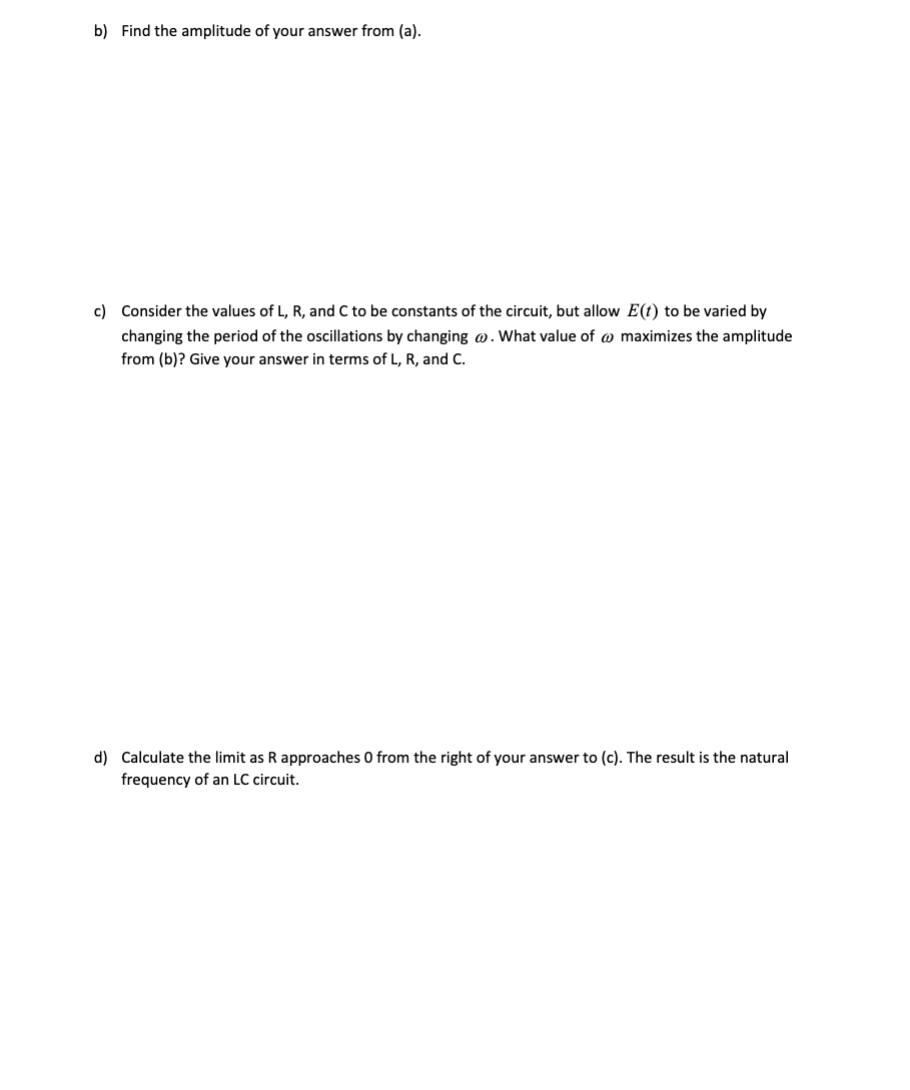
Consider the two differential equations: mx'+bx'+kx=F(r) L+ R] +1: 50) d: C where m, b, and k are constants for a spring-mass system and L, R, and C are constants for an electrical circuit consisting of an inductor, resistor, and capacitor in series. a} If we write the circuit equation in terms of q and its derivatives, we see that the circuit equation is analogous to forced motion of a spring. If the electromotive force E (I) is given by 50') = E] cos(mi) , nd the steadystate solution for charge {so just a particular solution]. Remember that if R > 0 , then your guess function could not pciissibhir overlap with the complementary solution. [1) Find the amplitude of your answer from {a}. c] Consider the values of L, R. and C to be constants of the circuit, but allow 50) to be varied by changing the period of the oscillations by changing a). What value of a) maximizes the amplitude from M? Give your answer in terms of L, R, and c, d) Calculate the limit as R approaches 0 from the right of your answer to (c). The result is the natural frequency of an LC circuit
Step by Step Solution
There are 3 Steps involved in it

Get step-by-step solutions from verified subject matter experts