







Question: please help!!! i will give thumbs up Data Table I: Titration of HCl solution 1. Initial buret reading before titration (0.00mL) 0.00mL 2. Final buret
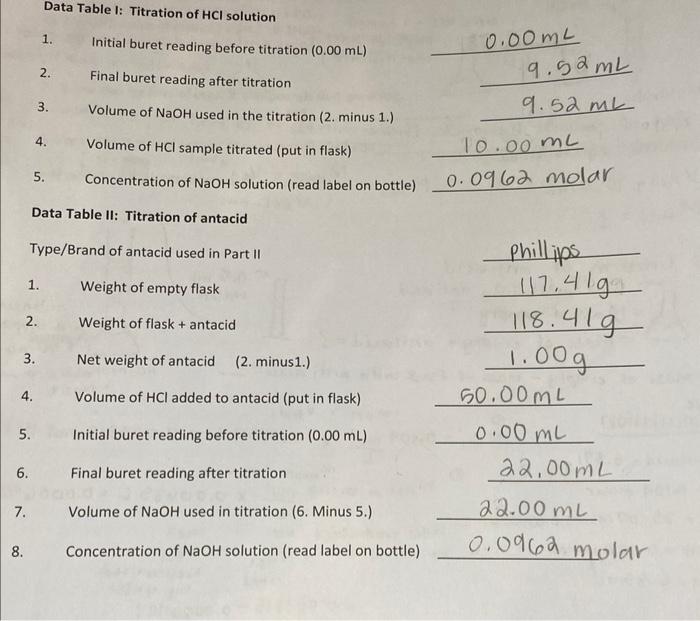
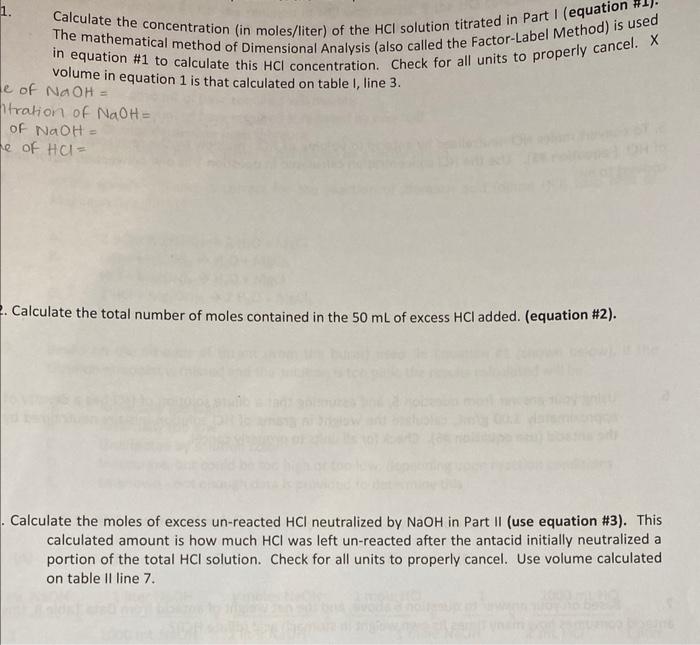
Data Table I: Titration of HCl solution 1. Initial buret reading before titration (0.00mL) 0.00mL 2. Final buret reading after titration 3. Volume of NaOH used in the titration (2. minus 1.) 4. Volume of HCl sample titrated (put in flask) 10.00mc 5. Concentration of NaOH solution (read label on bottle) 0.0962molar Data Table II: Titration of antacid Type/Brand of antacid used in Part II 1. Weight of empty flask phillips 2. Weight of flask + antacid 117,419 118.419 3. Net weight of antacid (2. minus1.) 1.00g 4. Volume of HCl added to antacid (put in flask) 50.00mL 5. Initial buret reading before titration (0.00mL)0.00mL 6. Final buret reading after titration 22,00mL 7. Volume of NaOH used in titration (6. Minus 5.) 22.00mL 8. Concentration of NaOH solution (read label on bottle) 0.0969m lar Calculate the concentration (in moles/liter) of the HCl solution titrated in Part I (equation H.). The mathematical method of Dimensional Analysis (also called the Factor-Label Method) is used in equation #1 to calculate this HCl concentration. Check for all units to properly cancel. X volume in equation 1 is that calculated on table I, line 3. 2 of NaOH= tration of NaOH= of NaOH= e of HCl= Calculate the total number of moles contained in the 50mL of excess HCl added. (equation \#2). Calculate the moles of excess un-reacted HCl neutralized by NaOH in Part II (use equation \#3). This calculated amount is how much HCl was left un-reacted after the antacid initially neutralized a portion of the total HCl solution. Check for all units to properly cancel. Use volume calculated on table II line 7
Step by Step Solution
There are 3 Steps involved in it

Get step-by-step solutions from verified subject matter experts
 Study Help