







Question: Please help me create 2-3 graphs/ figures to best represent the below results of my hypothesised interest. My study aimed to investigate whether amplitude-amplitude coupling,
Please help me create 2-3 graphs/ figures to best represent the below results of my hypothesised interest.
My study aimed to investigate whether amplitude-amplitude coupling, specifically delta-beta and delta-alpha coupling, is significantly higher in individuals with Major Depressive Disorder (MDD) compared to healthy controls. The results were analysed using Mann-Whitney tests to assess between-group differences and Spearman's rank correlation coefficients to evaluate amplitude-amplitude coupling.
My study found that participants with MDD had significantly higher delta-beta coupling compared to healthy controls (p = 0.021, 1-tailed). Additionally, participants with MDD had significantly higher delta-alpha coupling compared to healthy controls (p = 0.011, 1-tailed). These results support the hypothesis that amplitude-amplitude coupling is significantly higher in individuals with MDD.
My study found that delta-alpha coupling was significantly correlated with self-reported depressive symptoms in the MDD group (rho = 0.441, p = 0.018, 1-tailed). However, there was no significant correlation between amplitude-amplitude coupling and self-reported anxiety symptoms in either group.
I have attached images of my results in tables as well as my hypothesis and the study methods.
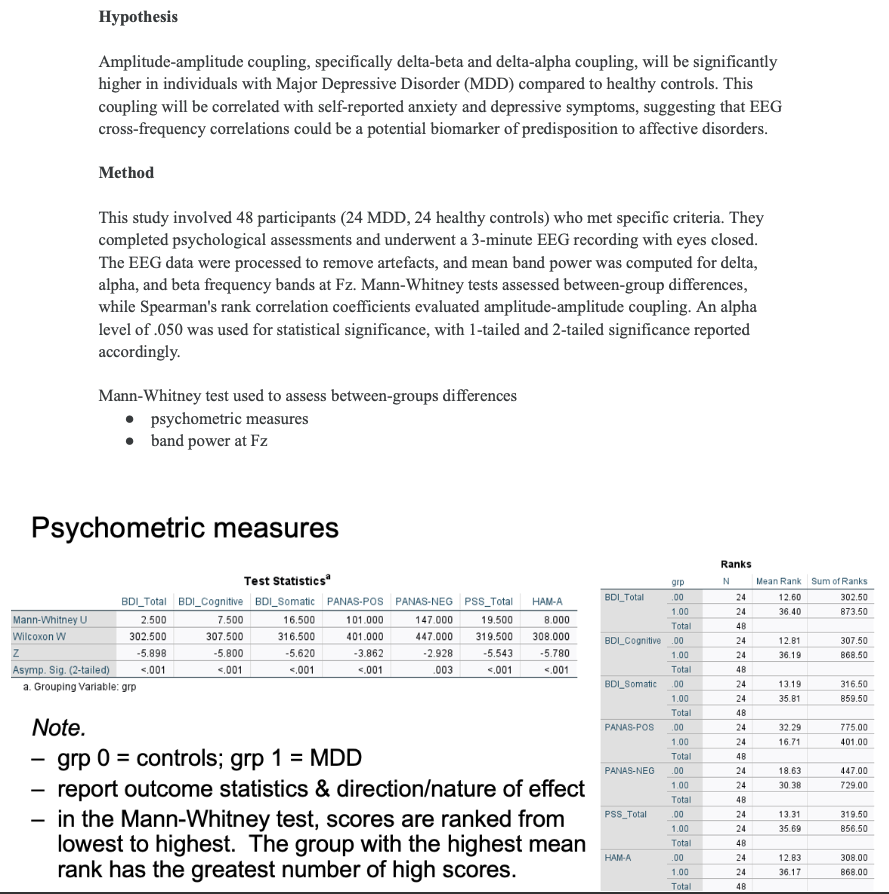
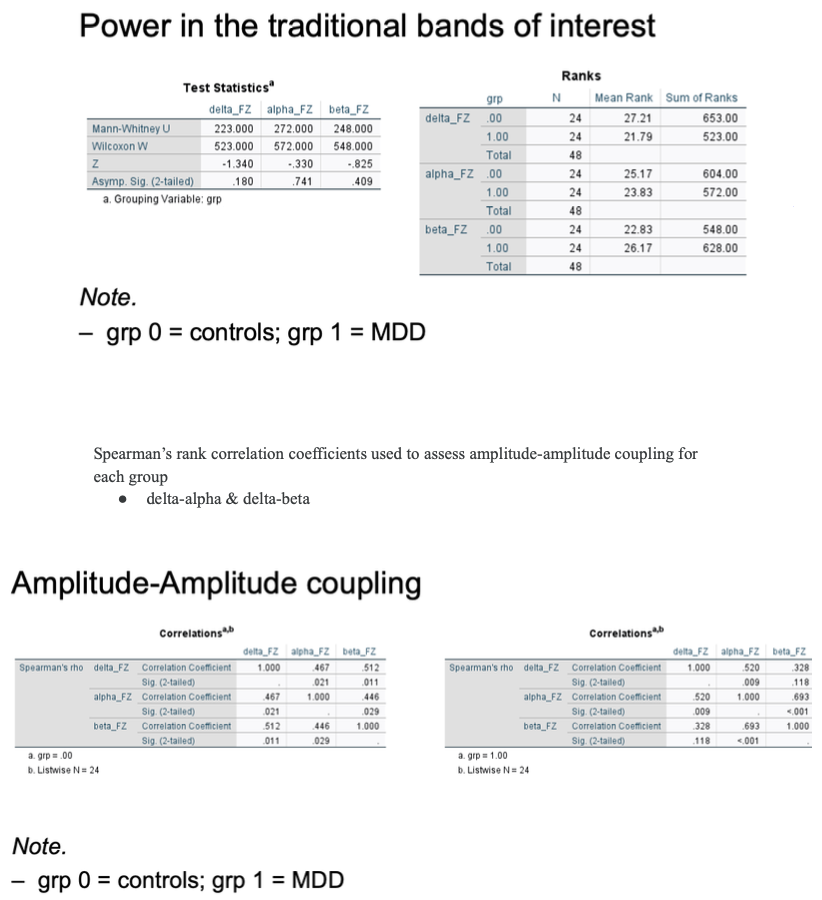
Hypothesis Amplitude-amplitude coupling, specifically delta-beta and delta-alpha coupling, will be significantly higher in individuals with Major Depressive Disorder (MDD) compared to healthy controls. This coupling will be correlated with self-reported anxiety and depressive symptoms, suggesting that EEG cross-frequency correlations could be a potential biomarker of predisposition to affective disorders. Method This study involved 48 participants (24 MDD, 24 healthy controls) who met specific criteria. They completed psychological assessments and underwent a 3-minute EEG recording with eyes closed. The EEG data were processed to remove artefacts, and mean band power was computed for delta, alpha, and beta frequency bands at Fz. Mann-Whitney tests assessed between-group differences, while Spearman's rank correlation coefficients evaluated amplitude-amplitude coupling. An alpha level of .050 was used for statistical significance, with 1-tailed and 2-tailed significance reported accordingly. Mann-Whitney test used to assess between-groups differences psychometric measures band power at Fz Psychometric measures Ranks Test Statistics grp N Mean Rank Sum of Ranks BDI_Total BDI_Cognitive BDI_Somatic PANAS-POS PANAS-NEG PSS_Total HAM-A BDI_Total .00 24 12.60 302.50 1.00 24 36.40 873.50 Mann-Whitney U 2.500 7.500 16.500 101.000 47.000 19.500 8.000 Total Wilcoxon W 302.500 307.500 316.500 401.000 447.000 319.500 308.000 BDL Cognitive .00 24 12.81 307.50 -5.898 -5.800 -5.620 -3.862 -2.928 -5.543 -5.780 1.00 24 36.19 868.50 Asymp. Sig. (2-tailed) <.001 .003 total a. grouping variable: grp bdi_somatic note. panas-pos controls mdd panas-neg .00 report outcome statistics direction of effect in the mann-whitney test scores are ranked from pss_total lowest to highest. group with highest mean ham-a rank has greatest number high scores. totalpower traditional bands interest ranks n sum delta_fz alpha_fz beta_fz u wilcoxon w z asymp. sig. spearman correlation coefficients used assess amplitude-amplitude coupling for each . delta-alpha delta-beta correlations rho coefficient .512 .446 .520 .693 .009 bota_fz .118 b. listwise>
Step by Step Solution
There are 3 Steps involved in it

Get step-by-step solutions from verified subject matter experts
 Study Help