Question: please help me to answer the 3 steps text book: organizational behavior a practical problem solving approach pages: 503-504 PROBLEM-SOLVING APPLICATION CASE #MeToo-Just Do It!
please help me to answer the 3 steps
text book: organizational behavior a practical problem solving approach
pages: 503-504
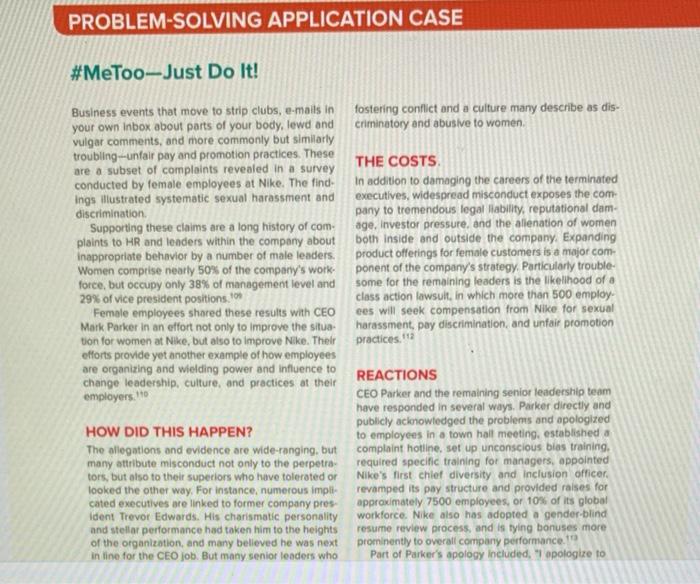
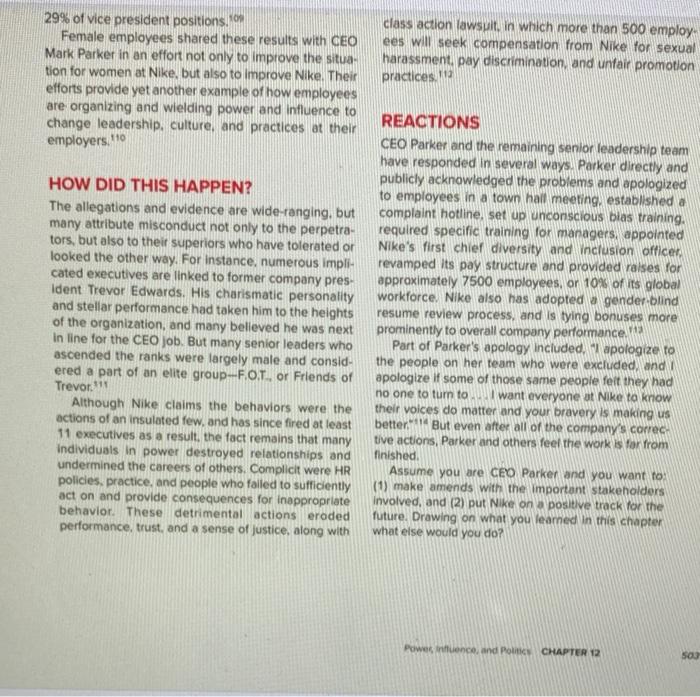
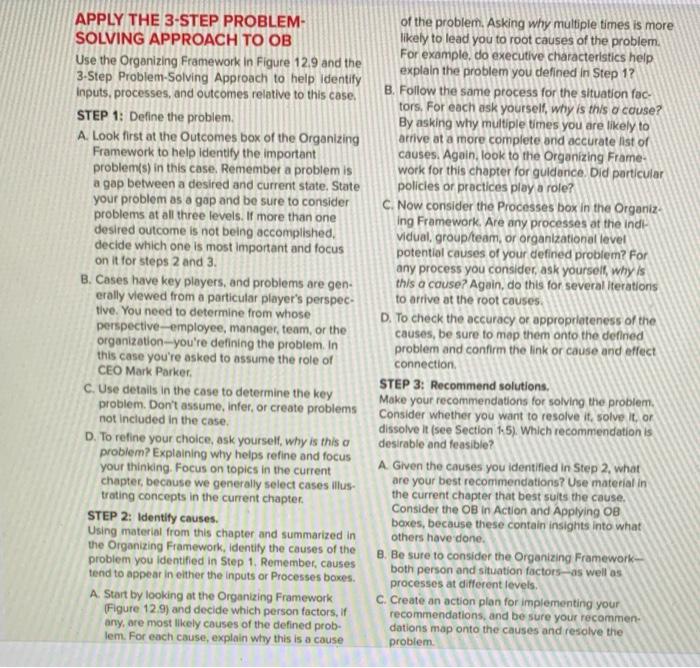
PROBLEM-SOLVING APPLICATION CASE #MeToo-Just Do It! fostering conflict and a culture many describe as dis- criminatory and abusive to women. Business events that move to strip clubs, e-mails in your own inbox about parts of your body, lewd and vulgar comments, and more commonly but similarly troubling-unfair pay and promotion practices. These are a subset of complaints revealed in a survey conducted by female employees at Nike. The find Ings illustrated systematic sexual harassment and discrimination Supporting these claims are a long history of com plaints to HR and leaders within the company about inappropriate behavior by a number of male leaders. Women comprise nearly 50% of the company's work force, but occupy only 38% of management level and 29% of vice president positions. 10 Female employees shared these results with CEO Mark Parker in an effort not only to improve the situa tion for women at Nike, but also to improve Nike. Ther efforts provide yet another example of how employees are organizing and welding power and influence to change leadership, culture and practices at their employers. 10 THE COSTS In addition to damaging the careers of the terminated executives, widespread misconduct exposes the com pany to tremendous legal liability, reputational cam- age, Investor pressure, and the alienation of women both inside and outside the company Expanding product offerings for female customers is a major com ponent of the company's strategy. Particularly trouble- some for the remaining leaders is the likelihood of a class action lawsuit, in which more than 500 employ ees will seek compensation from Nike for sexual harassment, pay discrimination, and unfair promotion practices. 112 HOW DID THIS HAPPEN? The allegations and evidence are wide-ranging, but many attribute misconduct not only to the perpetra tors, but also to their superiors who have tolerated or looked the other way. For instance, numerous impli- cated executives are linked to former company pres ident Trevor Edwards. His charismatic personality and stellar performance had token him to the heights of the organization, and many believed he was next in time for the CEO job. But many senior leaders who REACTIONS CEO Parker and the remaining senior leadership team have responded in several ways. Parker directly and publicly acknowledged the problems and apologized to employees in a town halt meeting, established a complaint hotline, set up unconscious bias training. required specific training for managers, appointed Nike's first chief diversity and inclusion officer, revamped its pay structure and provided raises for approximately 7500 employees, or 10% of its global workforce. Nike also has adopted a gender-blind resume review process, and is tying bonuses more prominently to overall company performance, Part of Parker's apology included. 7 apologize to class action lawsuit, in which more than 500 employ. ees will seek compensation from Nike for sexual harassment pay discrimination and unfair promotion 29% of vice president positions. Female employees shared these results with CEO Mark Parker in an effort not only to improve the situa- tion for women at Nike, but also to improve Nike. Their efforts provide yet another example of how employees are organizing and wielding power and influence to change leadership, culture, and practices at their practices. 112 employers. 10 HOW DID THIS HAPPEN? The allegations and evidence are wide-ranging, but many attribute misconduct not only to the perpetra- tors, but also to their superiors who have tolerated or looked the other way. For instance, numerous impli cated executives are linked to former company pres. Ident Trevor Edwards. His charismatic personality and stellar performance had taken him to the heights of the organization, and many believed he was next In line for the CEO job. But many senior leaders who ascended the ranks were largely male and consid- ered a part of an elite group-FOT.. or Friends of Trevor 1 Although Nike claims the behaviors were the actions of an insulated few, and has since fired at least 11 executives as a result, the fact remains that many individuals in power destroyed relationships and undermined the careers of others. Complicit were HR policies, practice, and people who failed to sufficiently act on and provide consequences for inappropriate behavior. These detrimental actions eroded performance, trust, and a sense of justice, along with REACTIONS CEO Parker and the remaining senior leadership team have responded in several ways. Parker directly and publicly acknowledged the problems and apologized to employees in a town hall meeting, established a complaint hotline, set up unconscious bias training, required specific training for managers appointed Nike's first chief diversity and inclusion officer revamped its pay structure and provided raises for approximately 7500 employees, or 10% of its global workforce. Nike also has adopted a gender-blind resume review process, and is tying bonuses more prominently to overall company performance Part of Parker's apology included. apologize to the people on her team who were excluded, and apologize if some of those same people felt they had no one to turn to want everyone at Nike to know their voices do matter and your bravery is making us better. But even after all of the company's correc tive actions, Parker and others feel the work is far from finished Assume you are CEO Parker and you want to (1) make amends with the important stakeholders Involved, and (2) put Nike on a positive track for the future. Drawing on what you feared in this chapter what else would you do? Powerience, and Politics CHAPTER 12 sou APPLY THE 3-STEP PROBLEM- SOLVING APPROACH TO OB Use the Organizing Framework in Figure 12.9 and the 3-Step Problem Solving Approach to help identify Inputs, processes, and outcomes relative to this case. STEP 1: Define the problem. A. Look first at the Outcomes box of the Organizing Framework to help identify the important problem(s) in this case. Remember a problem is a gap between a desired and current state. State your problem as a gap and be sure to consider problems at all three levels. If more than one desired outcome is not being accomplished, decide which one is most important and focus on it for steps 2 and 3. B. Cases have key players, and problems are gen. erally viewed from a particular player's perspec. tive. You need to determine from whose perspective-employee, manager, team, or the organization-you're defining the problem. In this case you're asked to assume the role of CEO Mark Parker C. Use details in the case to determine the key problem. Don't assume, Infer, or create problems not included in the case. D. To refine your choice, ask yourself, why is this o problem? Explaining why helps refine and focus your thinking. Focus on topics in the current chapter, because we generally select cases illus trating concepts in the current chapter STEP 2: Identity causes. Using material from this chapter and summarized in the Organizing Framework, identify the causes of the problem you identified in Step 1. Remember, causes tend to appear in other the inputs or Processes boxes. A. Start by looking at the Organizing Framework Figure 129) and decide which person factors, If any, are most likely causes of the defined prob- lem. For each cause, explain why this is a cause of the problem. Asking why multiple times is more likely to lead you to root causes of the problem. For example, do executive characteristics help explain the problem you defined in Step 1? B. Follow the same process for the situation fac- tors. For each ask yourself, why is this a cause? By asking why multiple times you are likely to arrive at a more complete and accurate list of causes. Again, look to the Organizing Frame- work for this chapter for guidance. Did particular policies or practices play a role? C. Now consider the Processes box in the Organiz- Ing Framework. Are any processes at the indl vidual, group/team, or organizational level potential causes of your defined problem? For any process you consider, ask yourself, why is this a couse? Again, do this for several iterationis to arrive at the root causes D. To check the accuracy or appropriateness of the causes, be sure to mop them onto the defined problem and confirm the link or cause and effect connection STEP 3: Recommend solutions, Make your recommendations for solving the problem. Consider whether you want to resolve it, solve it, or dissolve it (see Section 1-5). Which recommendations desirable and feasible? A Given the causes you identified in Step 2, what are your best recommendations? Use material in the current chapter that best suits the cause. Consider the OB in Action and Applying OB boxes, because these contain insights into what others have done B. Be sure to consider the Organizing Framework both person and situation factors as well as processes at different levels, C. Create an action plan for implementing your recommendations, and be sure your recommen dations map onto the causes and resolve the









 Study Help