Question: Please help me to draw cause and effect diagram ( I attached the picture with the example of how the cause and effect diagram should
Please help me to draw "cause and effect diagram" ( I attached the picture with the example of how the "cause and effect diagram" should look like). Also I provided the descriptions (my project) based on that "cause and effect diagram" should be created. Thank You
My project based on that the diagram (fish bone diagram)should be created: Goal, important aspect of my project/scenario are:
Our goal is to reduce the overtime hours in the HIM department.
Internal: HIM Department Staff
External: Other Physicians Offices, Third Party Payers, Patients, Attorneys, Physicians, Healthcare Providers, Revenue Cycle Department.
- III. Identify Services important to your customers based upon your Performance measure
- Coding
- Query Physicians
- ROI
- Transcription
- Health Information Storage and Retrieval
- Scanning and Indexing
- Assembling and Data Analyzing
- Deficiency Analysis
- Filling System for Paper Records
- IV. Survey
- Goal of the survey
The purpose of the survey is to determine what solutions are more effective in order to have a better workflow that will improve work hours. Excessive overtime can interfere with the employees ability to perform their task, create a burnout, and lower their productivity by not being efficient. In conclusion, long term overtime may be harmful.
My 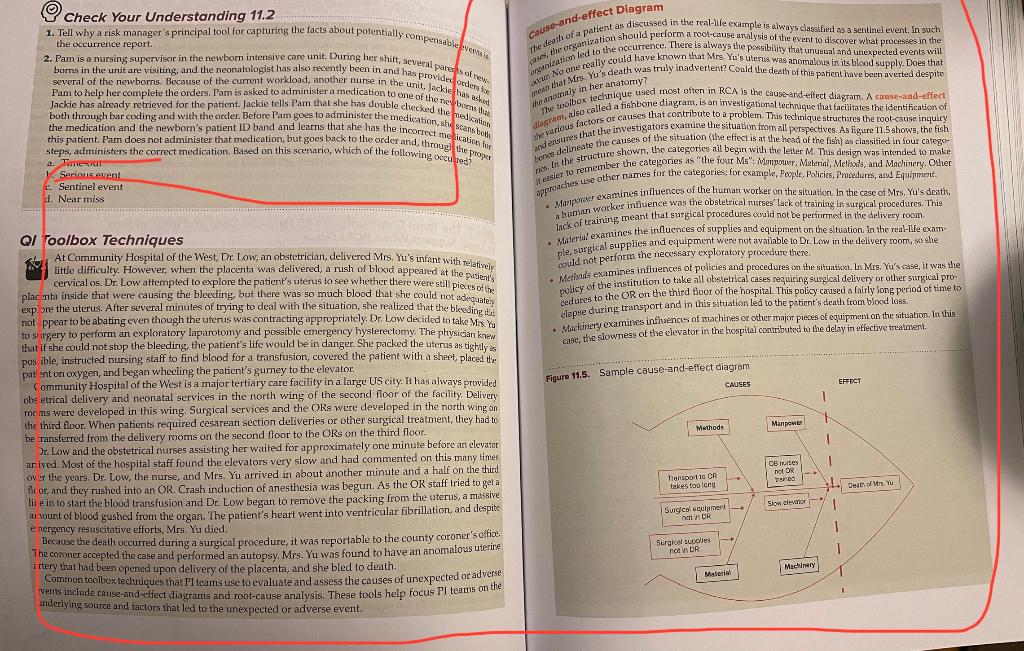
Check Your Understanding 11.2 in the real-life example is always classified as a sentinel event. In such Cause-and-effect Diagram The death of a patient as discuss was truly inadvertent? Could the death of this patient have been averted despite 1. Tell why a risk manager's principal tool for capturing the facts about potentially compensable breas the occurrence report 2. Pam is a nursing supervisor in the newborn intensive care unit. During her shift, several papers of several of the newborns. Because of the current workload, another nurse in the unit, Jack has asked boms in the unit are visiting, and the neonatologist has also recently been in and has provided coders los Jackie has already retrieved for the patient. Jackie tells Pam that she has double checked the medias Pam to help her complete the orders. Pam is asked to administer a medication to one of the best both through bar coding and with the order. Before Pam goes to administer the medication, scanso this patient. Pam does not administer that medication, but goes back to the order and through the post the medication and the newborn's patient ID band and learns that she has the incorrect sehat for steps, administers the correct medication. Based on this scenario, which of the following accused? a. Time 1. Serious event c. Sentinel event H. Near miss mean that Mrswatomy? the anomaly in her The the various factors or the organization should perform a rool-cause analysis of the event to discover what processes in the vision led to the occurrence. There is always the possibility that unusual and unexpected events will No one really could have known that Mrs. Yu's uterus was anomalous in its blood supply. Does that olbox technique tased most often in RCA is the cause and effect diagram. A cause-and-effect Magam, also called a fishbone diagram, is an investigational technique that facilitates the identification of e causes that contribute to a problem. This technique structures the root cause inquiry and erwures that the investigators examine the situation from all perspectives. As igure 11.5 shows, the fish ones delicate the causes of the situation the effect is at the head of the fish as classified in four catego- In the structure shown, the categories all begin with the letter M. This design was intended to make approaches use other names for the categories, for example, People, Policies. Procedures, and Equipment easier to remember the categories as the four Ms": Mmpower, Malenal, Methods, and Machinery. Other - Manporer examines influences of the human worker on the situation in the case of Mrs. Yu's death. a human worker influence was the obstetrical nurses' lack of training in surgical procedures. This lack of training meant that surgical procedures cxild not be performed in the delivery room Material examines the influences of supplies and equipment on the situation. In the real-life exam- ple, surgical supplies and equipment were not available to Dr. Low in the delivery room, she could not perform the necessary exploratory procedure there Melds examines influences of policies and procedures on the situation. In Mrs. Yu's case, it was the policy of the institution to take all obstetrical cases requiring surgical delivery or other surgical pro gedures to the OR on the third floor of the hospital. This policy caused a fairly long period of time to clapse during transport and in this situation led to the patient's death from blood loss. Mackinery examines influences of machines or other major pieces of equipment on the situation. In this case, the slowness of the elevator in the hospital contributed to the delay in effective treatment Figure 11.5. Sample cause-and-effect diagram CAUSES EFFECT 1 QI Toolbox Techniques At Community Hospital of the West, De Low, an obstetrician, delivered Mis Yu's infant with relatively little difficulty. However , when the placenta was delivered a rush of blood appeared at the patien cervical os. Dr. Low attempted to explore the patient's uterus to see whether there were stil pieces of the placenta inside that were causing the bleeding, but there was so much blood that she could next adequately exp ore the uterus. After several minutes of trying to deal with the situation, she realized that the bleeding to not ppear to be abating even though the uterus was contracting appropriately, Dr. Low decided to take Ms to surgery to perform an exploratory laparotomy and possible emergency hysterectomy. The physician knew that if she could not stop the bleeding the patient's life would be in danger . She packed the uterus as tightly s posible, instructed nursing staff to find blood for a transfusion, covered the patient with a sheet placed to patient on oxygen and began wheeling the patient's gurney to the elevator. Community Hospital of the West is a major tertiary care facility in a large US city. It has always provided obs etrical delivery and neonatal services in the north wing of the second floor of the facility. Delivery Toms were developed in this wing, Surgical services and the ORs were developed in the north wing on the third floor. When patients required cesarean section deliveries or other surgical treatment, they had to be ransferred from the delivery rooms on the second floor to the ORs on the third floor. Dr. Low and the obstetrical nurses assisting her waited for approximately one minute before an elevator an ived. Most of the hospital staff found the elevators very slow and had commented on this many times over the years. Dr. Low, the nurse, and Mrs. Yu arrived in about another minute and a half on the third floor, and they rushed into an OR. Crash induction of anesthesia was begun. As the OR staff tried to get a line in to start the blood transfusion and Dr Low began to remove the packing from the uterus, a massive ar vount of blood gushed from the organ. The patient's heart went into ventricular fibrillation, and despite energency resuscitative efforts, Mrs. Yu died. Because the death occurred during a surgical procedure, it was reportable to the county coroner's office The corner accepted the case and performed an autopsy. Mrs. Yu was found to have an anomalous uterine irtery that had been opened upon delivery of the placenta, and she bled to death. Common toolbox techniques that Piteams use to evaluate and assess the causes of unexpected or adverse wents include cause and effect diagrains and root-cause analysis. These tools help focus Pl teams on the anderlying source and factors that led to the unexpected or adverse event Methods Manpower 1 Transport 1 OR takes too long Courses DR Prines Dests. Y Siow clear 1 Surgicalment DOOR 1 Surgical supplies no VDR ... Macarry Materi









 Study Help