Question: Please help me write a 2000-word business report for this case John is a sole trader who owns TechFab, a small but successful manufacturing business
Please help me write a 2000-word business report for this case
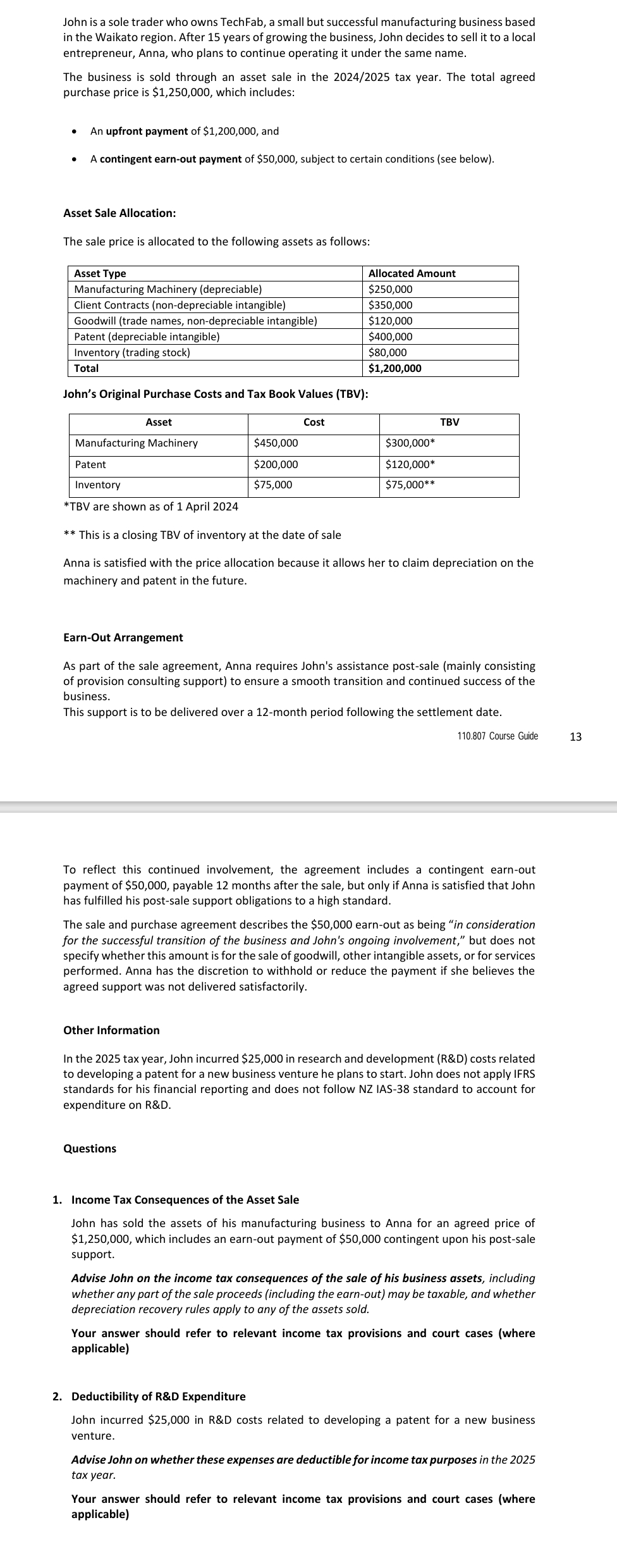
John is a sole trader who owns TechFab, a small but successful manufacturing business based n the Waikato region. After 15 years of growing the business, John decides to sell it to a local entrepreneur, Anna, who plans to continue operating it under the same name The business is sold through an asset sale in the 2024/2025 tax year. The total agreed purchase price is $1,250,000, which includes: An upfront payment of $1,200,000, and A contingent earn-out payment of $50,000, subject to certain conditions (see below). Asset Sale Allocation: The sale price is allocated to the following assets as follows: Asset Type Allocated Amount Manufacturing Machinery (depreciable) $250,000 Client Contracts (non-depreciable intangible) $350,000 Goodwill (trade names, non-depreciable intangible) $120,000 Patent (depreciable intangible) $400,000 Inventory (trading stock) $80,000 Total $1,200,000 John's Original Purchase Costs and Tax Book Values (TBV): Asset Cost TBV Manufacturing Machinery $450,000 $300,000* Patent $200,000 $120,000 Inventory $75,000 $75,000** TBV are shown as of 1 April 2024 ** This is a closing TBV of inventory at the date of sale Anna is satisfied with the price allocation because it allows her to claim depreciation on the machinery and patent in the future. Earn-Out Arrangement As part of the sale agreement, Anna requires John's assistance post-sale (mainly consisting of provision consulting support) to ensure a smooth transition and continued success of the business. This support is to be delivered over a 12-month period following the settlement date. 110.807 Course Guide 13 To reflect this continued involvement, the agreement includes a contingent earn-out payment of $50,000, payable 12 months after the sale, but only if Anna is satisfied that John has fulfilled his post-sale support obligations to a high standard. The sale and purchase agreement describes the $50,000 earn-out as being "in consideration for the successful transition of the business and John's ongoing involvement," but does not specify whether this amount is for the sale of goodwill, other intangible assets, or for services performed. Anna has the discretion to withhold or reduce the payment if she believes the agreed support was not delivered satisfactorily. Other Information In the 2025 tax year, John incurred $25,000 in research and development (R&D) costs related to developing a patent for a new business venture he plans to start. John does not apply IFRS standards for his financial reporting and does not follow NZ IAS-38 standard to account for expenditure on R&D. Questions 1. Income Tax Consequences of the Asset Sale John has sold the assets of his manufacturing business to Anna for an agreed price of $1,250,000, which includes an earn-out payment of $50,000 contingent upon his post-sale support. Advise John on the income tax consequences of the sale of his business assets, including whether any part of the sale proceeds (including the earn-out) may be taxable, and whether depreciation recovery rules apply to any of the assets sold. Your answer should refer to relevant income tax provisions and court cases (where applicable) 2. Deductibility of R&D Expenditure John incurred $25,000 in R&D costs related to developing a patent for a new business venture. Advise John on whether these expenses are deductible for income tax purposes in the 2025 tax year. Your answer should refer to relevant income tax provisions and court cases (where applicable)John is a sole trader who owns TechFab, a small but successful manufacturing business based n the Waikato region. After 15 years of growing the business, John decides to sell it to a local entrepreneur, Anna, who plans to continue operating it under the same name The business is sold through an asset sale in the 2024/2025 tax year. The total agreed purchase price is $1,250,000, which includes: An upfront payment of $1,200,000, and A contingent earn-out payment of $50,000, subject to certain conditions (see below). Asset Sale Allocation: The sale price is allocated to the following assets as follows: Asset Type Allocated Amount Manufacturing Machinery (depreciable) $250,000 Client Contracts (non-depreciable intangible) $350,000 Goodwill (trade names, non-depreciable intangible) $120,000 Patent (depreciable intangible) $400,000 Inventory (trading stock) $80,000 Total $1,200,000 John's Original Purchase Costs and Tax Book Values (TBV): Asset Cost TBV Manufacturing Machinery $450,000 $300,000* Patent $200,000 $120,000 Inventory $75,000 $75,000** TBV are shown as of 1 April 2024 ** This is a closing TBV of inventory at the date of sale Anna is satisfied with the price allocation because it allows her to claim depreciation on the machinery and patent in the future. Earn-Out Arrangement As part of the sale agreement, Anna requires John's assistance post-sale (mainly consisting of provision consulting support) to ensure a smooth transition and continued success of the business. This support is to be delivered over a 12-month period following the settlement date. 110.807 Course Guide 13 To reflect this continued involvement, the agreement includes a contingent earn-out payment of $50,000, payable 12 months after the sale, but only if Anna is satisfied that John has fulfilled his post-sale support obligations to a high standard. The sale and purchase agreement describes the $50,000 earn-out as being "in consideration for the successful transition of the business and John's ongoing involvement," but does not specify whether this amount is for the sale of goodwill, other intangible assets, or for services performed. Anna has the discretion to withhold or reduce the payment if she believes the agreed support was not delivered satisfactorily. Other Information In the 2025 tax year, John incurred $25,000 in research and development (R&D) costs related to developing a patent for a new business venture he plans to start. John does not apply IFRS standards for his financial reporting and does not follow NZ IAS-38 standard to account for expenditure on R&D. Questions 1. Income Tax Consequences of the Asset Sale John has sold the assets of his manufacturing business to Anna for an agreed price of $1,250,000, which includes an earn-out payment of $50,000 contingent upon his post-sale support. Advise John on the income tax consequences of the sale of his business assets, including whether any part of the sale proceeds (including the earn-out) may be taxable, and whether depreciation recovery rules apply to any of the assets sold. Your answer should refer to relevant income tax provisions and court cases (where applicable) 2. Deductibility of R&D Expenditure John incurred $25,000 in R&D costs related to developing a patent for a new business venture. Advise John on whether these expenses are deductible for income tax purposes in the 2025 tax year. Your answer should refer to relevant income tax provisions and court cases (where applicable)
Step by Step Solution
There are 3 Steps involved in it
1 Expert Approved Answer
Step: 1 Unlock
Question Has Been Solved by an Expert!
Get step-by-step solutions from verified subject matter experts
Step: 2 Unlock
Step: 3 Unlock
Students Have Also Explored These Related Accounting Questions!









 Study Help