







Question: Please help with the following question Consider the differential equation - dp dt = p(1.75- p)(p - 3) for the population p (in thousands) of
Please help with the following question
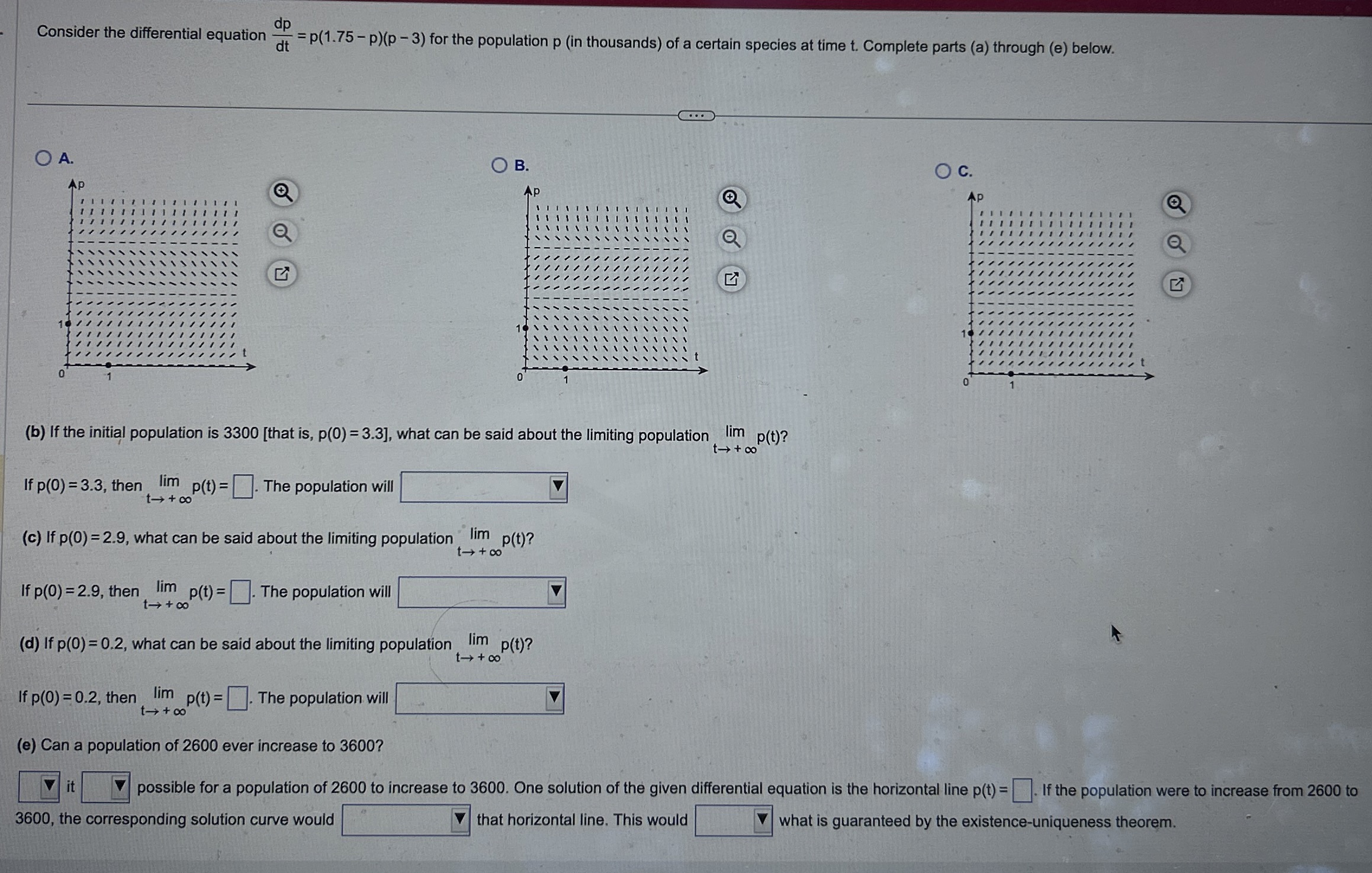
Consider the differential equation - dp dt = p(1.75- p)(p - 3) for the population p (in thousands) of a certain species at time t. Complete parts (a) through (e) below. O A. O B. O C. AP AP AP 1III (b) If the initial population is 3300 [that is, p(0) = 3.3], what can be said about the limiting population lim p(t)? 1-+ 00 If p(0) =3.3, then , lim p(1) = . The population will (c) If p(0) = 2.9, what can be said about the limiting population " lim p(t)? 1-+ 00 If p(0) = 2.9, then , lim p(1) = . The population will (d) If p(0) = 0.2, what can be said about the limiting population lim p(t)? 1 + 0o 1-+ 00 If p(0) =0.2, then lim p(t) = . The population will (e) Can a population of 2600 ever increase to 3600? possible for a population of 2600 to increase to 3600. One solution of the given differential equation is the horizontal line p(t) = . If the population were to increase from 2600 to 3600, the corresponding solution curve would that horizontal line. This would what is guaranteed by the existence-uniqueness theorem
Step by Step Solution
There are 3 Steps involved in it

Get step-by-step solutions from verified subject matter experts
 Study Help