







Question: Please help with the post lab calculations. Help with #2-6. I have all the info necessary to do so in the pictures. Thank you! -
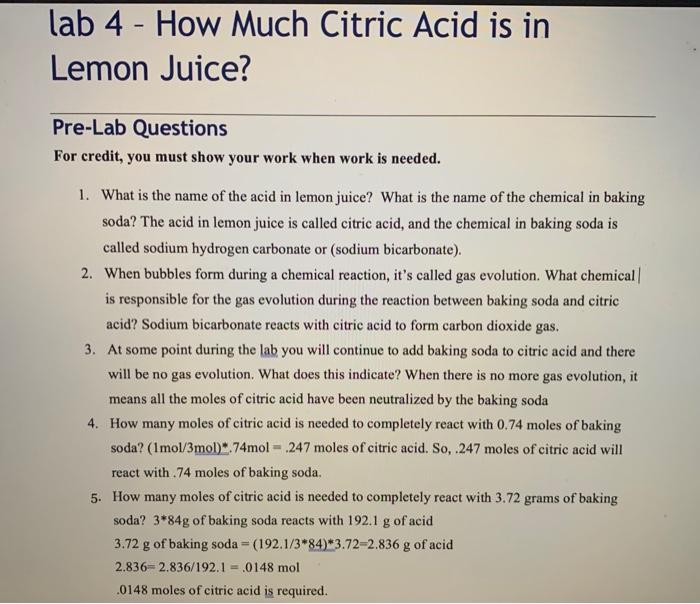
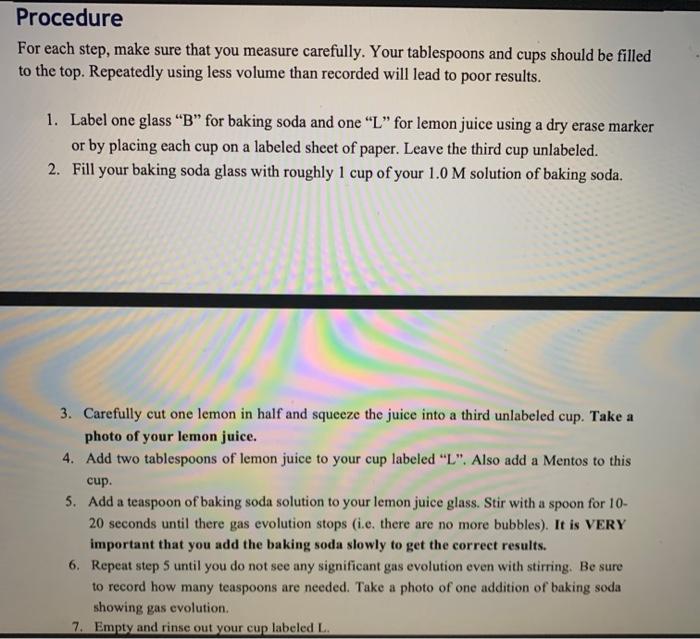
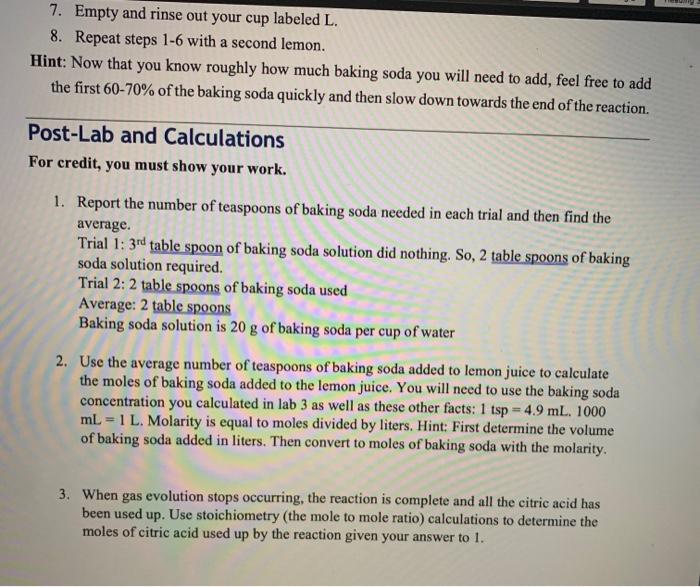
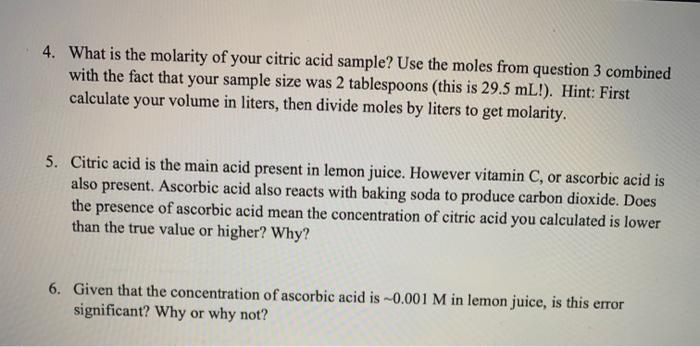
- lab 4 - How Much Citric Acid is in Lemon Juice? Pre-Lab Questions For credit, you must show your work when work is needed. 1. What is the name of the acid in lemon juice? What is the name of the chemical in baking soda? The acid in lemon juice is called citric acid, and the chemical in baking soda is called sodium hydrogen carbonate or (sodium bicarbonate). 2. When bubbles form during a chemical reaction, it's called gas evolution. What chemical is responsible for the gas evolution during the reaction between baking soda and citric acid? Sodium bicarbonate reacts with citric acid to form carbon dioxide gas. 3. At some point during the lab you will continue to add baking soda to citric acid and there will be no gas evolution. What does this indicate? When there is no more gas evolution, it means all the moles of citric acid have been neutralized by the baking soda 4. How many moles of citric acid is needed to completely react with 0.74 moles of baking soda? (Imol/3mol.74mol = 247 moles of citric acid. So, 247 moles of citric acid will react with.74 moles of baking soda. 5. How many moles of citric acid is needed to completely react with 3.72 grams of baking soda? 3*84g of baking soda reacts with 192.1 g of acid 3.72 g of baking soda =(192.1/3884)*3.72=2.836 g of acid 2.836- 2.836/192.1 = .0148 mol .0148 moles of citric acid is required. Procedure For each step, make sure that you measure carefully. Your tablespoons and cups should be filled to the top. Repeatedly using less volume than recorded will lead to poor results. 1. Label one glass B for baking soda and one "L" for lemon juice using a dry erase marker or by placing each cup on a labeled sheet of paper. Leave the third cup unlabeled. 2. Fill your baking soda glass with roughly 1 cup of your 1.0 M solution of baking soda. 3. Carefully cut one lemon in half and squeeze the juice into a third unlabeled cup. Take a photo of your lemon juice. 4. Add two tablespoons of lemon juice to your cup labeled "L". Also add a Mentos to this cup. 5. Add a teaspoon of baking soda solution to your lemon juice glass. Stir with a spoon for 10- 20 seconds until there gas evolution stops (i.e. there are no more bubbles). It is VERY important that you add the baking soda slowly to get the correct results. 6. Repeat step 5 until you do not see any significant gas evolution even with stirring. Be sure to record how many teaspoons are needed. Take a photo of one addition of baking soda showing gas evolution. 7. Empty and rinse out your cup labeled L. 7. Empty and rinse out your cup labeled L. 8. Repeat steps 1-6 with a second lemon. Hint: Now that you know roughly how much baking soda you will need to add, feel free to add the first 60-70% of the baking soda quickly and then slow down towards the end of the reaction. Post-Lab and Calculations For credit, you must show your work. 1. Report the number of teaspoons of baking soda needed in each trial and then find the average. Trial 1: 3rd table spoon of baking soda solution did nothing. So, 2 table spoons of baking soda solution required. Trial 2:2 table spoons of baking soda used Average: 2 table spoons Baking soda solution is 20 g of baking soda per cup of water 2. Use the average number of teaspoons of baking soda added to lemon juice to calculate the moles of baking soda added to the lemon juice. You will need to use the baking soda concentration you calculated in lab 3 as well as these other facts: 1 tsp = 4.9 mL. 1000 mL = 1 L. Molarity is equal to moles divided by liters, Hint: First determine the volume of baking soda added in liters. Then convert to moles of baking soda with the molarity. 3. When gas evolution stops occurring, the reaction is complete and all the citric acid has been used up. Use stoichiometry (the mole to mole ratio) calculations to determine the moles of citric acid used up by the reaction given your answer to 1. 4. What is the molarity of your citric acid sample? Use the moles from question 3 combined with the fact that your sample size was 2 tablespoons (this is 29.5 mL!). Hint: First calculate your volume in liters, then divide moles by liters to get molarity. 5. Citric acid is the main acid present in lemon juice. However vitamin C, or ascorbic acid is also present. Ascorbic acid also reacts with baking soda to produce carbon dioxide. Does the presence of ascorbic acid mean the concentration of citric acid you calculated is lower than the true value or higher? Why? 6. Given that the concentration of ascorbic acid is -0.001 M in lemon juice, is this error significant? Why or why not
Step by Step Solution
There are 3 Steps involved in it

Get step-by-step solutions from verified subject matter experts
 Study Help